Neil Pasricha's Monthly Book Club - October 2026

Hey everyone,

Welcome to Neil’s Monthly Book Club!

I’ve been sending this out the last Saturday of every month since ... November, 2016. Suddenly 10 years! Thank you for a decade of reading together.

Comb the back issues here.

Let's get to the books...

Neil

PS: Invite others to join us here.​

1. The Circadian Code: Lose Weight, Supercharge Your Energy, and Transform Your Health from Morning To Midnight by Satchin Panda, PhD (b. 1971). Last week I flew overnight from Toronto to Barcelona and landed at 9:30am local time, 3:30am Toronto time, and ran straight into my day. I was groggy. Head-bobby. After a day to “acclimatize” I gave my talk the next morning then flew nine hours home—leaving at lunch and, with a six hour change the other way, landing before dinner. Brutal on the body! On the mind. Disrupting our circadian rhythms with light interruption happens so many ways now. Not just travel, but shift work, screen work, living in big bright boxes in the middle of pitch black streets. In this broad 2018 book based on decades of research Satchin Panda links circadian disruption to everything from ADHD to autism to Alzheimers to cancer. Turns out “…modern humans largely evolved near the equator and their daily activity was directed by the sun and influenced by a very strong corresponding circadian rhythm. Primitive men and women had to wake up before the sun came up if they wanted to be successful hunters: Their strategy was to wait for their meal to stroll by a water hole. … Anthropologists assume early humans ate their last meal just around twilight, leaving them plenty of time to find a safe place to sleep before nightfall.” He shows how new and disruptive nighttime light is and then in Chapter 3 titled “Is your Circadian Code in Sync?” he lays out three pages of Y/N questions: “Do you feel anxious? Do you have lower back pain? Do you snore? Do you wake up congested? Do you get tired in the afternoon? Do you have trouble making decisions? Do you spend over an hour on the computer, phone, or TV before bedtime?” As you tick off the yeses you realize this is a big deal. The things we need to do to help are not rocket science: Stop eating after dinner, give your digestive system 12 or 13 hours to rest, get sunlight in the mornings, get exercise and movement during the days. But the book serves as a prod to get ourselves in gear. Worth pairing with the Timeshifter app if you’re circadianally jolted like me.

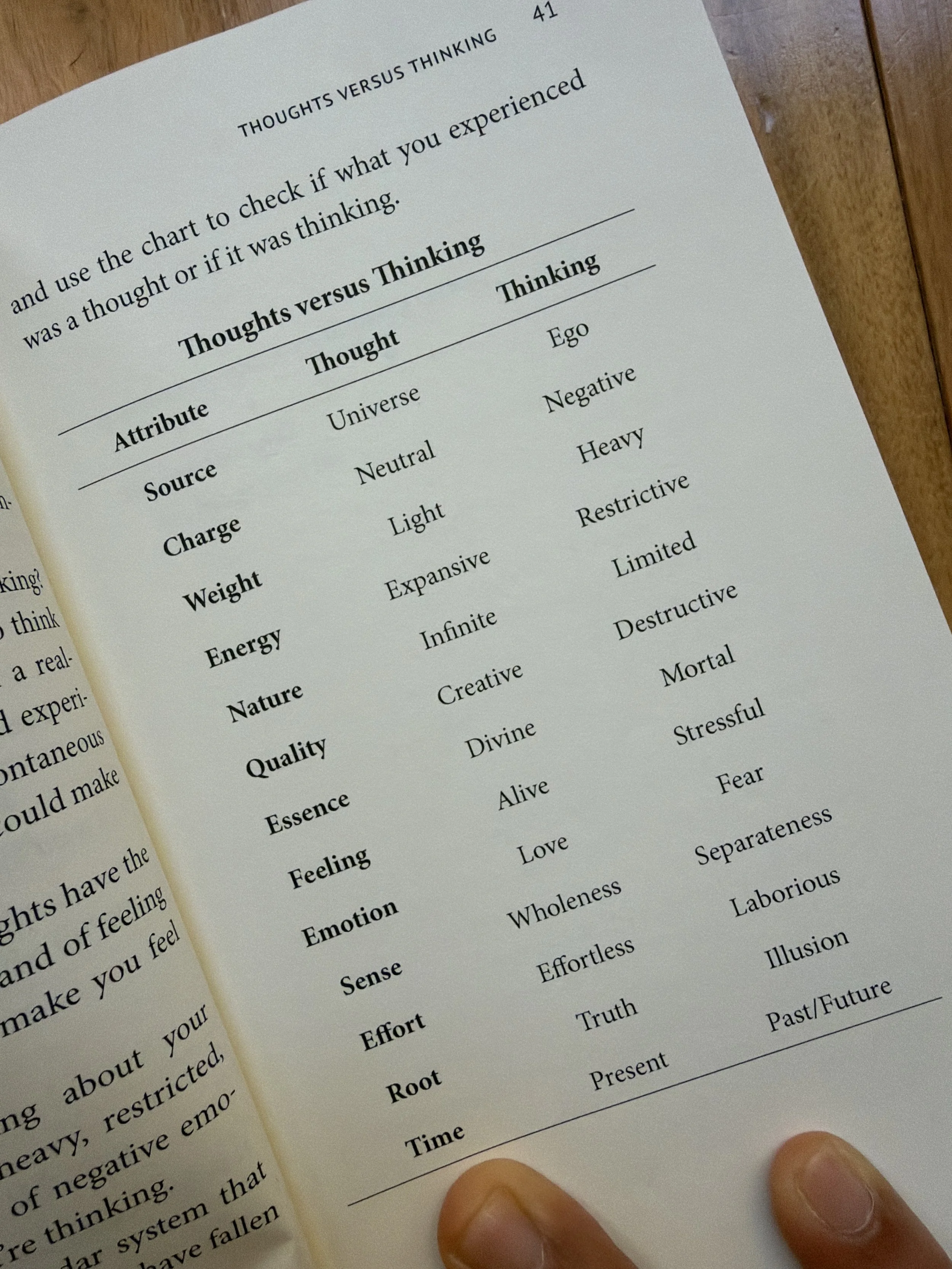
2. Don’t Believe Everything You Think: Why Your Thinking is The Beginning & End Of Suffering by Joseph Nguyen. “This book is designed to help you discover the root cause of your mental suffering—and how we all have the power to choose a new experience,” writes Nguyen on Page 6. What’s the root cause of our mental suffering? It is … thinking. That's it. Thinking itself! Yes, on Page 21: “… the moment we stop thinking is when our happiness begins.” Sounds hard, right? Well, he delineates between thoughts—which are “energetic, mental raw materials our minds use to understand and navigate our world” and thinking which is “the judgment or opinion we have about our thoughts.” In a table he publishes on Page 41 he lays out the difference between the two:

A philosophical book, preached by someone on the other side of enlightenment, beckoning us to climb the fence and join the blissful stroll. I don’t deny the power of the offer but it’s … hard to get there? When he writes on Page 56 “If life begins to feel unclear, disorganized, and stressful … allow your thinking to settle by acknowledging it and giving it space to pass without judgment, and slowly the mind will clear again.” I … would like to do that. But I feel I require structure, tools, systems. Am I fighting too much with my overthinking? Or maybe it's that that I haven't yet mastered the skill of letting it settle.I like systems like “Two Minute Mornings,” “Two Minute Evenings,” “I’m Dead To The World” and “Untouchable Days.” I sort of cordon off my overthinking. Put it in boxes. Maybe that means I am using thinking as a tool to fight overthinking? Or maybe my route to get there is more sidewindy? I am still trying to figure it out. This is a short philosophical book that says “We are only ever one moment away from remembering that we always have in our possession an infinite well of clarity, love, joy, and peace.”

3. Secrets Of Adulthood: Simple Truths For Our Complex Lives by Gretchen Rubin (b. 1965). Gretchen Rubin and I grew up together in the blogosphere. What began nearly two decades ago as a year-long “Happiness Project” to trial-and-error her own happiness pursuits has most recently evolved into a collection of simple aphorisms and advice. I love aphorisms! I published a slew on my birthday as I turned 47, 46, 45, 44, and 43. Gretchen doles them out better than most. A few examples: “It is easier to change our surroundings and our schedules easier than it is to change ourselves,” “To make solitude more pleasant, add a quiet, wordless presence: a candle flame, a flower in a vase, a fish swimming in a bowl,” “At some point a parent much switch from coach to cheerleader,” and “One day now will be a long time ago.” A short and simple book we can add to our Enlightened Bathroom Reading list.

4. Number The Stars by Lois Lowry (b. 1937). And now it’s time for this month’s Leslie’s Pick! Over to you, Les: “I remember being deeply moved as a young girl when I read Number the Stars, probably in about grade 6 or so. So much so that I went on to read many books about the Holocaust (another favourite being 'The Nightingale') where deep resilience, determination and bravery were showcased amidst such horrific acts of hate and war. Therefore, I couldn’t wait to pull out Number the Stars, and read it to my children when there were old enough. Our 10-year -old and I just finished it and I am so glad to have reread and perhaps found it even more powerful as an adult. It is the story of two best friends, one Christian and one Jewish, in 1943 in Copenhagen, and is based on the true bravery of the Danish Resistance who smuggled nearly 7000 Jewish people to safety in Sweden. I found myself sobbing reading the last pages to my son. Tears of grief for the events of World War II and for all those who live in fear for their lives today and tears of incredible awe at the strength of the human spirit, the bravery of people who stand up and work to resist violence and discrimination, and tears of hope that one conversation at a time I am raising children who will help to make the world we live in a more peaceful place. A must read for adults and children alike.”

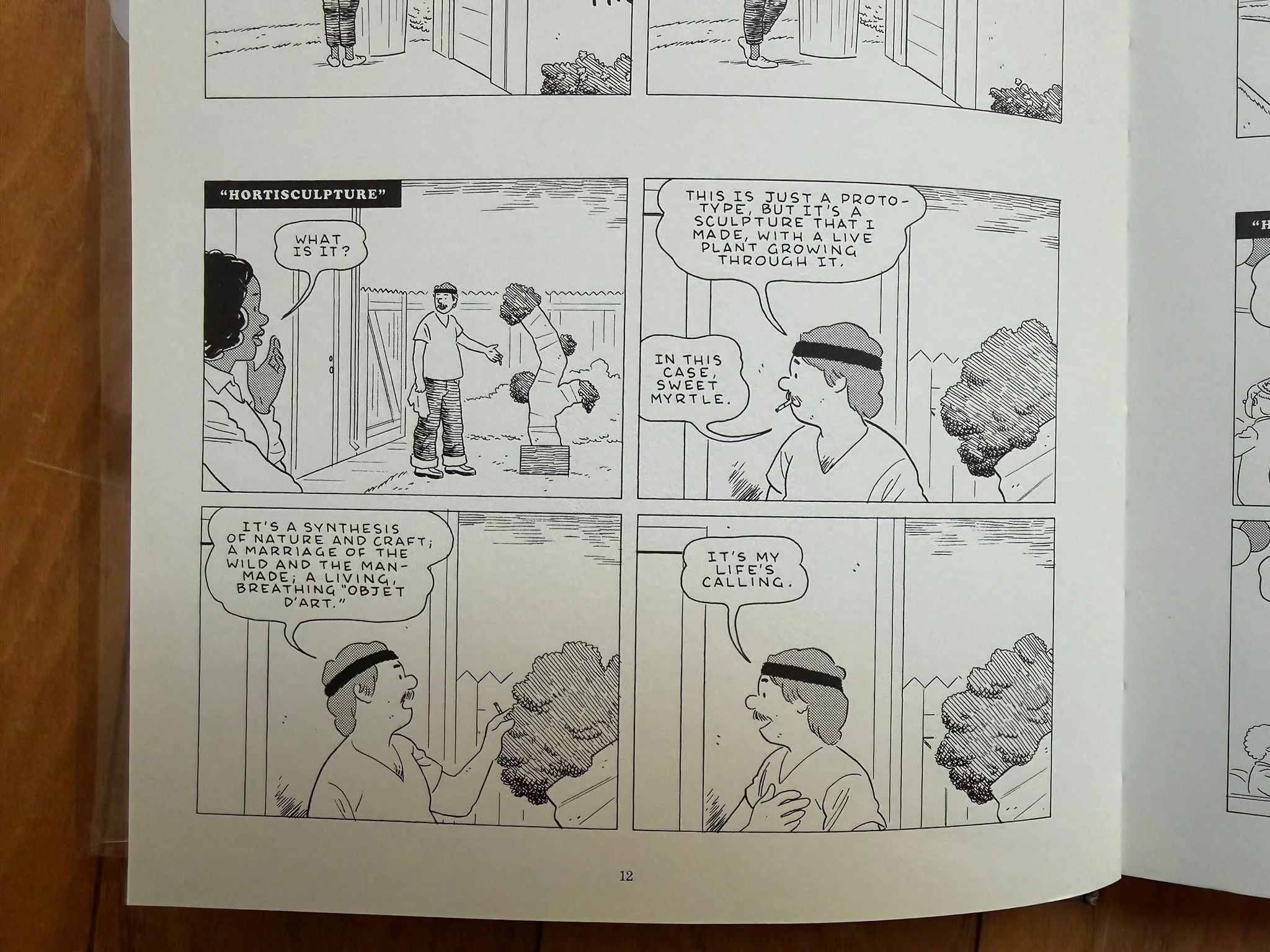
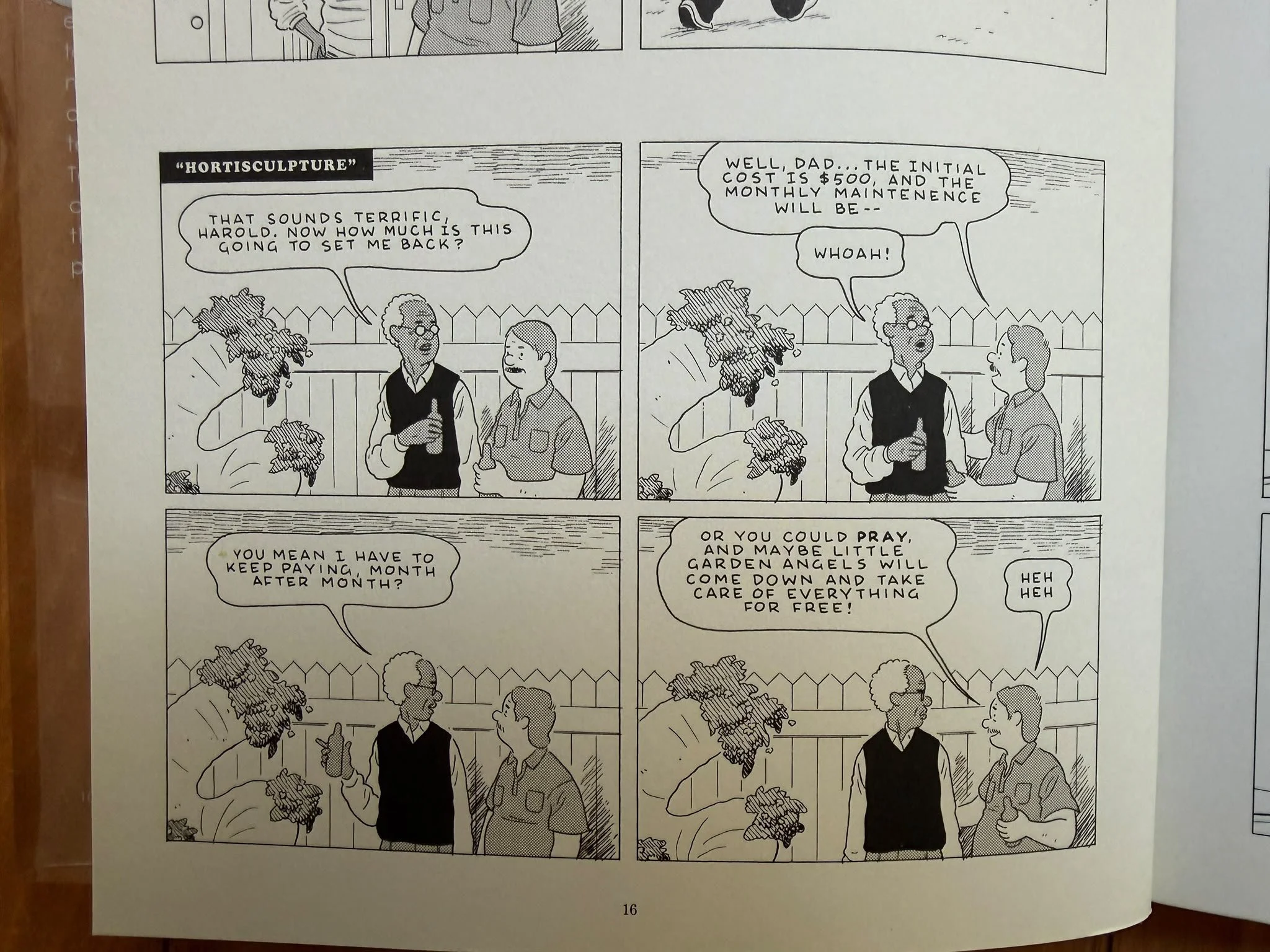
5. Killing and Dying by Adrian Tomine (b. 1974). Adrian Tomine ("Toe-meen-eh") may be the best graphic novelist working today and I think this is his best graphic novel. Six unrelated contemporary slice-of-life stories that are funny, sad, and seem to always offer a prism of reflection to something you may be feeling inside. In the opening tale we follow a local landscaper as he tries valiantly to get a new business off the ground: Hortisculpture!

Plants growing in metal sculptured tubes to use as lawn decoration. Might it work!? We get the artistic highs and lows, the marriage stress, and live out the dream, and the nightmare.

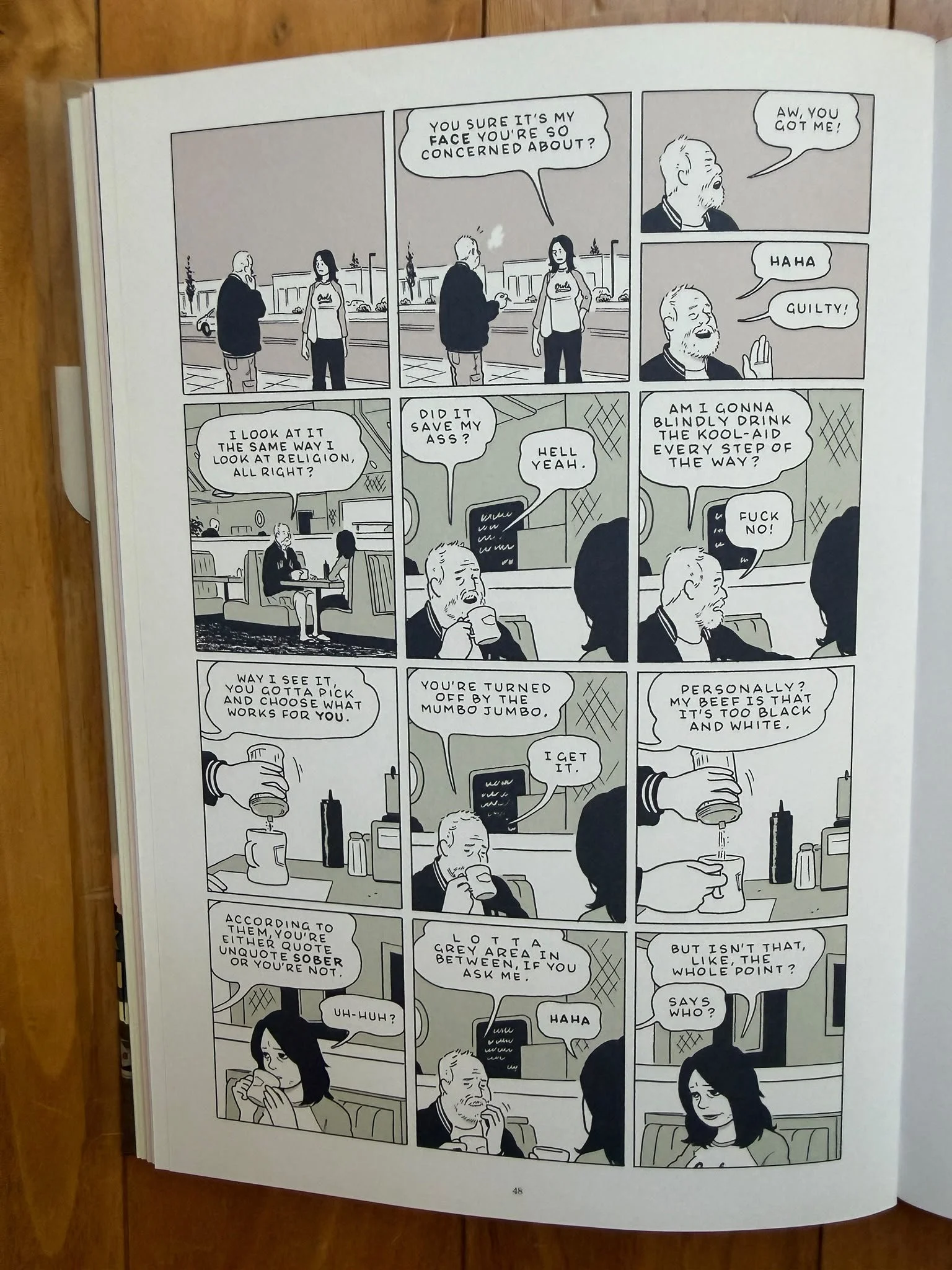
The second story follows a college student who discovers that she bears a striking resemblance to an online porn star. In the third story, “Go Owls,” we follow two people who meet at an AA meeting, and follow their relationship as it evolves into something both of them seemingly need but don’t want. Scenes jump like a movie, dialogue is pitch perfect, and you wonder how Tomine grew this gift to render such realistic reflections of modern life. A gem. (Here's Page 2 of 'Owls' below.)
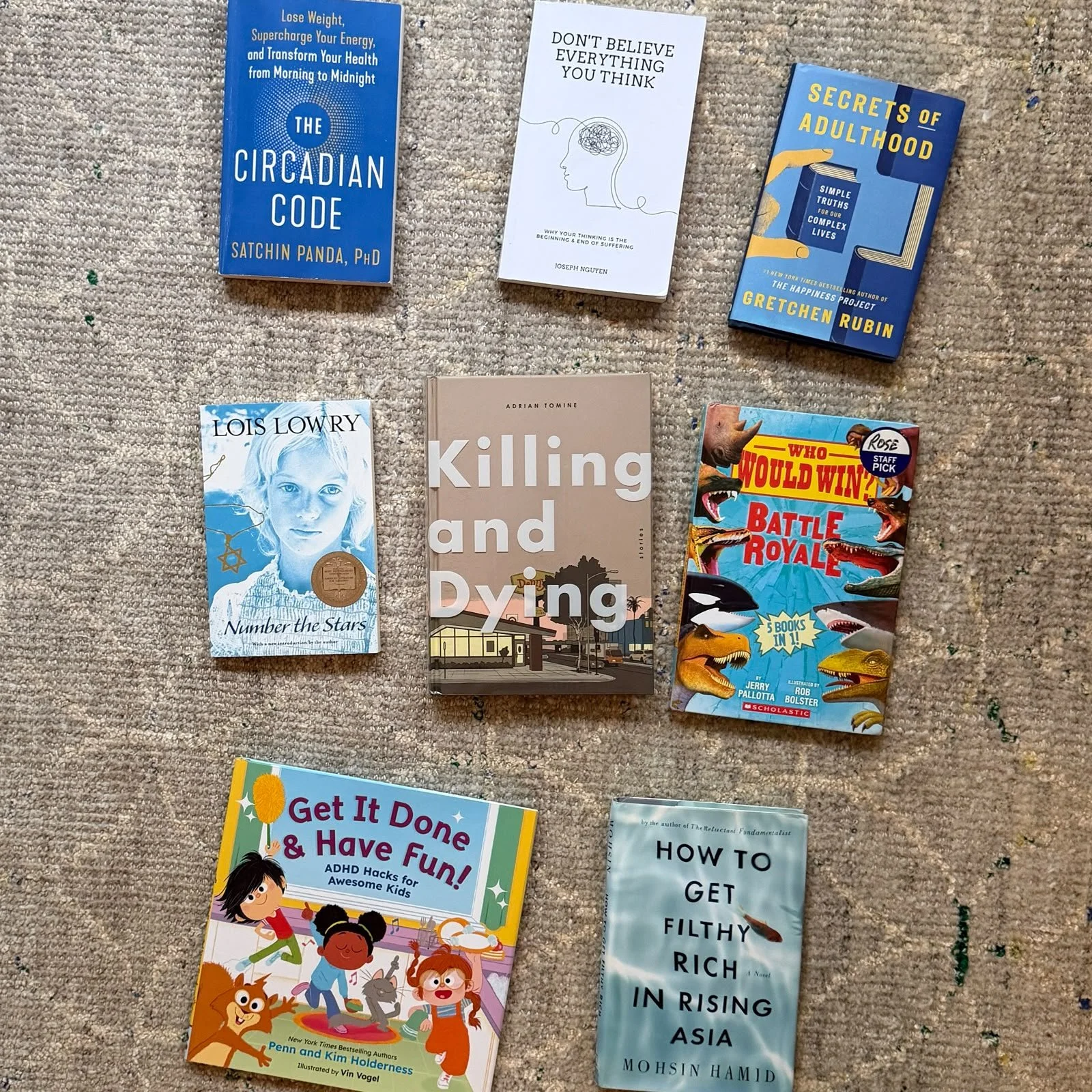
6. Who Would Win? Battle Royale by Jerry Pallotta (b. 1953). Every night before bed our 5-year-old wants to hear “Killer Whale vs Great White Shark” or “Rhino vs Hippo” or “Polar Bear vs Grizzly Bear.” I admit I was, uh, skeptical of these books ... but they’ve won me over. Each 30ish page battle begins by summarizing the strengths of each animal—how many teeth, how far away they smell blood, what they eat, etc—and then culminates in a massive fight scene. He’s started mentioning that a six foot tall person is the “same length as a male Orca dorsal fin" and even started writing his own book tentatively titled "Rabbit vs Chicken." He informs me the chicken is going to 'peck the rabbit in the nose 1200 times' to take it. A slightly squeamish way to get little ones into books.

7. Get It Done & Have Fun: ADHD Hacks for Awesome Kids by Penn and Kim Holderness (b. 1974, 1976). I hung out with Penn and Kim on their popular Holderness Family Podcast a few years ago and then they came and joined me and Leslie on 3 Books afterwards. Their latest children's book teaches kids with ADHD how to make chores fun. "We'd rather let spiders crawl on our head than spend five minutes making our bed. We're rather wake up with our skin turned green than put dirty dishes into this machine." Nobody likes chores! Especially people with ADHD. So the solution is to add "S.P.I.C.E"—Stakes, Passion, Innovation, Competition, and Engagement—in the form of gamification. Cleaning your room takes too long? "What if you just cleaned for the length of a song." Cleaning the kitchen is exhausting? Turn it into an arcade, they suggest. "You get twenty points if you rinse a dish clean, twenty more if it goes in the machine!" With wonderful rhymes and a simple message it's a great pairing to their meatier masterpiece 'ADHD is Awesome' (11/24).

8. How To Get Filthy Rich In Rising Asia by Mohsin Hamid (b. 1971). This entrancing second-person novel is the coming-of-age story of you—a poor boy from a poor family in a poor unnamed country—on your rise to riches. “Look, unless you’re writing one, a self-help book is an oxymoron,” it begins. “You read a self-help book so someone who isn’t yourself can help you, that someone being the author. This is true of the whole self-help genre. It’s true of how-to books, for example. And it’s true of personal improvement books, too. Some might even say it’s true of religion books. But some others might say that those who say that should be pinned to the ground and bled dry with the slow slice of a blade across their throats. So it’s wisest simply to note a divergence of views on that subcategory and move swiftly on.” The book opens with you huddled under a bed with you nearly dying from contracting Hepatitis E from contaminated water and then starting up a phony bottled water company before eventually growing and then ruling over a massive empire … before the cards start tumbling. Mohsin Hamid has a hypnotic voice. He was born in Lahore, Pakistan, spent time as a child in California, moved back to Pakistan, came back for a couple Ivy League degrees, worked as a McKinsey consultant, before becoming a novelist. All of that fascinating history is somehow woven into this book. Listen to my chat with Mohsin on 3 Books right here.

9. There is no nine! Just our regular loot bag of links. Bird Wall 2 is coming along! Professor Ethan Kross and I discuss our inner voice. I like Mark Manson's Bed Theory. Shoutout to a 96.5 year old man I love but have never met. Ryan Holiday hits 10 years of The Daily Stoic … I'm a big fan of daily, as you know! Anand Giridharadas chats with Rich Roll on empathy, compassion, and understanding people we disagree with. Adam Grant explores why having friends doesn't always prevent loneliness (and congrats to him on his new bestseller 'Vibe'!) Powerful speech from a Toronto school headmaster challenging his students to speak up on sexual assault. The Daily Roost is a bird mail club celebrating a different bird every month. My favorite election candidate. Delightful bird call request. 91-year-old Lloyd Kahn skateboarding. I love this Awesome Box in Ottawa. And finally my ancient but still-helpful advice on strategically trick-or-treating tonight!​