Hey everyone,
Let’s get right to the books!
Neil
PS. All my stuff is handwritten from me to you—no ads, no AI—since 2008. Join us!
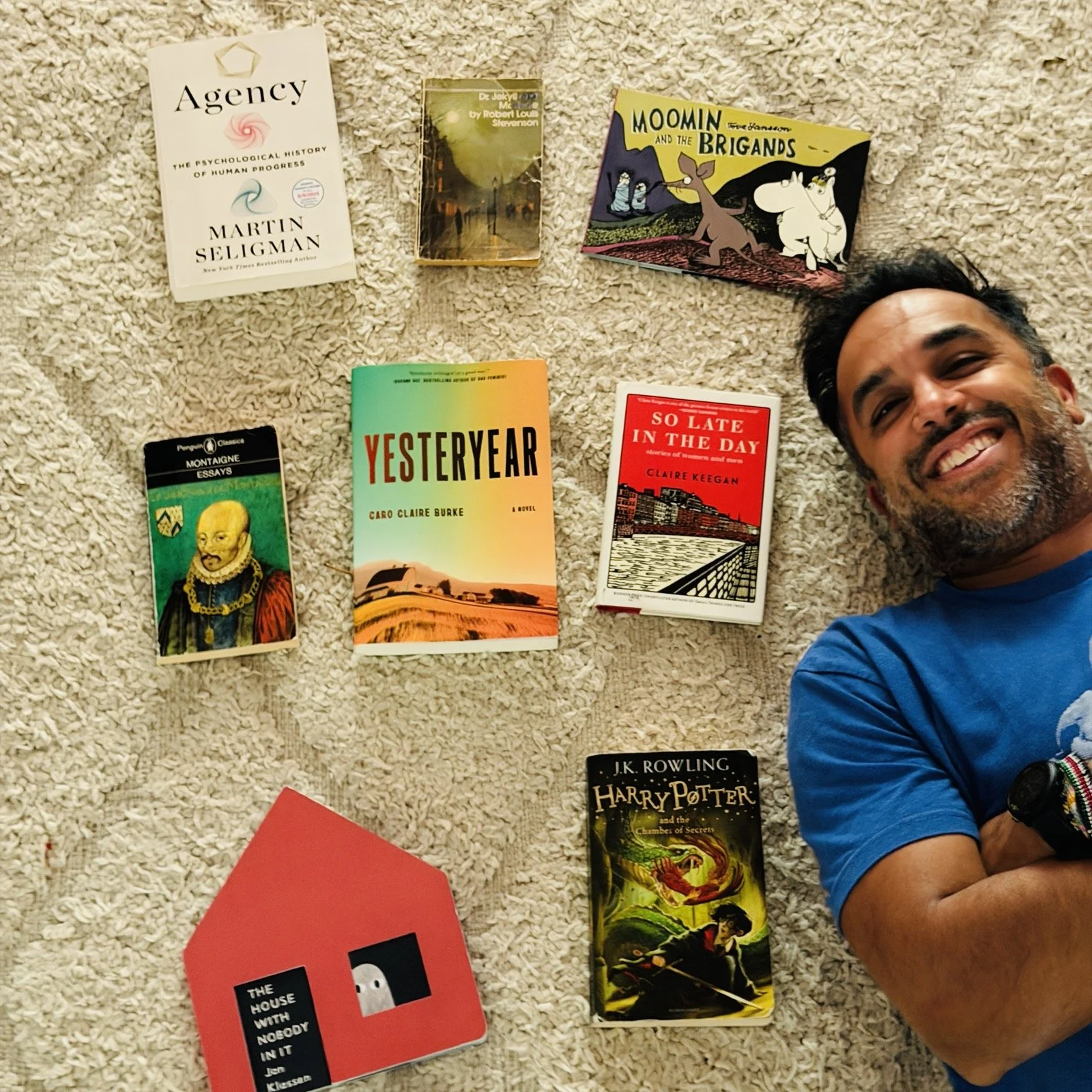
1. Agency: The Psychological History of Human Progress by Martin Seligman (b.1942). Do you remember the opening theme song of ‘Martin’? Mar-innnnnnnnn! Da-daaa-dadudah. Mar-innnnnnnnn! Da-daaa-dadudah. I am ashamed to admit that song runs through my head whenever I meet anybody named Martin. (How y’all feelin’?)
Thankfully, Martin Seligman does not go by Martin! Everyone calls him Marty. He just turned 84 and, no biggie, is about to drop his thirty-first book, after classics like ‘Learned Optimism’ (1990), ‘Authentic Happiness’ (2002), and ‘Flourish’ (2011). But this new book does something wild: He takes a concept, a loose concept, tightens it, then proceeds to tie it to the end of a long stick and just draaaaaaaag it through the annals of history. Per the subtitle this is ‘the psychological history of human progress.’ But, uh, what even is agency? That would be “the belief that ‘I can accomplish my goals’” (Page 16). And its components? Marty’s distills it into 1) Efficacy (“my estimate of achieving a specific goal in the here and now”), 2) Optimism (“my estimate that I can achieve my goal in the future, perhaps the distant future”), and 3) Imagination (“my mental representation of the range of goals I can achieve beyond the here and now”). He lays out his core hypothesis on Page 19: “Agency drives action. This psychological state is a proximal driver of human progress over history. When it is present, progress occurs. When it is absent, stagnation occurs.” O-kay. With you, Marty! But, come on now ... progress? Everybody defines that differently! “Ah,“ I picture Marty saying, crossing his leather shoes and leaning back on his leather chair by the window in the corner of his mahogany office. “Turn the effing page, dude.” Marty says progress has five realms: Thought, Philosophy, and Religion; Science, Medicine, and Technology; Literature, Music, and Art; Quality of Human Life; and Politics and Freedom. Now we’re on Page 22 but get ready because here comes 230 pages of history—from 40,000 BCE to Ancient Greece to Ancient China (mesmerizing!) to Medieval Europe to the Renaissance to Black Agency to Women’s Agency. This is the history book I’ve always wanted: economical on WHAT ACTUALLY HAPPENED, expansive on WHAT IT MEANT. On a podcast five years ago, Marty shared how he told his daughter Amanda, a history PhD, about the idea for this book, and she said something like, “You don’t know anything about history — start reading ‘The Cambridge Ancient History!’” By that time, by that podcast in 2020, he had “only” read the first two volumes—about 2,000 pages—and still had 14,000 pages to go. When was the last time you read 16,000 pages of history? LOL. Man, I love this guy. What a mind, what wisdom. There is a reason he invented positive psychology! With Mike, of course, more professionally known as Mihaly Csikszentmihalyi (“ME-high CHICK-sent-me-HY-ee”). No corners cut in the making of this book. Great philosophers? World altering literature? Big inventions? Major historical events? All mentioned, all discussed. With details on how they were driven by agency. With citations! We need agency. After I read ‘The Age of Surveillance Capitalism’ by Shoshana Zuboff (05/23), I became more aware of how my behavior is nudged, cajoled, controlled. You know that ad you got for that thing you were just ... thinking about? That. Big data, big AI, big insights on your little behaviors, knowing more about you, steering you, along and along and along in very BUY A PRESSURE WASHER non-agentic ways. This book helps get your agency back, get your mojo back. I was hooked from Page 26 when we're told about the first-ever empirical study on agency and control for humans in the 70s. The TL;DR is that old folks in homes who got to set up their rooms, control their time, take care of their plants were more active, healthier, and died, no biggie, at half the rate of those who were told someone else would set up their room, someone else would control their time, someone else would water their plant. Sucks to be on the wrong floor of that study! An incredible book that feels like you’re riding a rocket through time with the greatest self-help writer of the past half century. Thank you, Marty. You are a glittery gem.
2. Dr. Jekyll and Mr. Hyde by Robert Louis Stevenson (1850-1894). I'm writing more and more about overthinking these days. And I'm starting to grow more comfortable with the idea that thoughts are, you know, just thoughts. They aren’t us, per se, but more … things floating ... past us, through us. Confusing! Because they’re inside us (wherever they are) and—big one—they also … sound like us. Our thoughts talk in our voice! So, of course, makes sense, when you perceive thoughts, when you “have” thoughts … they do really feel, you know, owned. Even ... agentic? But ... are they? Do we actually have them? More and more, I’m feeling like, you know, maybe … our thoughts have us. Part of the work might be recognizing the gripping nature of thoughts—whether we have them, whether they have us—as part of the issue. That gripping, that tightness, creates a stickiness that … sort of glues us and our thoughts together. They feel like us! But we have to learn to separate, let thoughts float by, let us watch without always having. Also, we have scary thoughts. We all do! So learning to watch them float by, seeing them like balloons floating through the sky of our minds, helps relieve us of the obligation to attach. What do you think? What are your .... thoughts ... on that? As I was reading this book I was thinking "Oh, poor Robert Louis Stevenson." There is just no way he could have written this epic masterpiece, in a spastic few days on cocaine apparently, without feeling deeply tethered and troubled by his thoughts. Nabokov gave lectures theorizing that, through hunchback alter-ego Hyde, Stevenson was processing his closeted homosexuality. Maybe? Who knows! All I know is this tightly coiled 103-page, 141-year-old masterpiece will twist you in delightfully wild ways. Start with the structure! First 66 pages are a third-person story of Mr. Utterson, local town lawyer who grows increasingly concerned his pal, good Dr. Jekyll, is leaving his will to mysterious Mr. Hyde. Nosy, sleuthy Utterson comes across Mr. Hyde one night and is instantly repulsed by him. Then, when Mr. Hyde is later seen murdering a dude on the street he’s like, “Waaaaait a minute, Jekyll! Who is this guy!” The mystery deepens when Hyde disappears, Jekyll hosts some terrific parties, and then ... Jekyll disappears. POOF! I mean, that’s like half of the book. But wait! Then this other guy dies and turns out he gave Mr. Utterson a letter saying, “Do not open till after Jekyll dies” … and then we get that letter and after all that we get, here it is finally, Jekyll’s letter. Together, these two letters are the second half of the book and they send the whole story roller-coastering backwards. What a feat! Stevenson creates a captivating protagonist who we don’t hear ... until Page 79! He’s like the shark in ‘Jaws.’ An exploration of duality, of people, of the many types of people, we all are. I thought of my friend Chris Kim a lot reading this book. Back at Harvard, he’d confess late on a long walk down Mass Ave, that he heard … voices. In his mind. That were not his. Chris was gay told me that when he came out, his dad bought him weights … so he could exercise … so he could get better. May they both rest in peace. (Chris’s dad sadly took his own life on the anniversary of Chris’s suicide.) What is the Hyde to your Jekyll? What thoughts do you have? What thoughts have you? What views might feel cancerously attached to your own view of yourself? There is so much we don’t know about the brain, the mind. I’m working on it in this overthinking book. I’m down the mine shaft now. On Page 91, Stevenson (writing as Jekyll), describes how Jekyll “… projected and shared in the pleasures and adventures of Hyde, but Hyde was indifferent to Jekyll, or remembered him as the mountain bandit remembers the cavern in which he conceals himself from pursuit. Jekyll had more than a father’s interest; Hyde had more than a son’s indifference. To cast in my lot with Jekyll was to die to those appetites which I had long secretly indulged and had of late began to pamper. To cast it in with Hyde, was to die to a thousand interests and aspirations, and to become, at a blow and forever, despised and friendless.” I quit cannabis this year after 23 years. This book made me think about that. I have thoughts I wrestle with, I struggle with. This book made me think about them. 141 years later, this spastic expulsion from the author of ‘Treasure Island’ stands as an endlessly blinking lighthouse … calling us to shore.
3. Moomin and the Brigands by Tove Jansson (1914-2001). We borrowed an idea from Leslie’s wondrous grandparents Bob (94) and Joan (92) who took each of their grandkids on a trip when they turned 16. I’m impatient so we started with a “Daddy Trip” for our kids as they turn 10—they pick a city and we go for a few days. I just spent an incredible few days with my son in Montréal. I pasted a Photo Diary of our trip here and included our Emoji Diary, too, which I find a fun skimmable way to revisit and share trips. Here’s our Emoji Diary for the third day of our trip:
💪🏾Workout
🥚L’Evidence - 51
🏥 Raplapla - 98
🥯 Fairmont - 99
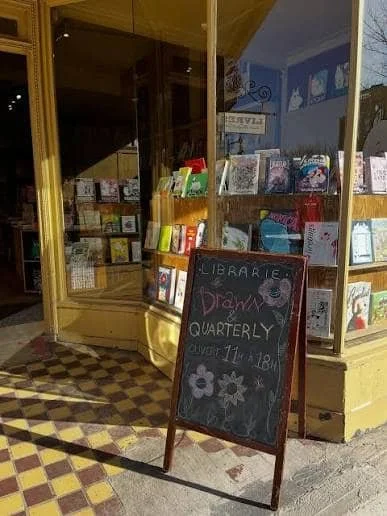
📚 Librarie Drawn & Quarterly
🛝 Aquazilla - 100
🪝 Comedy club
🍟 Dunn’s - Poutine and Smoked Meat - 99
🍟 Le Belle Province - Poutine - 100
R 33K / D 27K
Every meal and attraction is recorded with an average rating out of 100! Step count recorded at the end of the day. You’ll notice we picked a crappy place for breakfast—highly recommend L'Avenue instead, which earned a 97 the next day!—and we went to an incredible toy store with a working toy hospital called Raplapa:
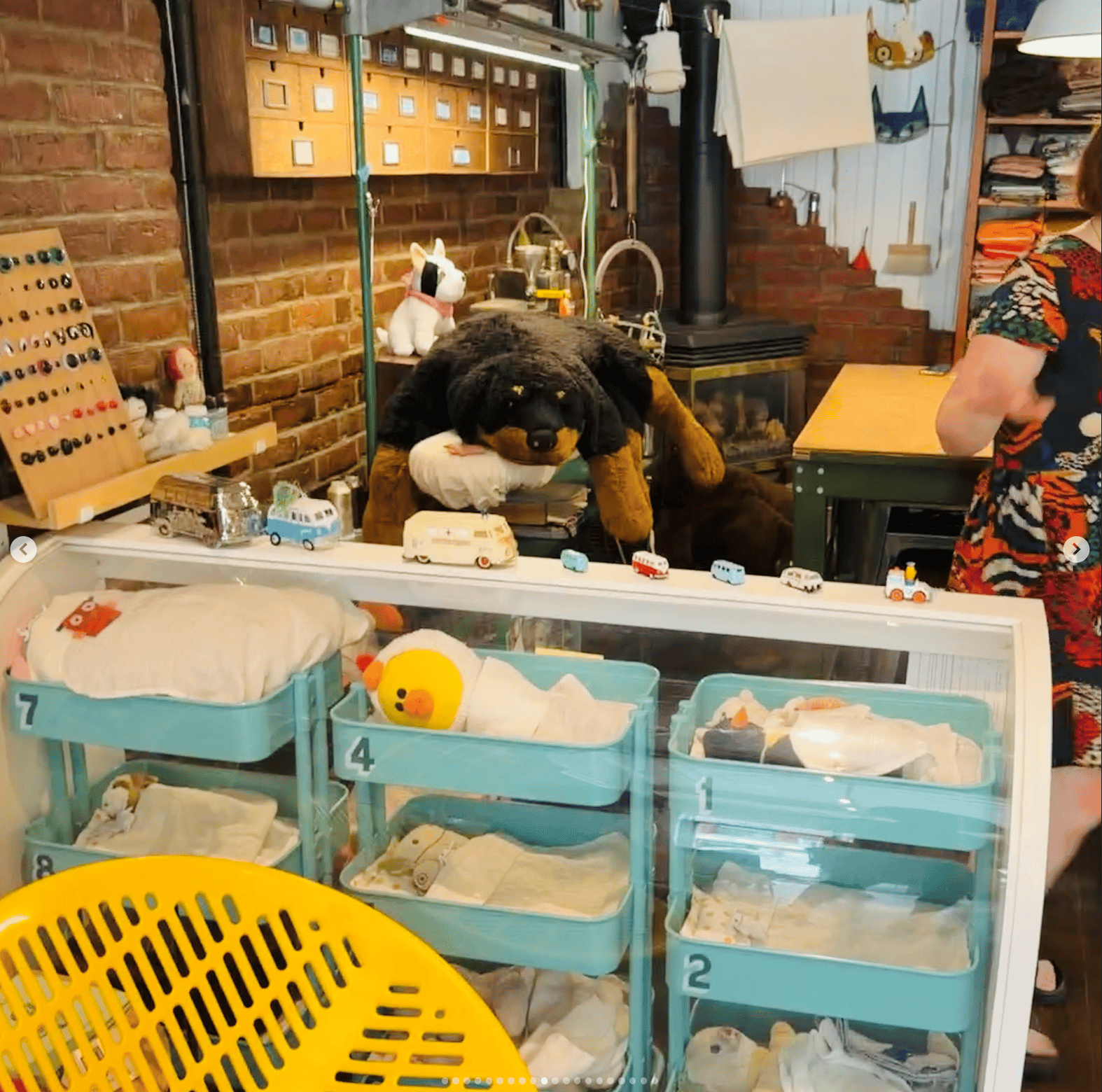
Then we went to the famous Fairmont bagels (Est. 1919), which my son liked better than St-Viateur (Est. 1957), before walking up to Librairie Drawn & Quarterly—the flagship bookstore of the best graphic novel publisher in the world. Chris Ware! Lynda Barry! Daniel Clowes! Adrian Tomine! Kate Beaton! All here!


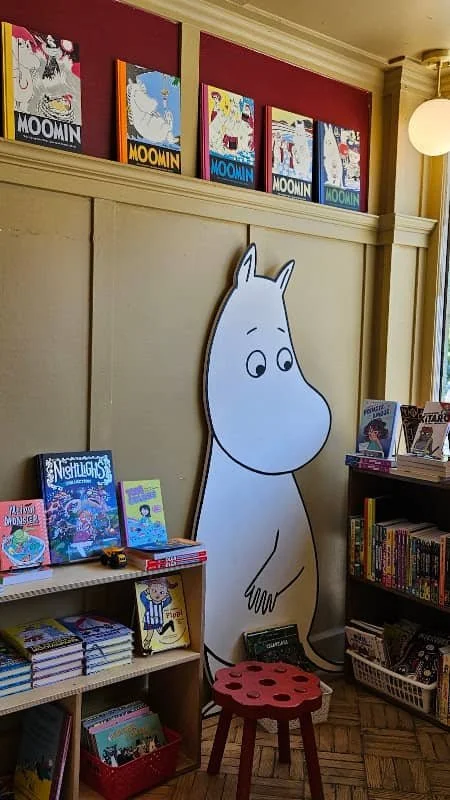
And, yes, oh my my, the wild Tove Jansson. That would be the Finnish author and artist who started as a political cartoonist for the anti-Fascist magazine Garm and who published her first Moomin book—this one!—back in the 1940s. She went on to write picture books, comic-strips, plays, and even an opera. This book is wild! I highly encourage you to read the first four pages here:
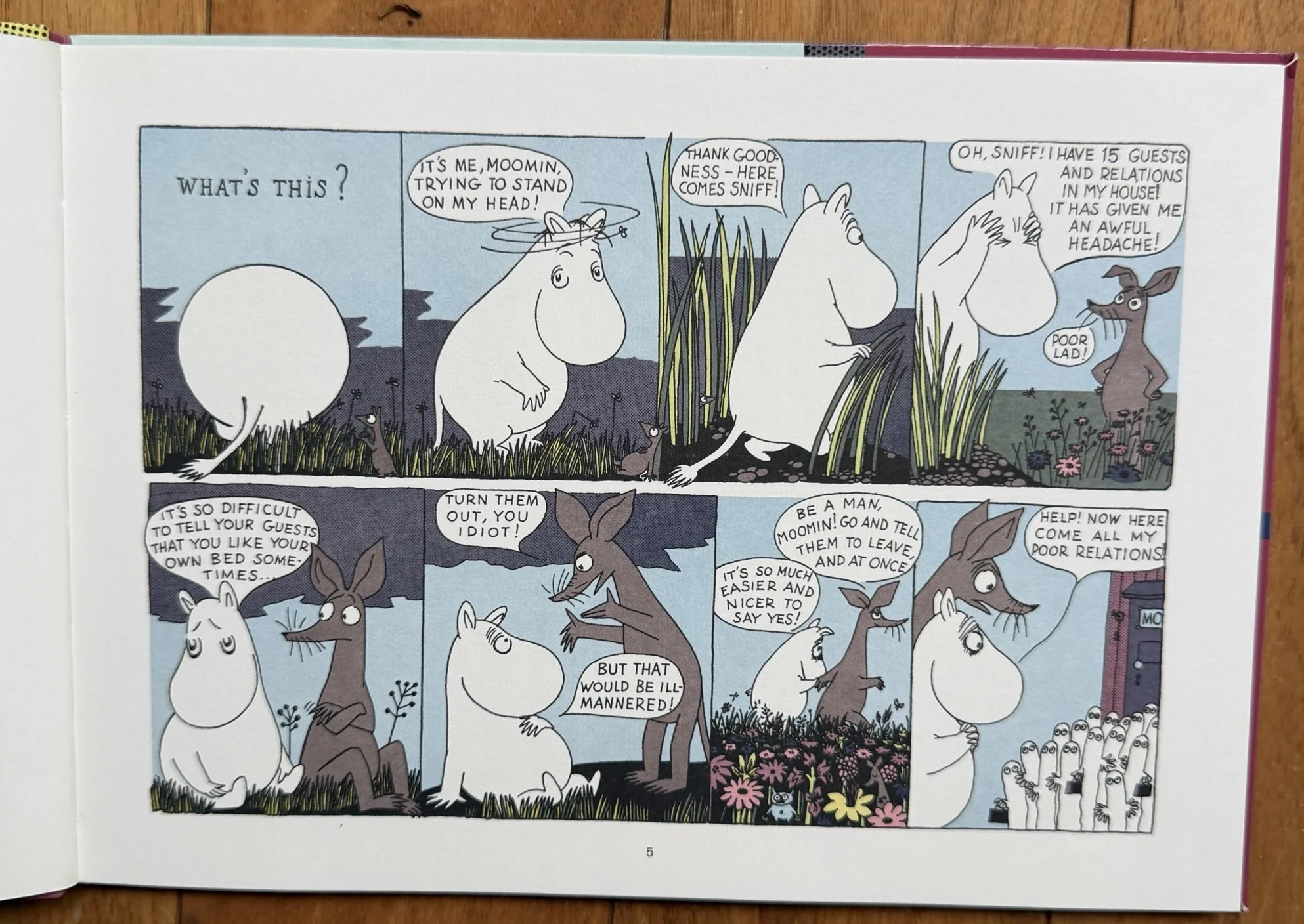
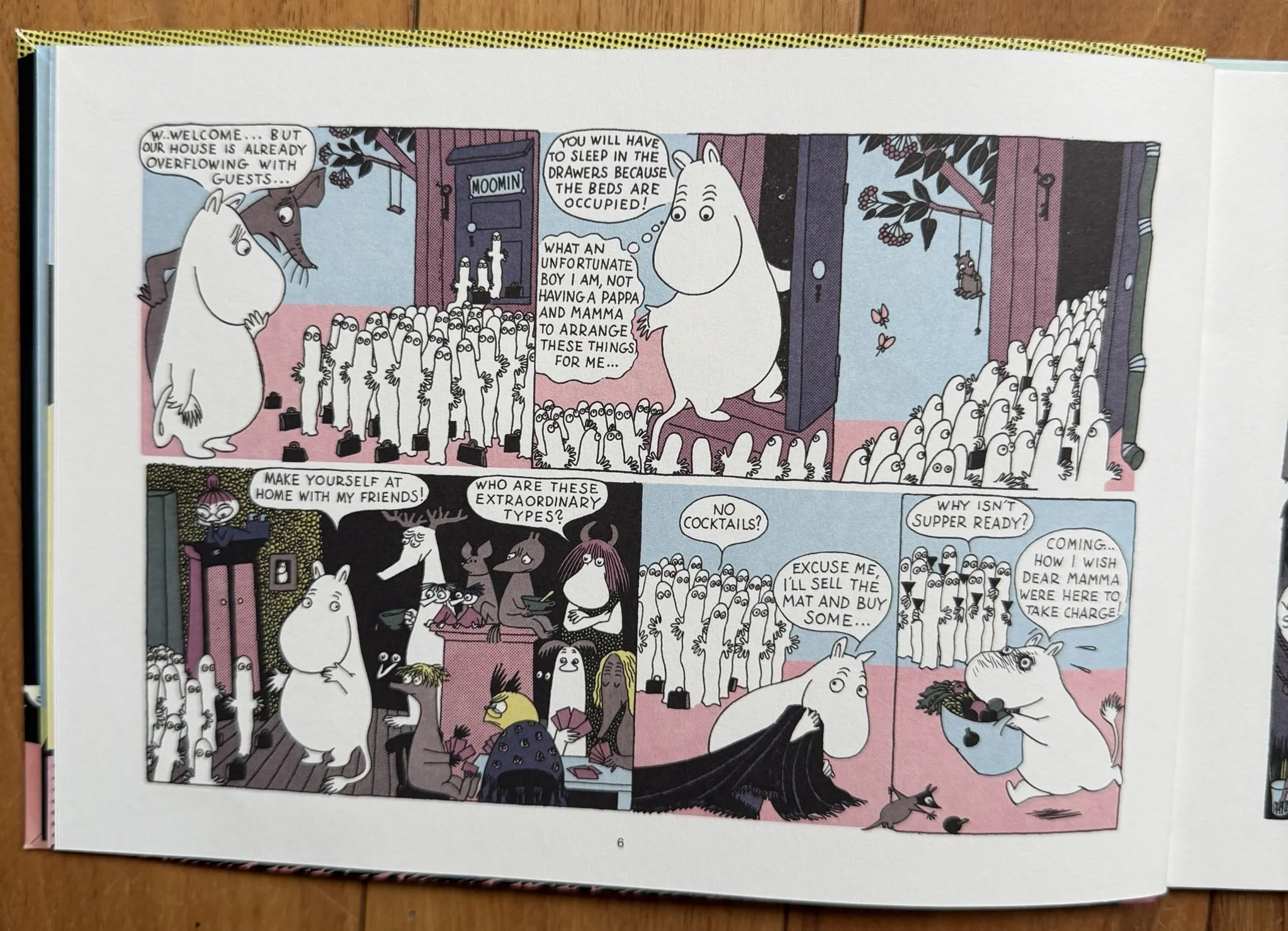
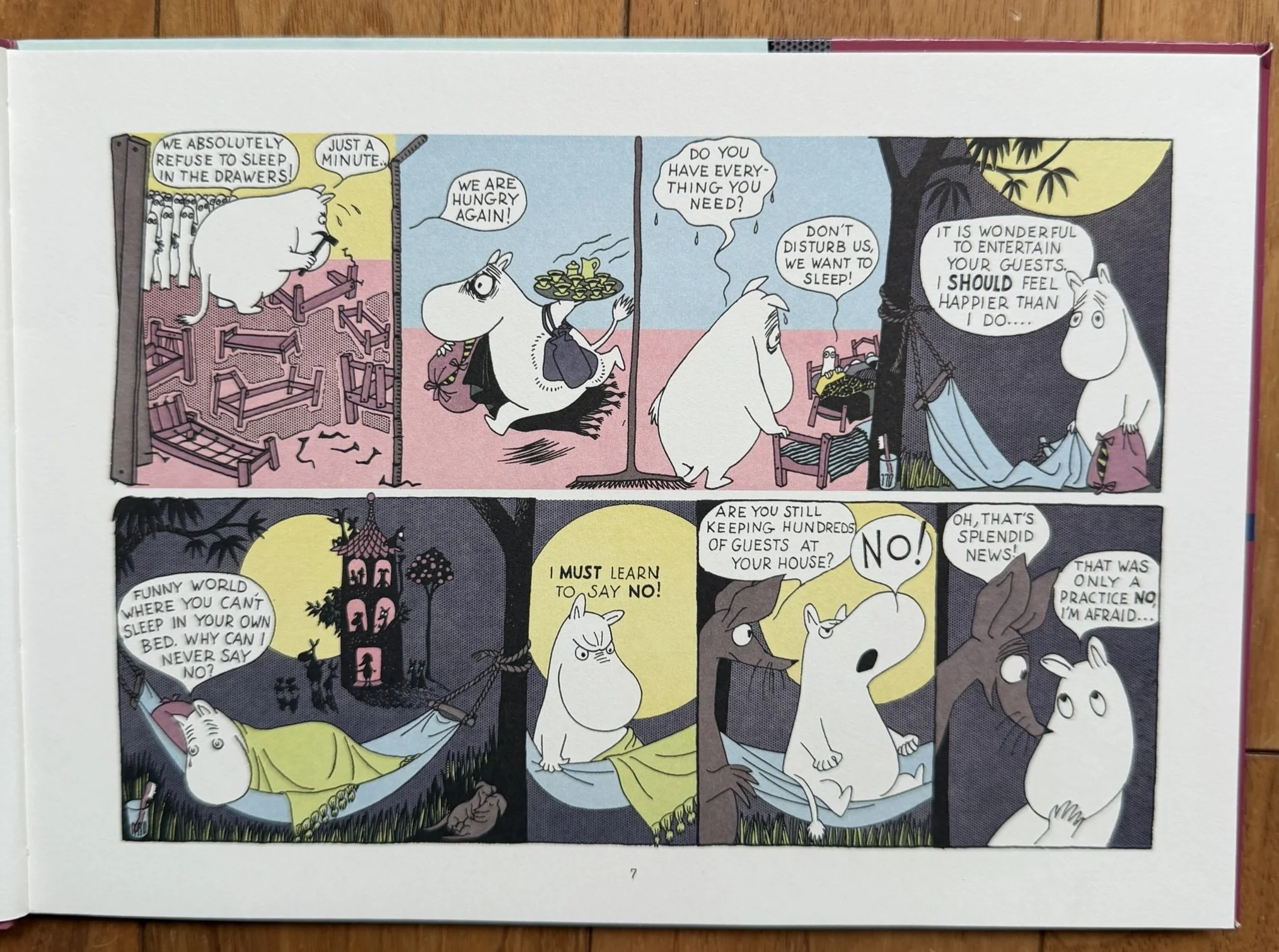
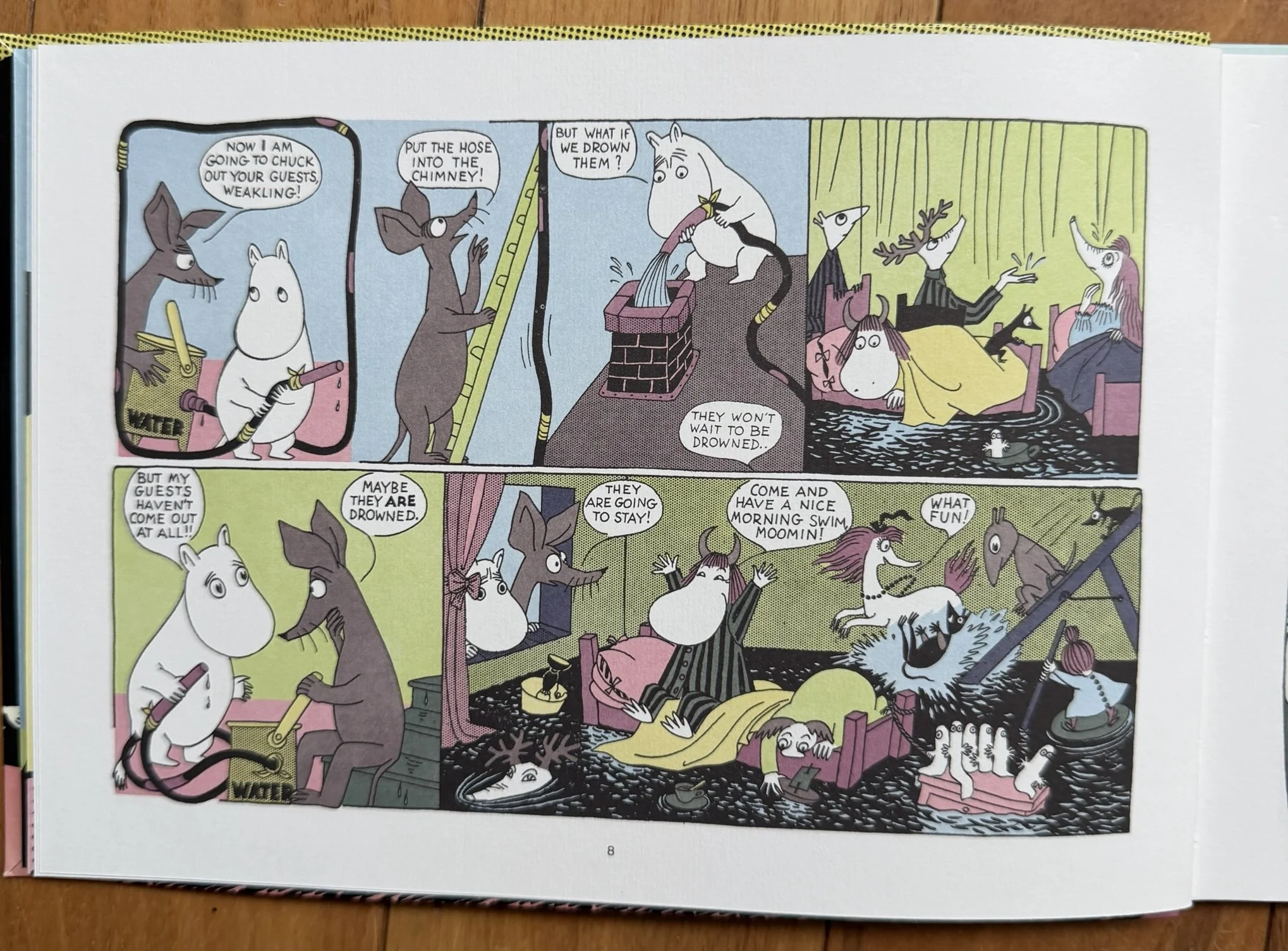
The story is ... endlessly exploding. Like a flower that blossoms into yellow blooms, then purple spindly-things, then fireworks. Acidity, absurdity, puns, and such lushness. I am so grateful to Drawn & Quarterly for re-releasing these books in English a couple years ago. Get the whole set here! Moomin’s pushy relatives invade his house, and while trying to evict them, he and his pal Sniff chase endless get-rich-quick schemes before he falls in love, rescues her from a kidnapping, and everyone is eventually saved. Entrancing and perfect for all ages.
4. Essays by Michel Montaigne (1533-1592). This month we visited the wonderful Owl Pen Book Shop in Bracebridge, Ontario. Family owned and operated by Katherine Cumberland, this bookstore is stuffed to the brim with endless treasures. Last year I found a pile of Hermans! They had every Herman treasury except the first. Buuuuut guess what I found this year? The first one! My Herman collection is complete. (Shoutout to übermensch Seth Godin who, after reading my review of ‘The Second Herman Treasury’ (07/25), connected me with Andrews McMeel Publishing, asking them to put Herman back in print! Not back in print yet, but still available used...). Anyway, while my kids plopped down in the kid’s section, I went upstairs and found so many gems. I walked out with like 20 books. First up is this one: ‘Essays’ by Montaigne, a unique story-of-my-views not story-of-my-life autobiography published in … 1580! Did you know this book is what actually coined and created the word essay? Essays! The Middle French word “essai” already meant “a trial”, “a test”, but Michel was the first person to use it to describe ... writing. From Chapter 8 on Idleness he writes: “As we see ground that lies fallow, teeming, if rich and fertile, with countless kinds of wild and useless plants, and observe that, to keep it serviceable, we must master it and sow it with various crops of use to ourselves … so it is with our minds. If we do not occupy them with some definite subject which curbs and restrains them, they rush wildly to and fro in the ill-defined field of the imagination.” Wait, what? Here I am trying to explore overthinking and this guy covered it 500 years ago! LOL. He explores it again in Chapter 21 on “The Power of the Imagination”: “I have personal knowledge of a case of a man for whom I can answer as for myself, and who could not fall under the least suspicion of impotence or of being under a spell. He had heard a comrade of his tell of an extraordinary loss of manhood that had fallen on him at a most inconvenient moment; and, when he was himself in a like situation, the full horror of his story had suddenly struck his imagination so vividly that he suffered a similar loss himself.” When was the last time you read a 500-year-old book about erectile dysfunction? He goes on to share the remedy to the problem—the awareness of it, the sharing of it, the processing of it beforehand—in his typical super-clear, lucid, mathematical way of discussing things. This is an absolutely massive book and I’ve read maybe … 10% of it? If that? But you flip to any page, read any paragraph, and encounter either a totally sideways thought (he’s got an essay on cannibalism!) or, you know, the most exquisite crystallized bit of wisdom you’ve read in years.
5. Yesteryear by Caro Claire Burke. And now it is time for this month’s Leslie’s Pick, a book personally chosen and reviewed by the love of my life. For a full list of Leslie’s picks, click here. Over to you, Les: “‘Yesteryear’ seemed like such a cool premise. I bought it thinking it was about a current day mother posting on social media about her homeschooling, farming, naturalistic ‘back to what really matters’ life who then time travels back to when most women actually lived like that but didn’t have social media to share, connect (and perform) through. My assumptions were not incorrect, it did explore this idea, but the novel turned out to be a bit more like a ‘Truman Show’ horror story than I expected. Perhaps surprising to some, I felt deep empathy for the kind of unlikeable protagonist, and found some of the extreme, even unhinged (as Roxane Gay says in her blurb) reflections on the pressures, overwhelm, and relentlessness of motherhood almost absurdly resonate with the less extreme experiences my friends and I have had. However, sadly, this book missed a fuller exploration of the main character’s inner world and, as a result, never arrived at a compassionate reflection on whether, perhaps, the character was actually suffering from a major mental health disorder brought on by her matrescence. A deeper lean into how such a crazy turn of events could have actually happened would have made this book, which had great potential, much more powerful. Therefore, I do recommend it and admit I couldn’t put it down, but think ‘All Fours’ by Miranda July (08/24) and ‘My Wild and Sleepless Nights’ by Clover Stroud (01/24)—previous Leslie’s Picks—are much better explorations of the ‘unhinged’ and oh-so-human beauty and challenge of being a mother and a woman.”
6. So Late In The Day: Stories Of Women And Men by Claire Keegan (b.1968). My son was in the middle of his second reading of the entire Percy Jackson and the Olympians Series when I noticed he just … stopped. “I don’t want to finish it,” he told me. “I don’t want to be done.” He read the series years ago but had the compulsion to reread it this summer, and then, in the middle of the last book, stopped. I GET IT DUDE. I read Claire Keegan’s ‘Foster’ in 2023 (09/23) and then read ‘Small Things Like These’ in 2025 (01/25) and, you know, I’ve seen ‘So Late In The Day’ so many times in bookstores. A collection of just three short stories—that’s it!—from the titular 2022 New Yorker piece to 2008’s ‘The Long And Painful Death’ to 1999’s ‘Antarctica’ …. but I just couldn’t bring myself to read it. I did eventually buy it! Then it sat on my bookshelf for a year. I wanted to read it but I also knew when I read it … I would be done reading it … and I did not want that. But, yes, the time has finally come. I opened it. I cracked it. I finished. And now I have to tell you that ‘So Late In The Day’ is … the single best short story I have ever read. Ever! And I love short stories. George Saunders, Alice Munro, David Sedaris, Raymond Carver, Joy Williams, Tobias Wolff, more, more, I just want more! But Claire Keegan’s ‘So Late In The Day’ is such a feat, such an astounding display of emotion, economy, and omission, that it takes the cake ... and the enchilada. Btw, even though it’s 46 pages, it’s in 18-point with 3/4" margins … so it’s more like 15 pages! Flies by. And the second I finished reading I flipped back to the beginning and read it again. RIGHT AWAY! I don’t think I have ever done that. It begins so simply, so mysteriously, with a random office cubicle worker in Dublin, staring out the window: “On Friday, July 29th, Dublin got the weather that was forecast. All morning, a brazen sun shone across Merrion Square, reaching onto Cathal’s desk where he was stationed by the open window. A taste of cut grass blew in and every now and then a close breeze stirred the ivy, on the ledge. When a shadow crossed, he looked out; a gulp of swallows skirmishing, high up, in camaraderie. Down on the lawns, some people were out sunbathing and there were children, and beds plump with flowers; so much of life carrying smoothly on, despite the tangle of human upsets and the knowledge of how everything must end.” She’s gooooooood. “As good as Chekhov,” David Mitchell says. Maybe better! Turns out today is Cathal’s wedding day and I HAVE SAID TOO MUCH! Read this masterpiece. If you can. You don’t have to! You have the right to dip, the right to skip, and the right to quit. But it is so damn good. Here is the New Yorker link to the titular story—yes, I just wanted to say titular again—which is the strongest one though the other two are still golden. Now I am going to stop writing this review because I have the book sitting beside me and I am desperately itching to read it a third time while simultaneously rueing the fact I have already read it twice.
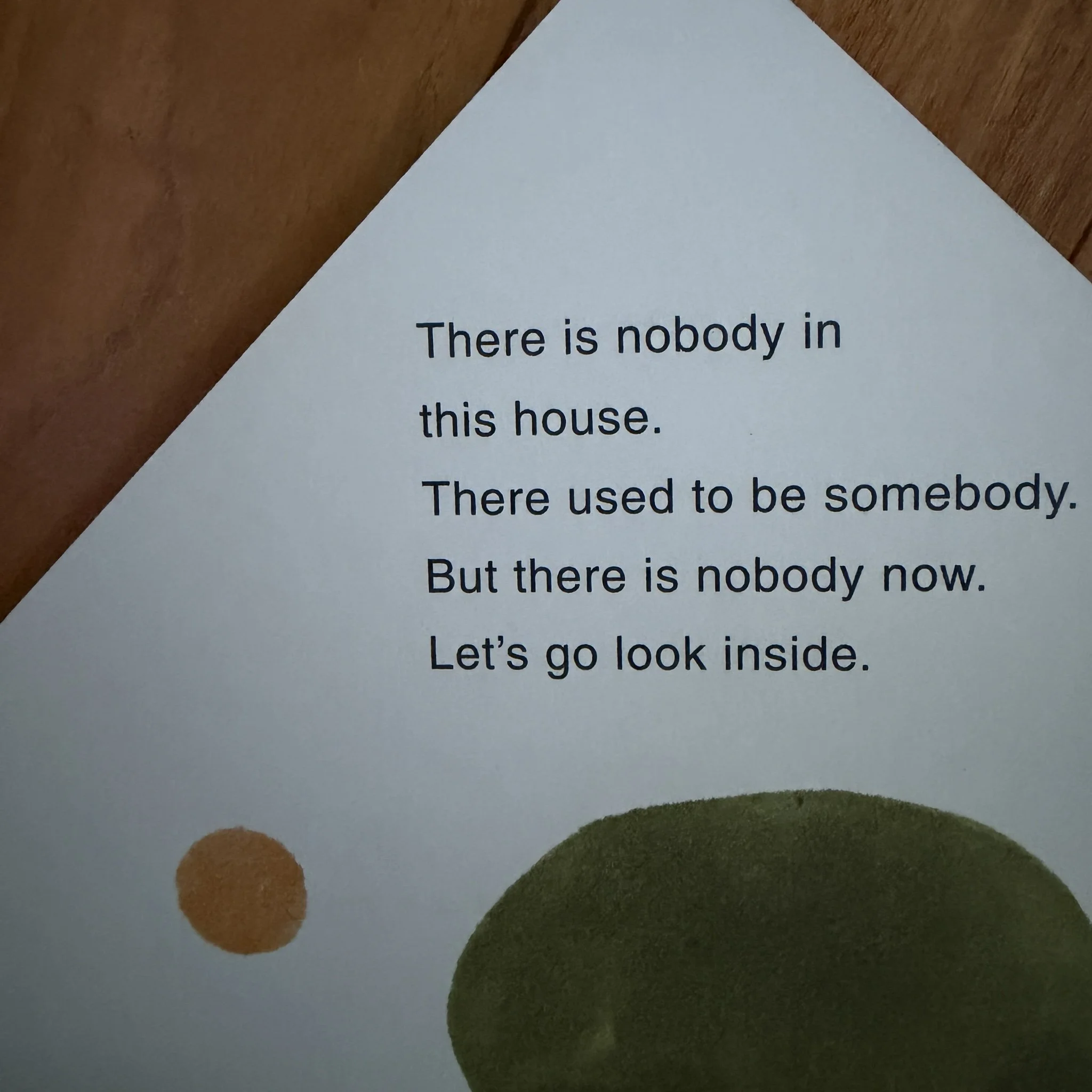
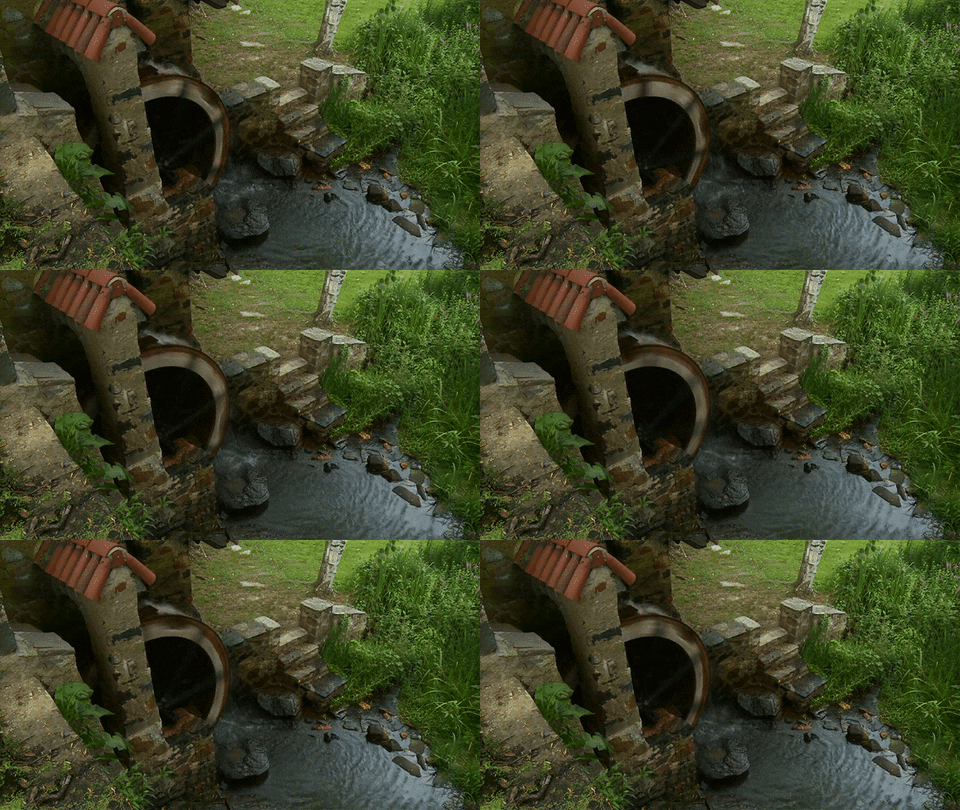
7. The House With Nobody In It by Jon Klassen (b.1981). Jon Klassen’s mind is like a watermill. Big. Severe. Heavy. That thing is churning. It’s like a ballet move on tippy-toes—with abs seriously clenched—and an output so sleek … so simple.
I was down in LA a few months ago and Jon drove to my hotel in the middle of nowhere and we walked around some pier and had one of those long dinners where you feel so intellectually gluttonous to be with someone you order way too much food—to, like, match gluttonouses? Anyway, we were strolling through the empty diesel-smelling parking garage after and when we got to his car Jon said, “Oh! I brought something for you! It’s my only copy of a book coming out in a few months.” He sat down, signed it, pontificated on some deeply layered and nuanced topic, as is his gift, and then handed me the book.

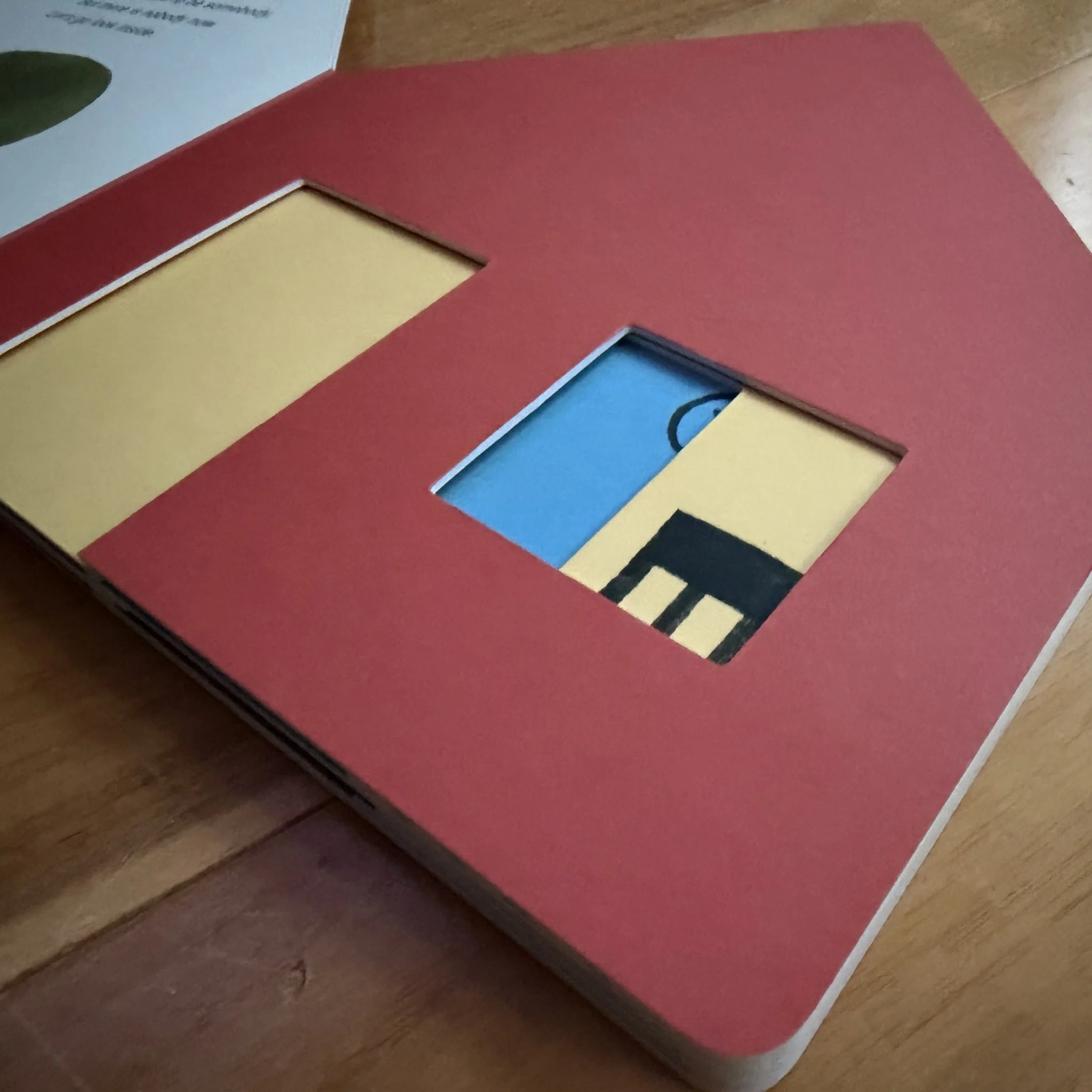
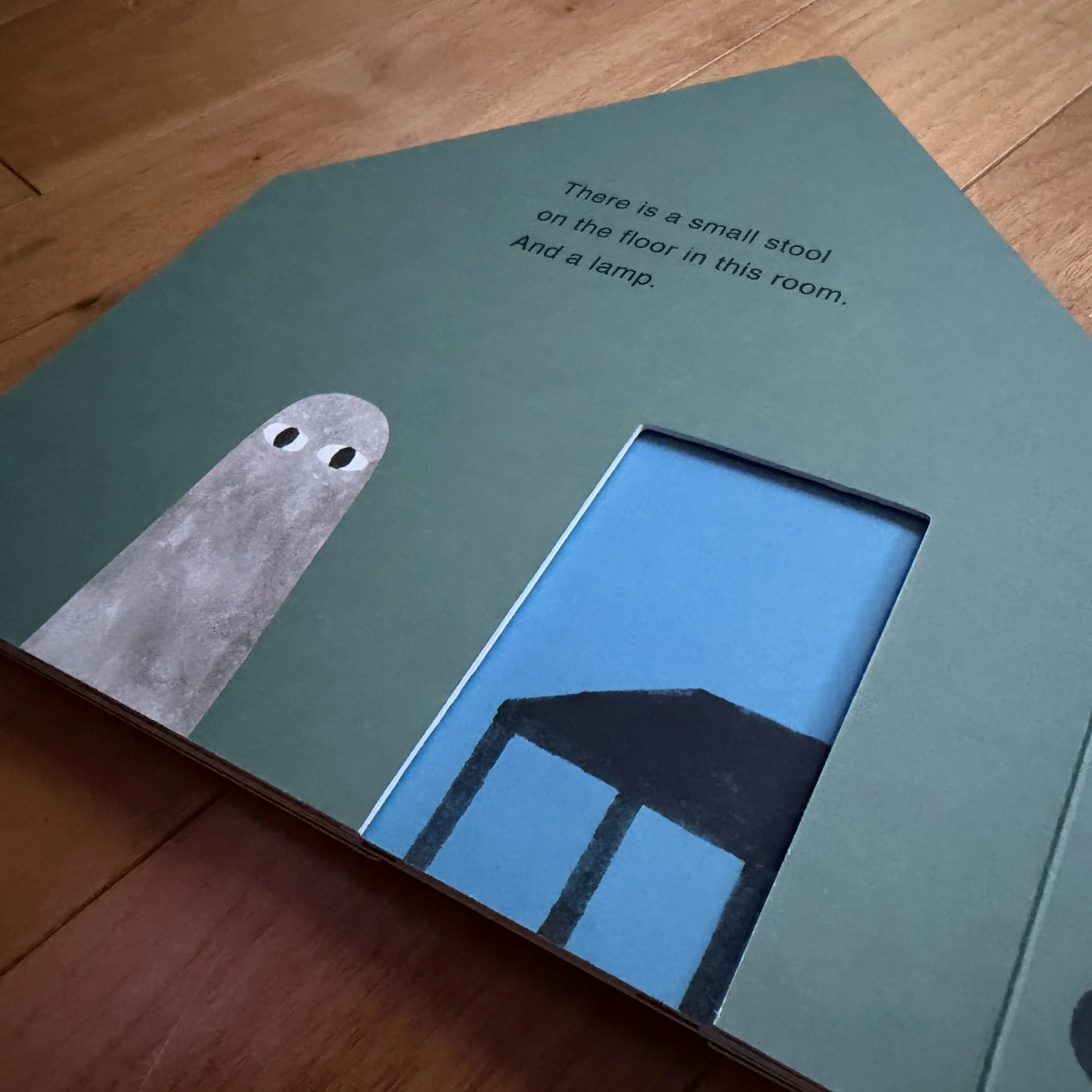
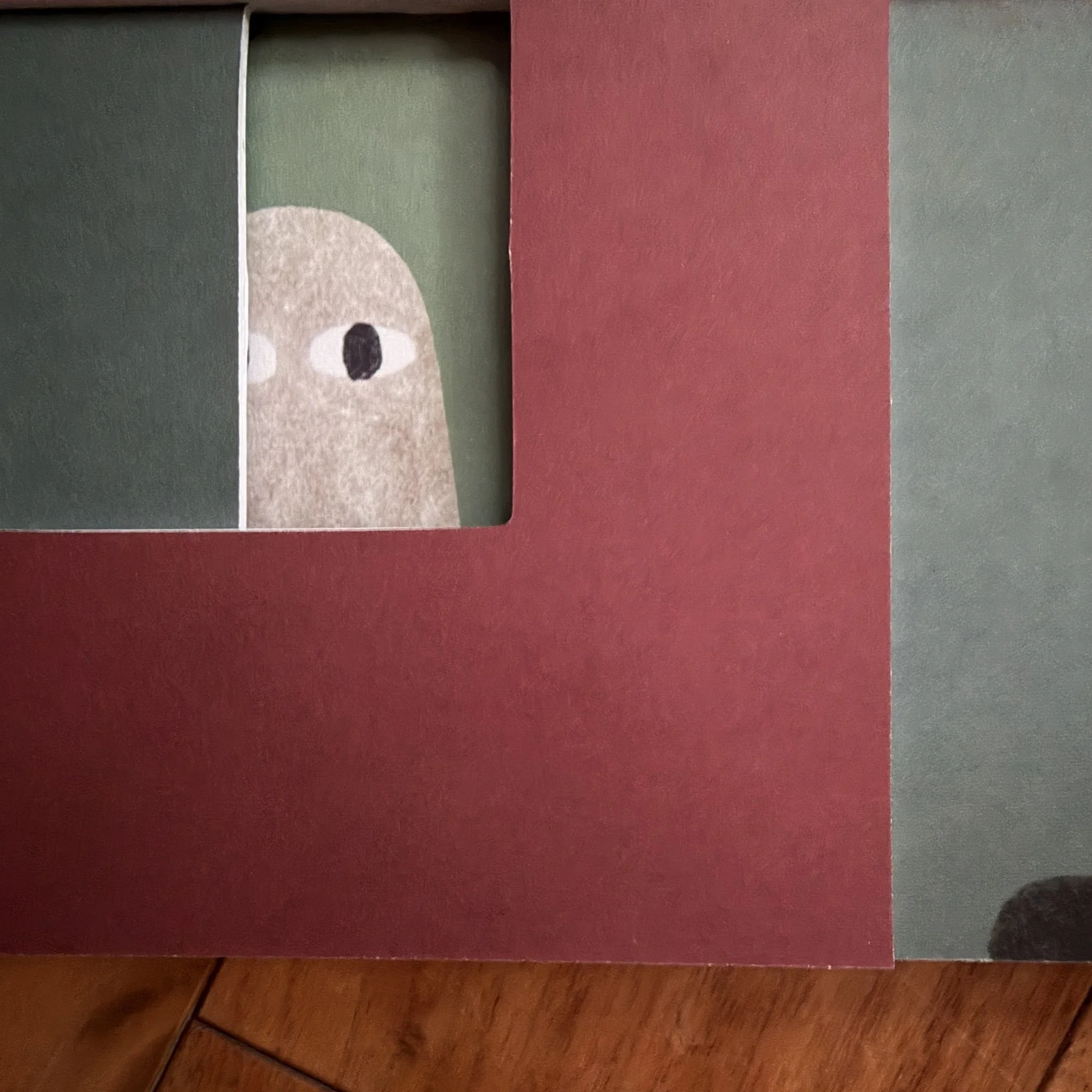
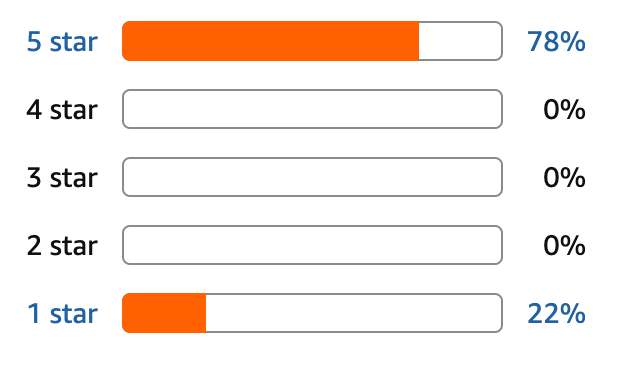
We had a nice goodbye and then I read the whole book on the thirty-second walk to the hotel. How? I am Superman! No, it’s because the book has 117 words … total. Makes ‘The Cat in the Hat’ look like a phone book! But can I tell you honestly what I thought on first read? Uhhh. I didn’t like it. LOL. That was my first take. Sounds horrible! I feel awful saying that. But I was just like, “What? What is this? What am I missing?” Turns out I missed the whole thing. I stuffed the board book in my suitcase, threw it on my shelf at home, and only a couple months later did I pick it up to go, “Ohhhhhhhhhhhhh.” There is a secret to this book. A glorious, twisting, super-obvious secret, that is somehow not-secret, and yet—well, I can’t spill it. It’s too good! How does he do it? Too good! He’s a watermill! This is now immediately one of my favorite board books of all time! And, btw, I looked at the Amazon.com ratings for the book and I’m guessing other people did what I did too? Check out the split!
But honestly: This book is exactly what we need! In an age when AI spits 10,000 words a second, what we need are more people spending a year drinking coffee in their studios, making books with 117 words in them! (As Jon says, “If someone says something and I have a picture next to it, it's just more interesting to watch if the picture is doing something else. If it's a double beat or redundant, then why are you drawing it?”!) Yes. Deep layers, hidden complexity, and emotional warbles. This is a ghost story for pre-schoolers! And, well, uh, post-schoolers! With shifting windows, subtly dimming light, and a brilliantly evocative shape (first house book ever?) that just feels so smooth and sharp in your hands. What a wondrous thing. (Jon told me he had so many back and forths with his publisher about every crack and corner of the thing.)