Neil's Monthly Book Club is my oldest and most popular email newsletter. Click here to subscribe.
Hey everyone,
I messed up.
I’m embarrassed.
I made such an obvious mistake.
After more than five years Instagram-sober on my phone I caved in and downloaded the app.
Why?
Well, I wrote a letter to Prime Minister Mark Carney that suddenly went viral and reached over 600,000 people. (Became my most viral tweet in 17 years on Twitter!)
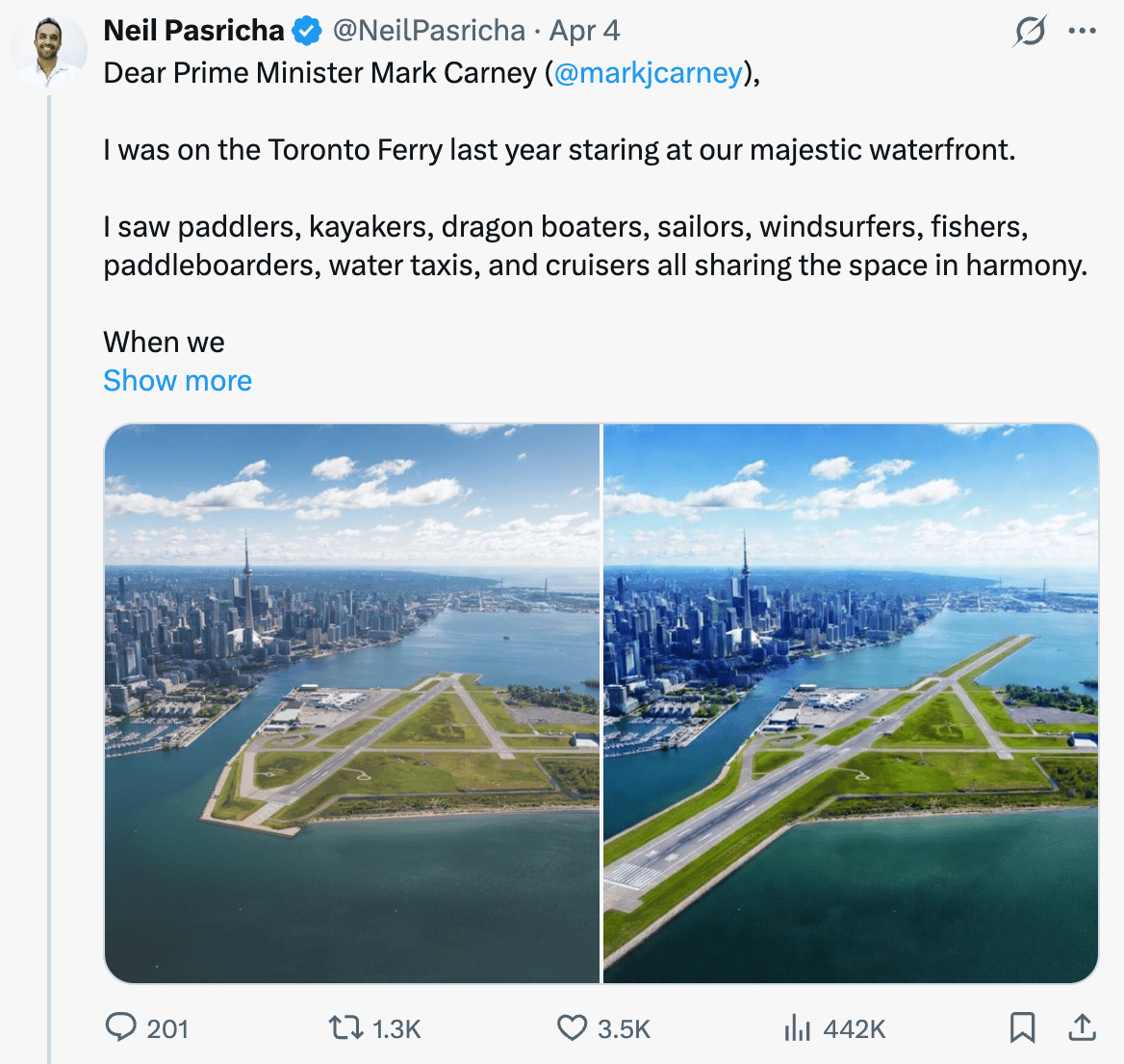
So, of course, I thought, you know, I’m on the soapbox now!
Prime Minister Mark Carney, Ontario Premier Doug Ford, Minister of Transport Steven MacKinnon are—I mean, I can literally see it—getting their channels completely flooded by my post.
I tagged them, everyone’s sharing it, and now 100s of people are asking for a Change.org petition, so of course... I gotta start posting Instagram “Stories” to drive signatures on my petition.
(Of course those wily devils at Facebook—I refuse to call it by their new company PR name—won't let me post Stories from desktop.)
So ... I downloaded it.
And I could suddenly feel my brain rotting.
(Which, no surprise, is exactly what it’s doing.)
I was suddenly in Reese Witherspoon’s kitchen, shopping in Target with Mel Robbins, and I started feeling ... excited and agitated and titillated and … dopamine-y. So much loud music! So many hot takes. And skin! So much skin. Now! Wait! I’m dancing with Oprah! We are dancing! Why are we dancing! We don’t know! Wait! We are dancing because ... we ... she ... we ... oh my gosh we did it together ... we have officially crossed ONE MILLION FOLLOWERS ... ON INSTAGRAM!!!
I felt myself slipping into total entertainment forever.
Which, you know, I know about!
But knowing and doing are two different things.
The saga cost me at least one book read.
Probably more!
Because books don’t flicker. Don’t scream. They don’t do their hair and put on tight shirts and jump up and down getting pretend speakerphone calls with good news.
Delete Instagram.
You heard me.
Delete Instagram.
Do it.
Stop thinking about it!
Do it.
Don’t worry—they won’t actually delete your account.
You make them way too much money for them to do that.
But it’s a step.
Delete Instagram from your phone.
And come hang out in the real world.
Because reminder!
Happiness is not for sale on social media.
I say when we look back on our lives together—and I’ll be right here with you, I want to do 1000 of these!—let's not reminisce about all that great scrolling we did decades ago … nor all the news stories we read in those stacks of yellowed newspapers in ours basements.
No.
When we look back let's geek out about all the books we read that are sitting on our overstuffed bookshelves.
That’s what I want to look back on.
That’s what I want us to spend time on.
Because we can’t compete with billions of dollars of research and AI specifically designed to steal our attention.
So ... let’s not.
Let’s delete Instagram.
Let’s sign the petition.
Let’s pick up a book instead.
Solidarity!
Neil
PS. If you sign the petition, please reply so I can thank you personally. Takes 30 seconds, no ads, no spam. Link goes to: http://www.change.org/billybishop (Thank you!)
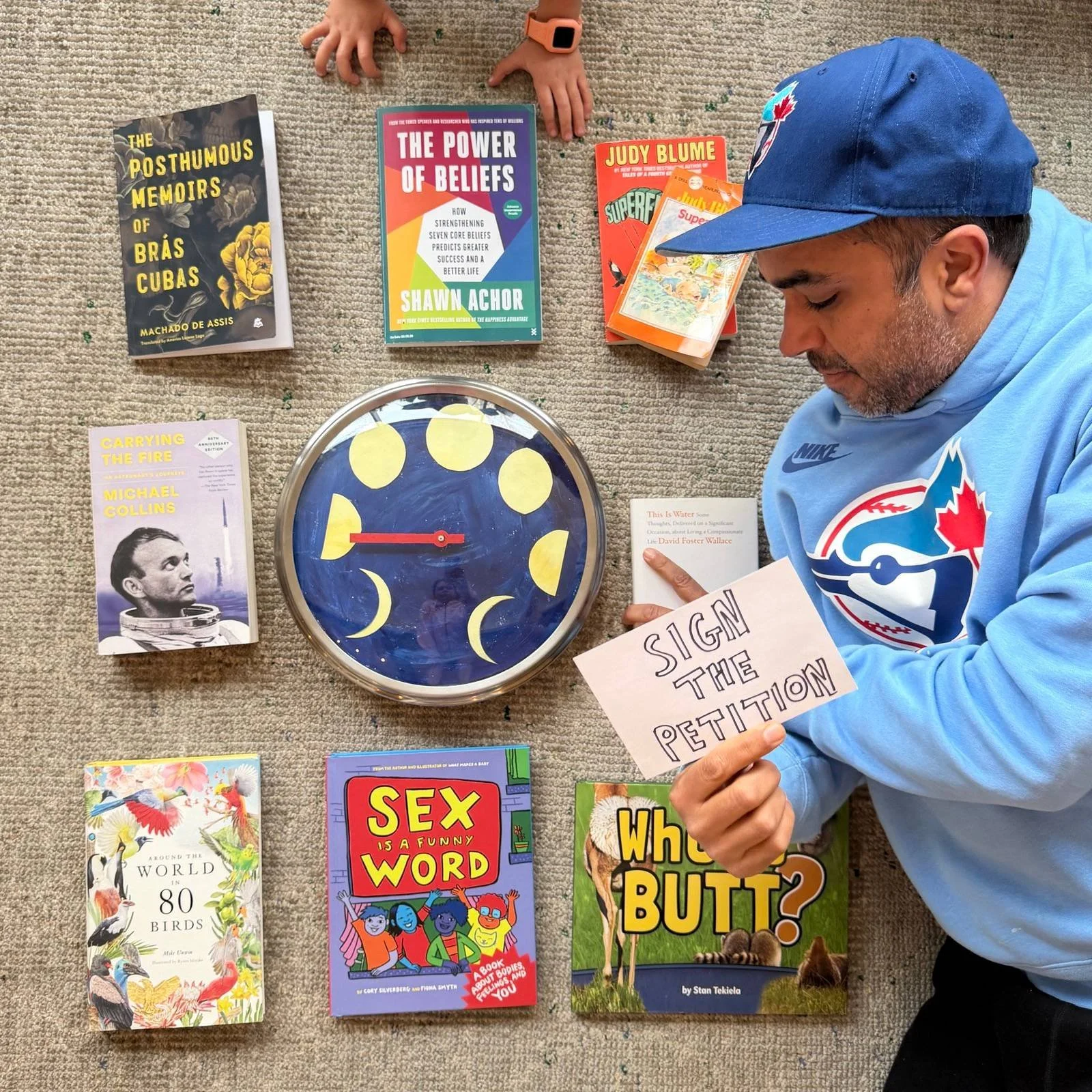
1. The Posthumous Memoirs of Brás Cubas by Machado de Assis (1839-1908). Translated by Américo Lucena Lage. So many letters on the cover of this book! What a garbled mouthful. I wonder if that visual overwhelm is why I left it languishing on my shelf for so long even after receiving it as a gift from my friend Wagner Moura. He even included a little note!
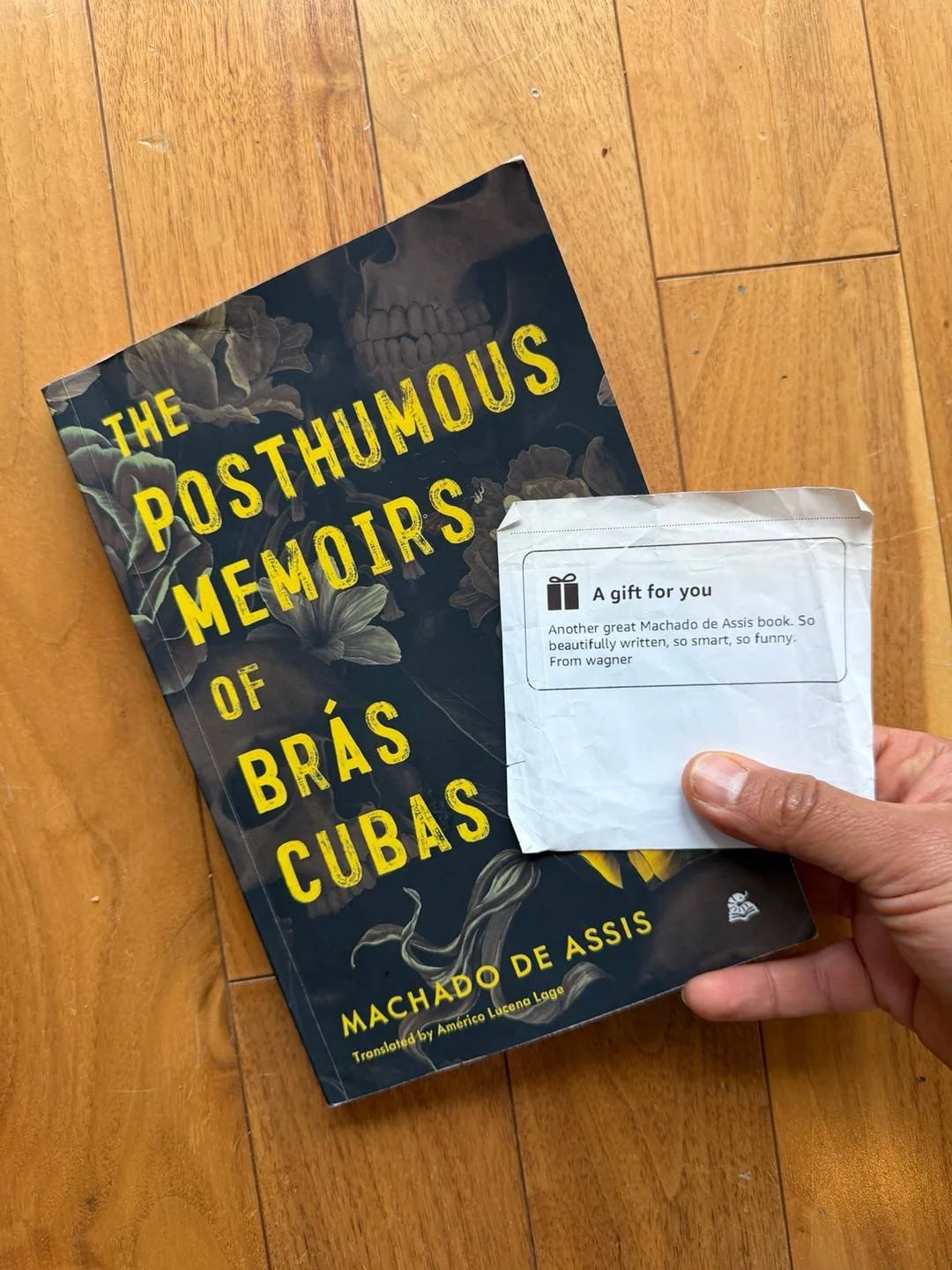
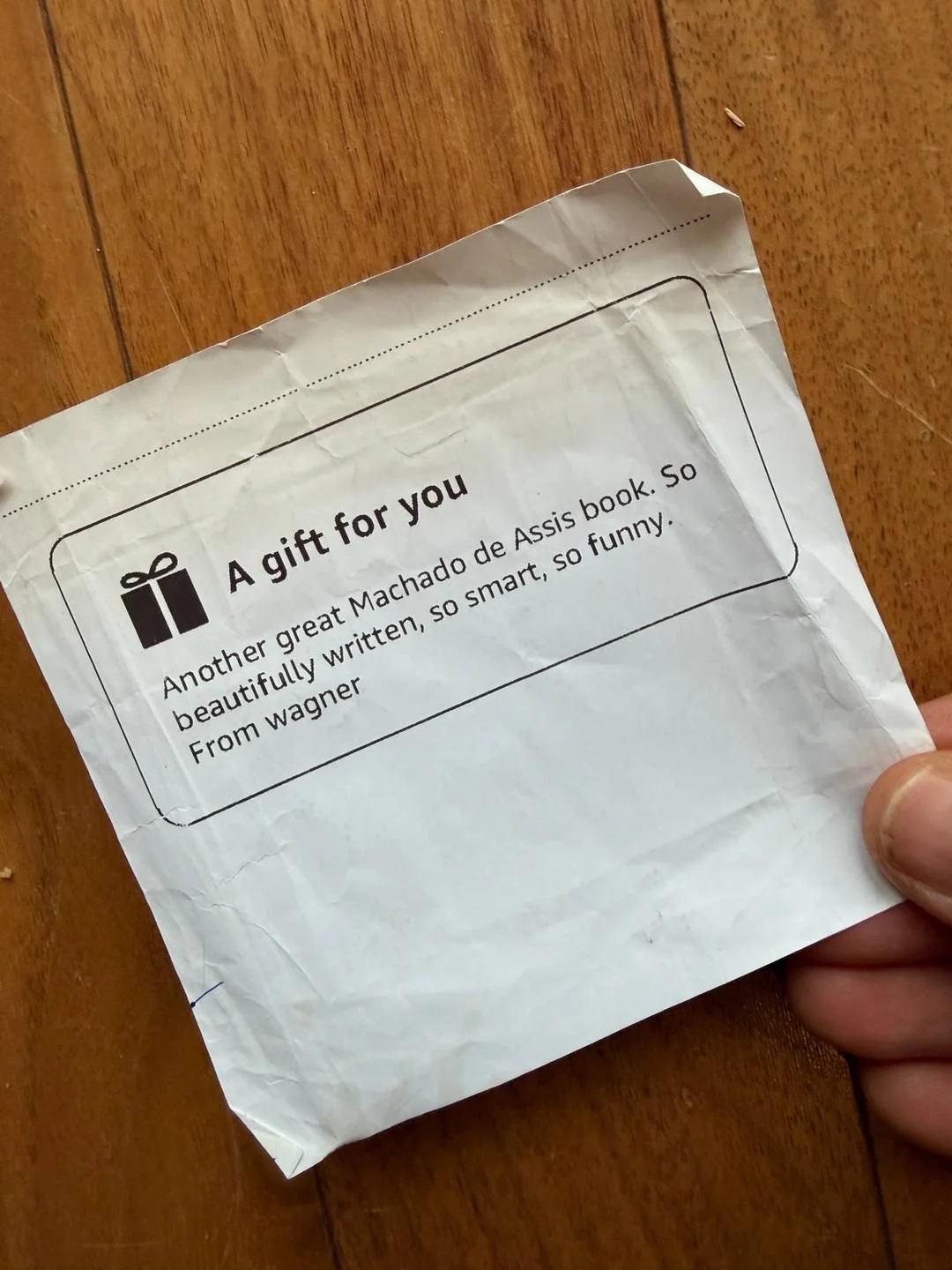
And oh my: What ... a ... book. What a book! A stunner. A gem. A knockout! BAM. This is one of those books I feel like I was waiting to read my whole life. It was written in Brazil 145 years ago (145 years ago!) and yet somehow feels like it was written by a witty avant-garde comedy writer. Seriously, I kept asking myself: who wrote this? Lena Dunham? Vladimir Nabokov? Mordecai Richler? It just has this air of a ballsy, confident, master wordsmith just toying with you—twistingly delightful puns, stunning narrative self-awareness, and a level of genre-shattering on par with ‘The Stinky Cheese Man and Other Fairly Stupid Tales’ by Jon Scieszka. OK, so: This book is a novel… written as though it’s a real memoir… that’s been written by a dead guy named Brás Cubas … just after he died of pneumonia. Um! What the hell? No, but stay with me here, because it somehow totally works. He lands this series of wild acrobatic twists on the mat without a single knee twitch. This book is 190 pages and 160 chapters ... which means the average chapter is 1.1875 pages. But that’s average! Some three pages, some one sentence! Reading this book feels like running through a dense forest at night. You’re going fast! You’re flying! But branches are slapping you in the face, tiny bugs are getting in your eyes, and your ankle twists a couple times. Are you up for this? I hope so because here comes one of the most exhilarating runs of your life. Here are the very first lines from Chapter 1 which is titled 'Death of the Author': “For a while, I debated whether to open these memoirs at the beginning or the end—that is, whether I would start with my birth or with my death. It is common practice to begin with birth, but two considerations led me to a different approach: First, I am not exactly a dead writer, but a dead man writing, for whom the grave was another cradle. Second, starting at the end might bring some elegance and freshness to the writing. Moses also recounted his own death, but only at the close of his tale—a fundamental distinction between this book at the Pentateuch.” Feel intimidating? It is, a bit, but don’t worry, he takes care of you. From Chapter 4 on (hilariously) Page 6: “…this book is written leisurely, reflecting the tranquility of a man no longer constrained by the brevity of the age, an extraordinarily philosophical, but also inconsistent work, sometimes austere, sometimes playful; something that neither edifies nor demolishes, neither inflames nor chills, but stands as more than mere pastime and less than crusade.” Yes! I mean, he describes it perfectly. There is a plot here—you can read it right here on Wikipedia—but reading this book has nothing to do with plot. It has to do with flying. In a kind of craft you’ve never flown in before. A vivid and transporting book where dreams are “cracks in the soul”, crowds are “cordially jubilant”, and where “tight boots are one of the greatest blessings on earth, for by causing pain to the feet, they give rise to the pleasure of taking them off.” Thank you to Wag for introducing me to the genius of Brazil’s most famous novelist of all time. I think I have either the fourth or fifth English translation of the book after the first one appeared in 1952 under the delightful title ‘Epitaph of a Small Winner.’ I looked into who else has read or said anything about this book and found this quote from Dave Eggers who called it “one of the wittiest, most playful, and therefore most alive and ageless books ever written.” Amen, Dave! This will be a book that most people will have never heard of but I guarantee I will not be able to shut up about it for a long time, if ever. Reading in its rawest, purest, freshest, rarest, most sparklingly alive form. An exquisite and extraordinary delight.
2. The Power of Beliefs: How Strengthening Seven Core Beliefs Predicts Greater Success And A Better Life by Shawn Achor (b. 1978). I first met Shawn Achor in Abu Dhabi years ago when we were both invited to speak to the Royal Family of the United Arab Emirates. I got there a few days early as requested—doing dress rehearsals, long dinners with the organizing team, meeting various extended family members—but Shawn was the rock star. He flew in, crushed it onstage, dropped research studies like he’d memorized all of Google Scholar, and then immediately flew out. I was like: Who was that masked man!? We became friends over the years and he was kind enough to blurb ‘The Happiness Equation’ after selling a million copies of his wonderful book ‘The Happiness Advantage.’ And then: Where did he go? Why did Shawn sort of just ... disappear? I got my answer on Page 79 of this book. Shawn shares that after his second child Zöe was born three months early—spending 50 days in the NICU!—he “made a decision to take my foot off the gas at work so I could be home with my young kids. For the next six years, I said no to all media, stopped doing international talks, and didn’t write another book until this one.” Six years!? Completely unplugging! Wow, I thought I was doing a decent job with my frantic deleting of Instagram. But this guy just … stopped posting completely. Superdad! But, you know, Shawn’s also still Shawn. Still an amiable son of an English teacher and neuroscience professor, with multiple Harvard degrees, and a witty research-centric form of writing that is precise and uniquely warm. That’s what makes his new book—out next week! order it now!—such a jaw-dropping wow. I know I will be handing out copies of this book for years because the research it presents is solid, the advice simple, and the power to alter a life astonishing. The whole thing begins with a bizarre observation Shawn made while being presented with different drug options for Zoe while she was in the incubator. He was reviewing a 2002 study where 180 patients who had suffered with severe knee osteoarthritis for years were offered a free knee surgery … but, unfortunately, only two thirds were actually going to get it. One third was going to receive a “sham surgery” where an incision would be made on their knee under anesthesia, leaving a similar scar, so the patients would have no way of knowing if they really got the surgery. (Crazy study! Who approved this!) Annnnnnnd: What happened six months later? Patients who received the “sham surgery” showed the same improvement in pain, inflammation, and mobility. The same! Even though they got nothing! What about a year later? Two years later? Same thing! Whaaaaat? Shawn tells us this is doubly fascinating because “osteoarthritis is a progressive condition that naturally gets worse over time, not better.” Then Shawn falls further down the rabbit hole and finds that the power of beliefs (see what I did there) is not only so strong … but it’s actually growing! He then tells us about a study showing that the placebo effect has actually doubled in twenty years. Doubled! Seriously. And that’s just the introduction. We’re going on a ride here. And the amount of research studies you are going to learn about is like… hundreds. Endless. It could be overwhelming if not for the tiny, sweet, digestible dosage he dispenses them with. Shawn is the gumball machine of research studies. And he tells us early that, “Beliefs are real, even when they are not true” so then … wouldn’t it make sense to know which ones can help us most and make sure we’re doing everything to grow those? It would! It does! And this book shows us how. The Seven Core Beliefs from Page 17 are:
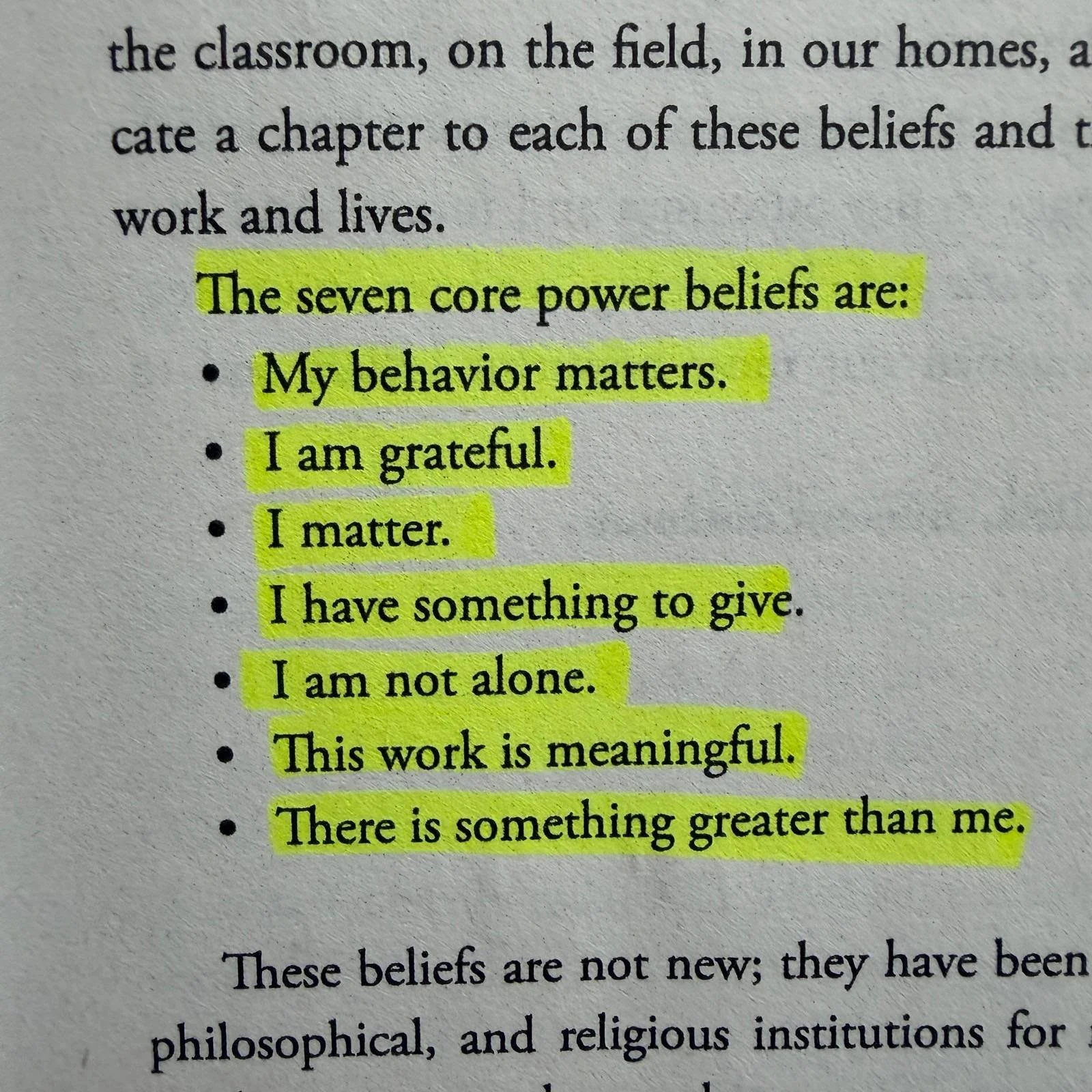
Sounds obvious maybe: My behavior matters, I am grateful, I matter, I have something to give, I am not alone, This work is meaningful, There is something greater than me. But did you know research shows “strengthening these core beliefs can help double the rate of promotion, potentially extend life more than 7.5 years, increase the likelihood of surviving cancer, and improve test scores by almost 25 percent.” This book isn’t just a listicle and piles of facts, though. Each belief is explained and supported through research, generous personal stories, and teaching which makes it a kind of textbook, too. Shawn is a natural professor. On Page 37, he tells us that “If, as a parent of a child starting a new school, you tell your kid ‘You’re going to love it here!’ you’ve just provided a meager meal for the brain. Much better would be: ‘You’re going to love it here because you started at a new school three years ago and ended up loving it [warrant]. And you are great at making friends like you did on your soccer team [specific warrant]. So, if you work hard and are kind [qualifiers], I believe you’re going to love it here, too.” Helpful, right? Doesn’t mean it’s easy! Shawn gets vulnerable and expresses a lot of ways in which he’s failed and how he’s learning to grow. Then, the last third of the book gives specific ways on how we can grow these beliefs. There are things he calls “The Disaster Elevator” or “The Memory DeLorean” where he gets into detail on how his family shares a ‘favorite family picture’ for Wednesday night viewing ceremonies. I took three pages of notes. So many highlights, so many dog ears, I’m going to have to paste quotes to My Favorite Pages soon. (Here’s a list of Favorite Pages I’ve made so far.) I think the six years Shawn took “off” were clearly more productive than most people’s six years on. Out of the cave, he's blinking into the light and giving us a book so desperately needed today. For you, for your spouse, for your kids, for your CEO, for your team, this is a book everyone will gain tremendous value in reading. Like I said earlier, the book comes out next week and you can get on Amazon, Barnes & Noble, Indigo, Audible, Libro.fm, or Walmart.
3. Superfudge by Judy Blume (b.1938). On the heels of my successful read-a-loud with my seven-and five-year-olds with ‘Tales of A Fourth Grade Nothing’ (02/26), published in 1972, we thought we’d move on to Blume’s 1980 sequel ‘Superfudge’. I had somehow never read it despite reading the original many times! And now ... I see why. Sorry, Judy. I still love you. The voice and tone and pace is still there. But that’s it! This book feels like trying to dive into the pool but accidentally landing a bellyflop. The chapters are much longer, the plot less zig-zaggy, Fudge feels relatively demure (his best lines are squawked by the Myna Bird he gets), and there are—sacrilege!—no pictures. We even had two versions. No pictures in either! The Hatcher family leaves New York City for Princeton and we lose Sheila, we lose Jimmy Fargo, we lose the threat of getting mugged in Central Park. The plot goes almost nowhere—Mr. Hatcher fails to write a novel, the boys sell chopped up worms to a neighbor, and Fudge insults his Kindergarten teacher and scares everyone by riding his bike far away. Skip this and move on to ‘Blubber’.
4. Carrying The Fire: An Astronaut’s Journey by Michael Collins (1930-2021). Did you get into the first trip we made around the moon in 50 years this month? Did you stare at the stunning photos from NASA? See Prime Minister Carney question the astronauts about maple syrup over Nutella? Or watch Artemis II sploosh back into the ocean? Phenomenal, right? We watched it on the CBC here in Canada and there was live extended interview with Colonel Chris Hadfield, who was the Canadian who commanded the International Space Station from December 19, 2012 to May 13, 2013, and who told me back in 2018 that ‘Carrying The Fire’ by Michael Collins (01/22) was one of his three most formative books (his other two were ‘The Mysterious Island’ by Jules Verne and ‘Factfulness’ by Hans Rosling). I picked up the book again this month and revisited my notes and highlights. Powerful read! I mean, say you were one of three people selected to blast off on Apollo 11, the first ever mission to land on the moon, but then just before you go they bring the three of you into a room and sit you down. “Neil, Buzz, you two will go down to the moon, walk around, plant a flag, give a speech to the world, and talk to the President. Michael? Uh, yeah, well, we need someone to stay on the ship. Sorry!” Michael takes the bummer in stride and seemingly absorbs every aspect of the experience and channels it into this poetic first-person account. Part of the beauty is that fifty years ago astronauts were much less … specialized? Collins is a wide-ranging thinker who writes in a wise, literary style. The book came out in 1974 and is still in print today and part of what’s magical here are the seemingly endless forwards and prefaces. Get this: Charles Lindbergh, who lived from 1902 to 1974, and who flew the first ever solo transatlantic flight in 1927 on the Spirit of St. Louis—a harrowing 33-hour hour trip from New York to Paris!—writes a breathtaking introduction that captures the human spirit towards flight. He reminds us that, “We find the speed of light and the vastness of space to be incompatible with biological time” and takes us into his story where “I had been without sleep for more than two days and two nights, and my awareness seemed to be abandoning my body to expand on stellar scales. There were moments when I seemed so disconnected from the world, my plane, my mind and heartbeat that they were completely unessential to my new existence.” Lindbergh died the year this book came out so in addition to this being very likely the last published piece of writing he put out, it also doubles as a kind of baton—from our attempted voyages into the air in the 1800s to the trips farther than we’ve ever gone before this month. A wonderful book that deserves a spot on your shelf. (Speaking of baton-passing, if you want to explore that a bit, you can watch my TED Listen from a few years back which has this idea of “What is your baton?” as a central theme. Admittedly, it takes a while to get there as the many critical comments on YouTube will tell you! LOL.)
5. My moon clock. I have a moon clock! It really works! Like, the hand actually moves around the clock ... once per moon. (How else am I going to know when to publish my podcast? LOL). I put the clock in this book club to remind me of the time I lost this month scrolling on Instagram. Dumb! But I do lots of dumb things. Like ten years ago I was in a local park and (I can’t believe I did this) I asked a dad I had literally just met five minutes ago—who was pushing his tiny daughter on the swing while rocking two infant twin sons in a stroller—where their mom was. “She’s dead,” he said, without a pause. “I'm ... sorry?”. “Yeah,” this stranger continued, tears welling up in his dark eyes. “She just died of cancer.” I... I mean ... talk about learning your lesson? We fell into a deep chat, deep connection, and so began my long love with the absolutely singular Alex Morley. Alex is a local Kindergarten teacher—so rare in men!—who is solo-parenting his 13-year old daughter Pia and his suddenly-10-year-old twin sons Sammy and Teo. Our families really love each other and now the Morleys have started a family business! I am very proud to tell you I own the tenth Morley Moon Clock ever made and Leslie and I have it proudly displayed on our family room bookshelf between photo albums and a red ceramic calavera we bought in Mexico City. (Which also gives us a tinge of Alex’s partner Kari's spirit who I never met but feel somewhere in these clocks.) As you guys know I never “sell stuff” in these book clubs. Maybe I’ll take on a sponsor one day! Maybe some cool company will offer to build me a Toronto podcast studio for the podcast (#visionboard). But, so far, 113 months in a row now I’ve kept this space ad free. So ... this is not an ad. Alex would never ever ask me to write this. But I’m sharing my Morley Moon Clock with you because I love it. Check out how beautiful they are:

And I honestly feel—like the Rock Clock I keep on my dresser—it just grounds me, centers me, and helps me eschew the oppression of Gregorian time. You can get your own Morley Moon Clock on their website or (argh) @morleymoonclocks on Mark Zuckerberg’s brainvice.
6. This Is Water: Some Thoughts, Delivered on a Significant Occasion, About Living a Compassionate Life by David Foster Wallace (1962-2008). I was sitting in an extremely cramped hotel room in The Drake Hotel in downtown Toronto (popular in Toronto before Drake got popular, btw!) with Mark Manson, who was kind enough to let me stumble in with my wires and the heaviest pile of 3 formative books of any guest I’d had on my show. (Mark’s 3 most formative books are ‘Atlas Shrugged’ by Ayn Rand, ‘A Brief History of Everything’ by Ken Wilber, and, yes, ‘Infinite Jest’ by David Foster Wallace.) In the middle of the interview I stupidly handed him a page of DFW quotes and the conversation basically stopped. There is dead air in the show. It was like catnip for him! He said, “Giving me David Foster Wallace quotes is like giving a dog treats.” There were some classic quotes on there like “You’ll stop worrying what others think about you when you realize how seldom they do” and “I do things like get in a taxi and say, 'The library, and step on it.’” DFW had such a unique turn of phrase and his one and only commencement speech, delivered to the 2005 graduating class of Kenyon College, resonates deeply. I think of it as some kind of Great Uncle to George Saunders’ famous 2013 Commencement speech on kindness. From Page 89: “But most days, if you’re aware enough to give yourself a choice, you can choose to look differently at this fat, dead-eyed, over-made-up lady who just screamed at her kid in the checkout line—maybe she’s not usually like this; maybe she’s been up three straight nights holding the hand of her husband, who’s dying of bone cancer, and maybe this very lady is the low-wage clerk at the motor vehicles department who just yesterday helped your spouse resolve a nightmarish red-tape problem through some small act of bureaucratic kindness.” In an increasingly robotic world where platforms and algorithms are pulling us apart, echo chambers splinter our realities, and loneliness is reaching record highs, this twisting, vivid, and airy 137-page speech offers the power to increase empathy, love, and connection. It’s easy to read this speech transcript online or watch it on YouTube but the book really is better. (The man loved books even if he knew reading felt hard!) It’s thoughtful, well-spaced, and serves as an endless physical reminder on how to live a compassionate life. Rest in peace, Dave.
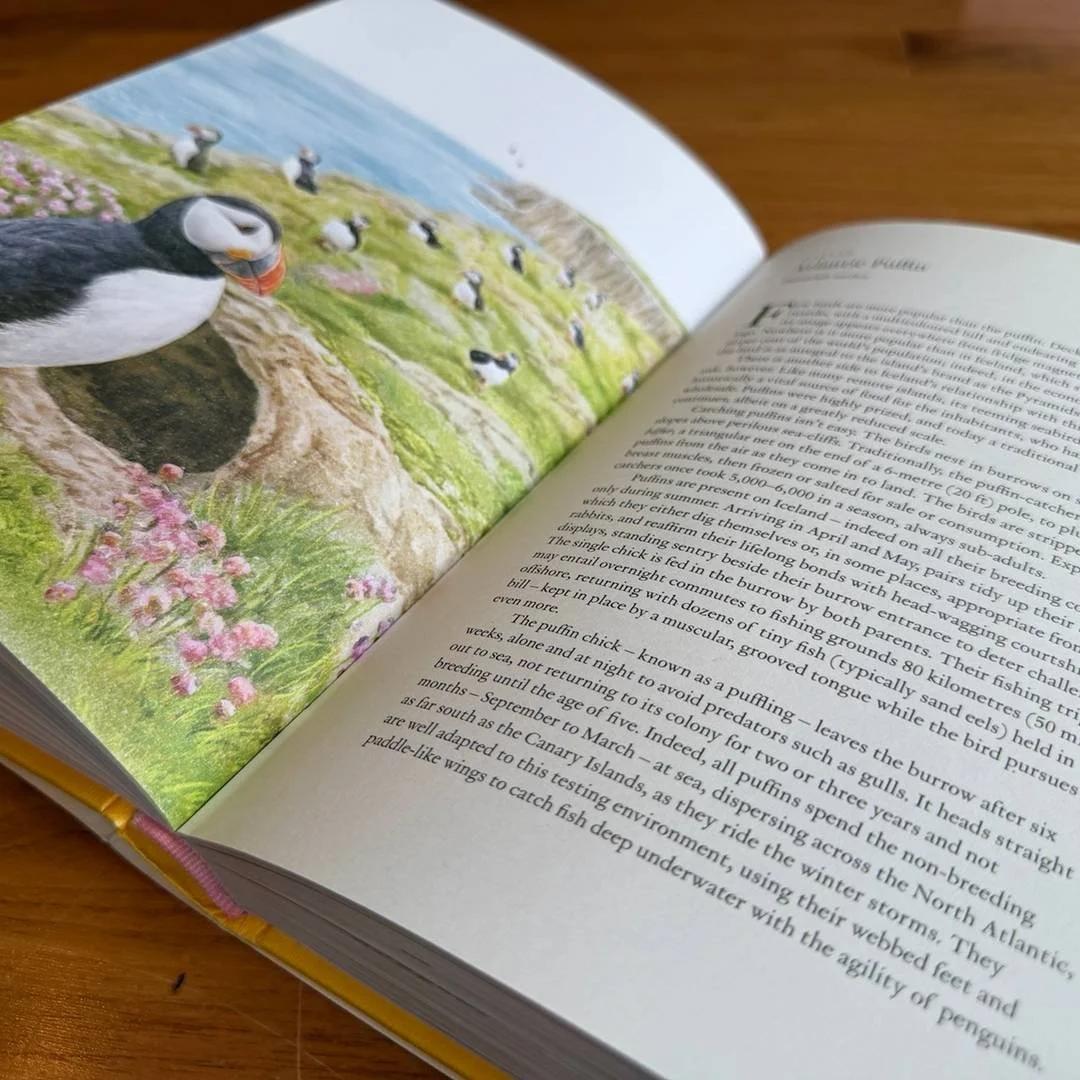
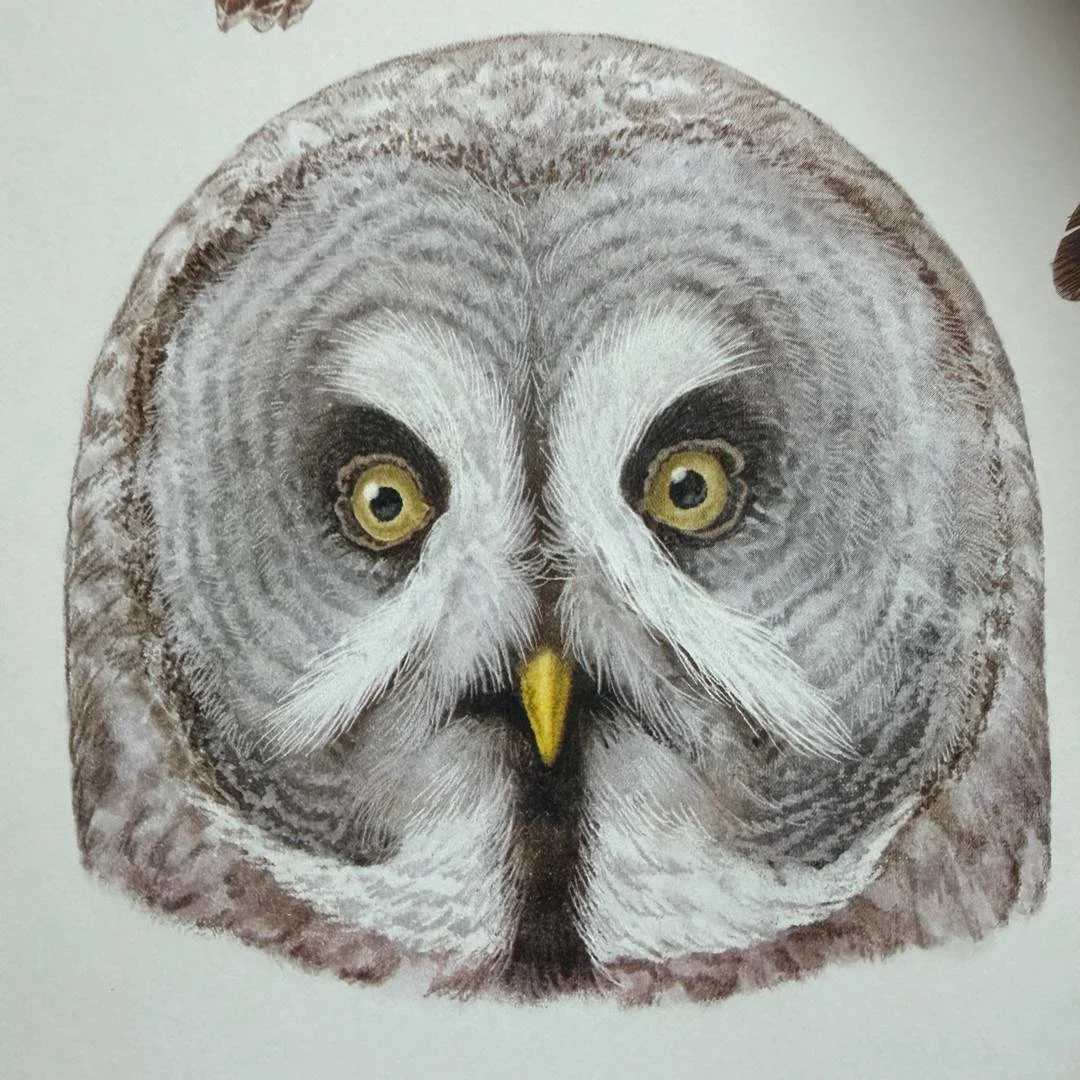
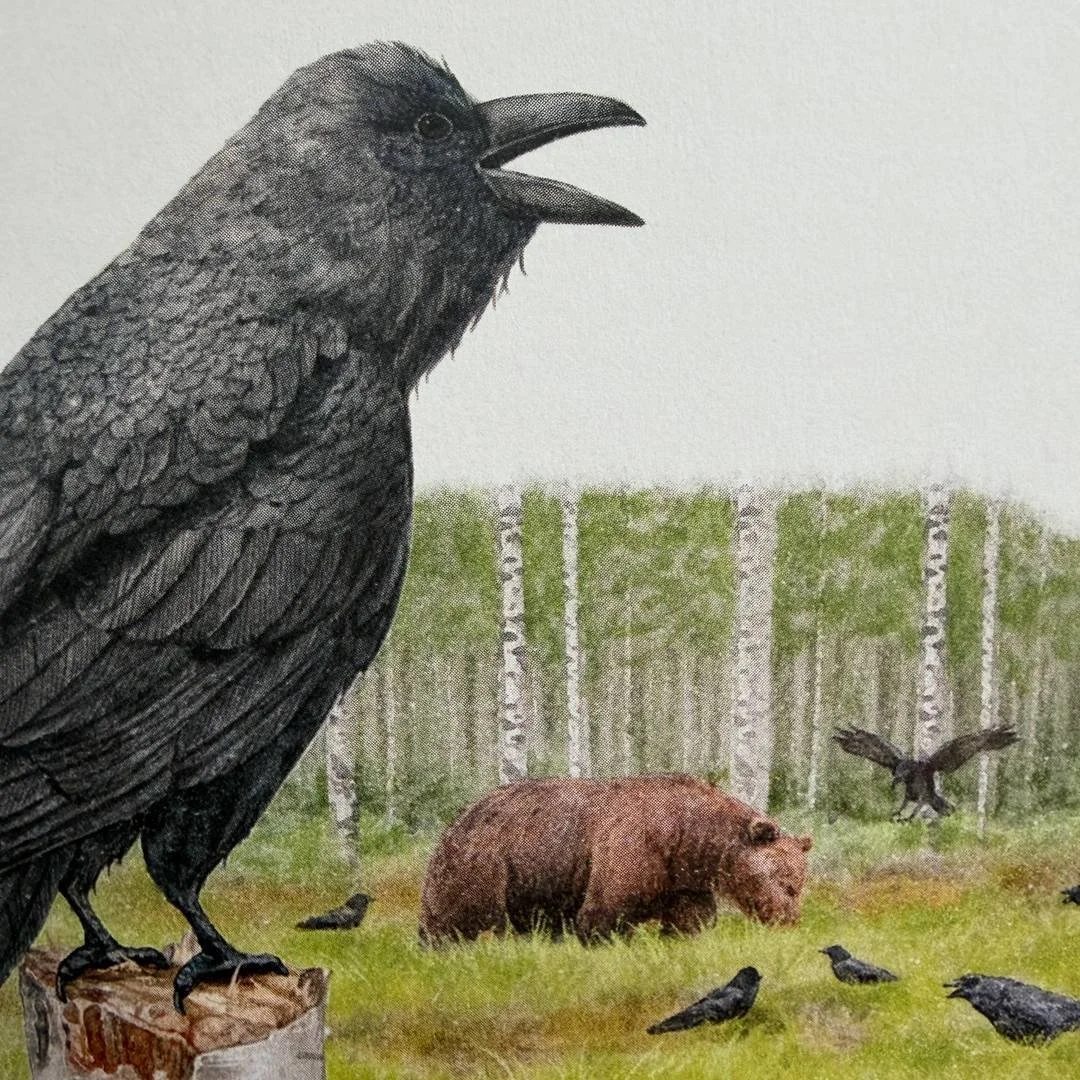
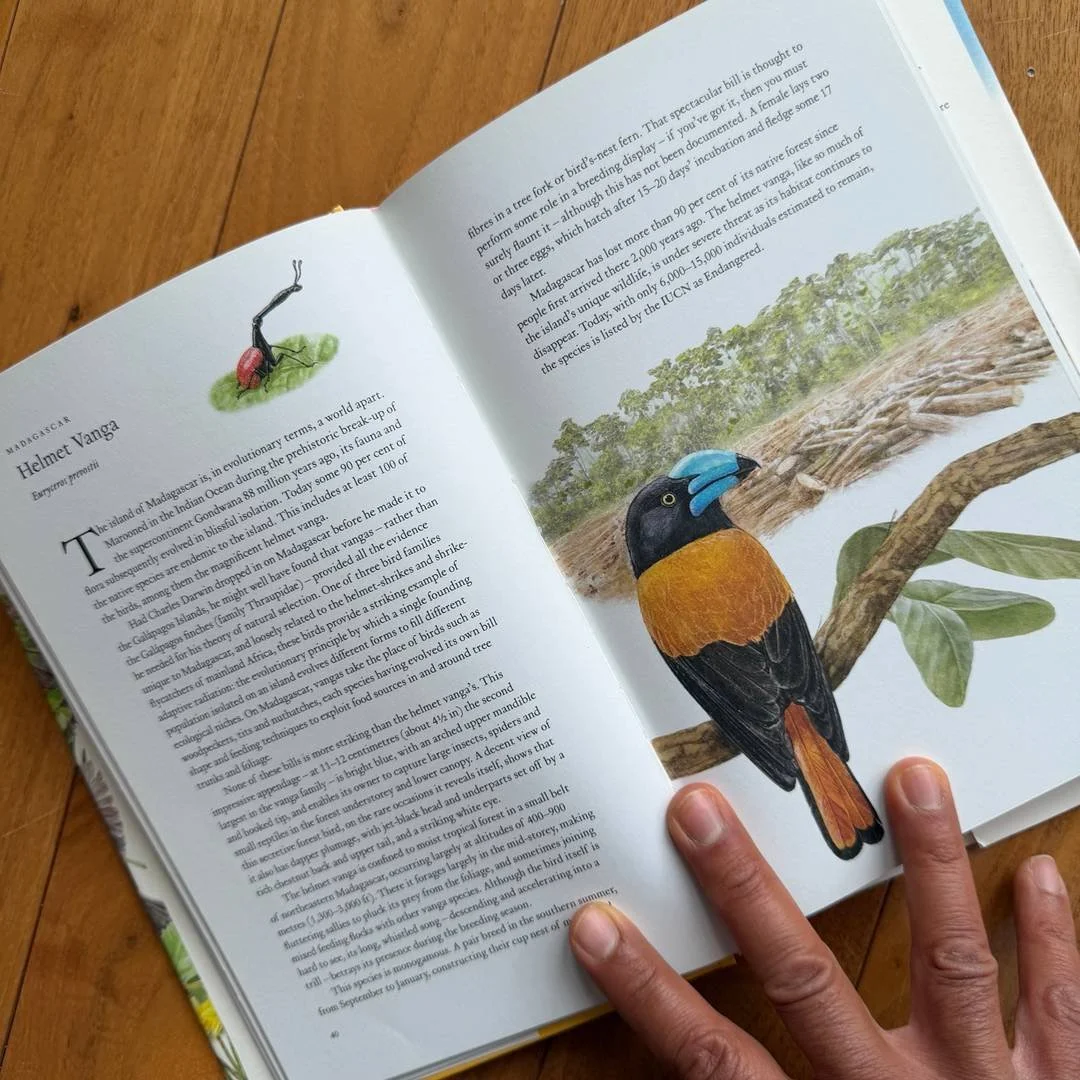
7. Around The World In 80 Birds by Mike Unwin (b.1965). Illustrated by Ryuto Miyake. I miss Donna. She was Leslie’s grandmother and felt like mine, too. She died on January 31, 2023 and I wrote about her soon after. The last gift she gave me on Christmas 2022, was this wondrous, evocative, endlessly informative book, which I love pulling out this time of the year! It’s the migration, everybody. Get your birding on! The book is organized thoughtfully by Continent and it’s clear that great thought went into trimming the over 11,000 species of birds on Earth into these 80 gems. The tone is warm, welcome, and knowledgeable. Erudite yet unpretentious! On Page 162 introducing the Red Junglefowl of Thailand: “The domestic chicken is, by a distance, the world’s most numerous bird. In 2018 the total population stood at an estimated 23.7 billion — that’s three chickens for every human. You could argue, in Darwinian terms, that this represents an evolutionary victory for Gallus gallus, the species to which it belongs. But given that this victory has been engineered by humankind, and most of the birds population languishes in abject confinement, it is surely something of a Pyrrhic one.” (Pyrrhic? Good word!) And just check out the illustrations that go along with the write-ups:
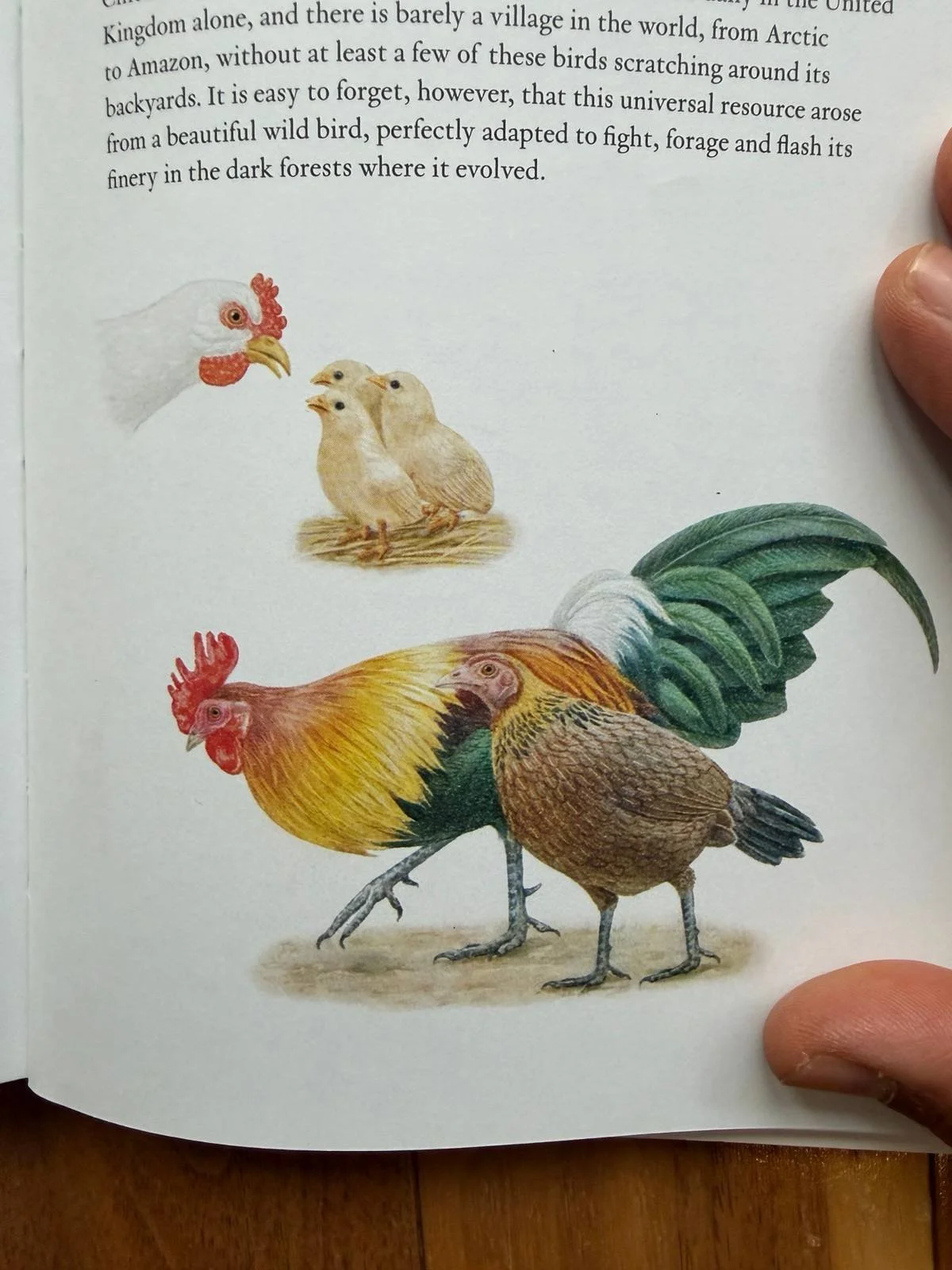
Tokyo-based illustrator Ryuto Miyake uses “acrylic gouache applied with a thin brush on stretched-out watercolour paper”—the kind of thing that AI will gobble up and spit out but, you know, there is quick beauty, and there is mastery, and this is decidedly the latter. You can stare into these images endlessly, making for the world’s greatest coffee table book!