Neil's Monthly Book Club is my oldest and most popular email newsletter. Click here to subscribe.
Hey everyone,
How was your February?
We fell into a wonderful Winter Olympics flow, culminating in back-to-back heartbreakers in the hockey gold medal games. Congrats to the US on winning two of the best games I’ve ever seen. I was reminded many times why bronze medalists are happier than silvers. (Derek Sivers has a great post on this, too.)
Hockey is newly fun for me to watch this year because we’ve suddenly become a hockey family. My oldest son started playing two years ago, my third son started last year, and I’m not getting any younger so I just signed up, too!
The first day in my “Over 45” league I discovered the average age was in the mid-sixties and the two Santa-bearded defensemen on my team were 73 and 79 years old, respectively.
Of course, they were phenomenal and (no surprise) I am by far the worst player in the entire league.
But I love it.
The speed, the sounds, the smell of the arena, the wind on my face. I’m awful! But I’m learning. Our learning rates are the steepest when we know the least.
So that's my tip this month: Take up something you’re horrible at! Just be awful and enjoy the feeling of learning ... bit by bit.
Over on the podcast feed (Apple / Spotify / YT) we’ve got chats with comedian Pete Holmes and environmentalist Paul Hawken and on the exact minute of the Worm Moon (coming March 3rd at 6:37am!) our next chapter will drop with happiness grandmaster Sonja Lyubomirsky.
Happy reading everybody—now let’s get to the books!
Neil
P.S. Invite others to join us right here. All my stuff online is 100% handwritten from me to you—no ads, no AI—since 2008.
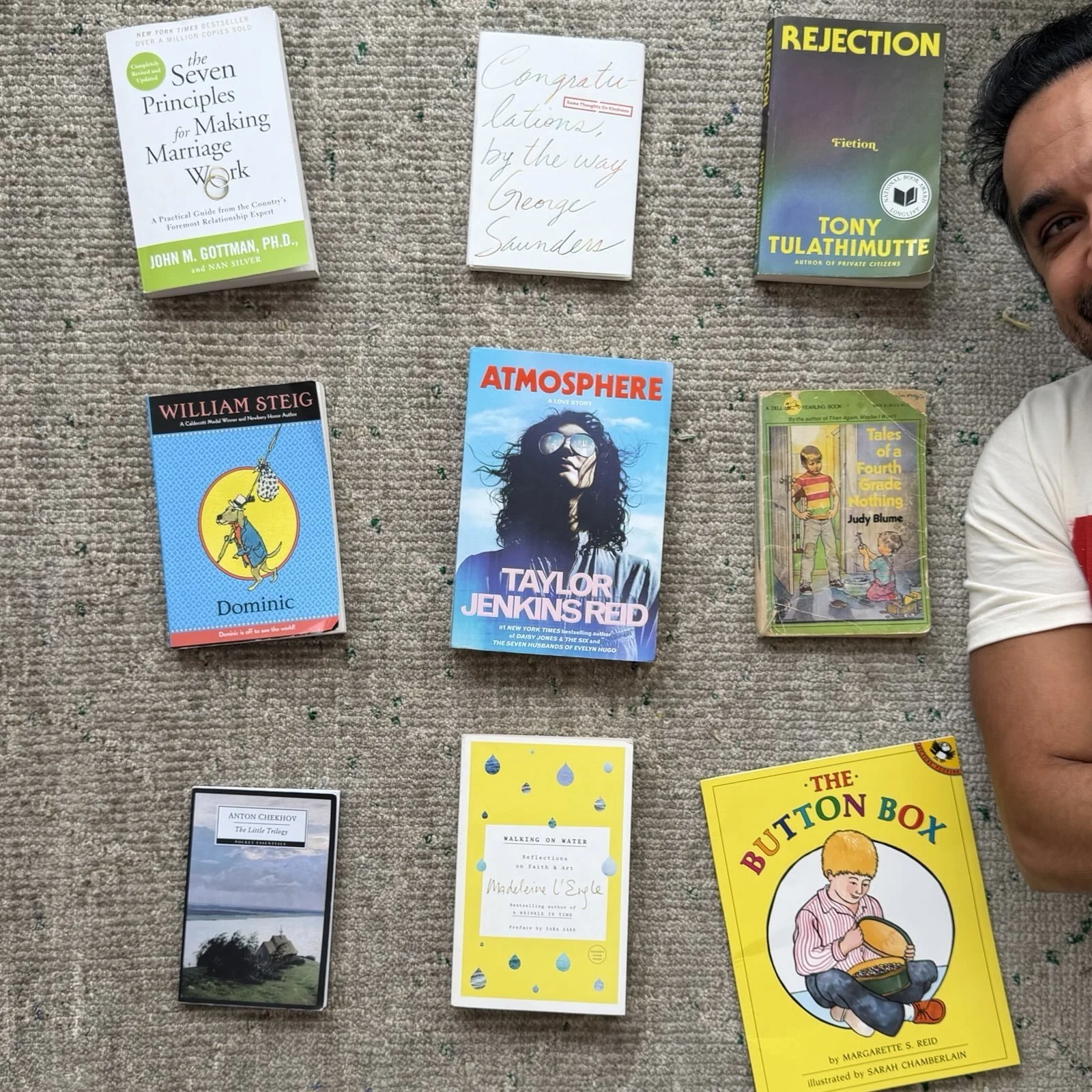
1. The Seven Principles for Making Marriage Work: A Practical Guide from the Country’s Foremost Relationship Expert by John M. Gottman (b.1942). I was walking on empty sidewalks around my neighborhood in the early pandemic, listening to episode #409 of The Tim Ferriss Show when a quote from Brené Brown hit me: “Marriage is the hardest thing I’ve ever done, hands down. Hardest thing I’ve ever done. You all hear me out there? Hardest thing.” I remember thinking, really? For Brené Brown? Maybe it struck me because I’d only been married a few years, maybe because it was my second marriage, maybe because Leslie was and is fairly Brené Browny herself (I mean, she had Brené’s parenting manifesto up in our house before we had kids). I thought about that quote a lot while reading this incredible book. Marriage is work! Beautiful, hard, glorious work. And here is the workbook. The book is based on the famous Gottman Institute, the 1996-founded “marriage research lab” Gottman founded with his third wife Julie—who he’s now been with for 39 years. The first of seven principles is to “Enhance Your Love Maps,” which is an ad copywriter’s way of saying “Get To Know Each Other Better”. Easy, right? Mayyybe. What makes the book special are its endless quizzes and questionnaires. Shall we do one right now to get a feel? It’ll take 30 seconds! Come on, let’s try. Your relationship will thank you. Here is the “Love Maps Questionnaire” from page 56. Just keep mental track of how many “Trues” (Ts) you score out of 20 here:
1. I can name my partner’s best friends. T F
2. I can tell you what stresses my partner is currently facing. T F
3. I know the names of some of the people who have been irritating my partner lately. T F
4. I can tell you some of my partner’s life dreams. T F
5. I am very familiar with my partner’s religious beliefs and ideas. T F
6. I can tell you about my partner’s basic philosophy of life. T F
7. I can list the relatives my partner likes the least. T F
8. I know my partner’s favorite music. T F
9. I can list my partner’s three favorite movies. T F
10. My spouse is familiar with my current stresses. T F
11. I know the three most special times in my partner’s life. T F
12. I can tell you the most stressful thing that happened to my partner as a child. T F
13. I can list my partner’s major aspirations and hopes in life. T F
14. I know my partner’s major current worries. T F
15. My spouse knows who my friends are. T F
16. I know what my partner would want to do if he or she suddenly won the lottery. T F
17. I can tell you in detail my first impressions of my partner. T F
18. Periodically I ask my partner about his or her world right now. T F
19. I feel that my partner knows me pretty well. T F
20. My spouse is familiar with my hopes and aspirations. T F
Okay! You’re done. If you scored 10 or more Ts, this is an “area of strength,” if 9 or below, then you “could stand some improvement.” That gentle tone pervades the book, and that’s part of what’s special. No judgment here, no scorn. Just some friendly researchers laying out what they’ve learned. In Principle 2: “Nurture Your Fondness and Admiration,” we are given the exercise to pick 5 compliments from a lengthy list that includes: “Those pastries were delicious,” “You smell so good,” and “Thanks for taking a bath with me.” It goes on and on through Principle 3 (“Turn Toward Each Other Instead of Away”), Principle 4 (“Let Your Partner Influence You”), Principle 5 (“Solve Your Solvable Problems”), Principle 6 (“Overcome Gridlock”), and Principle 7 (“Create Shared Meaning”). I love this book! I will flip it open and pull out a random exercise or questionnaire many, many times. To me, it’s a vital resource for any long-term relationship.
2. Congratulations, by the way: Some Thoughts On Kindness by George Saunders (b. 1958). If you have a daughter, grandson, sister, or nephew graduating this year, I recommend you get them this book. Most people have probably heard of Saunders as he’s been everywhere lately—Colbert! Ezra Klein! The Atlantic!—in support of his new novel ‘Vigil’, which just debuted at #1 on the New York Times bestseller list:
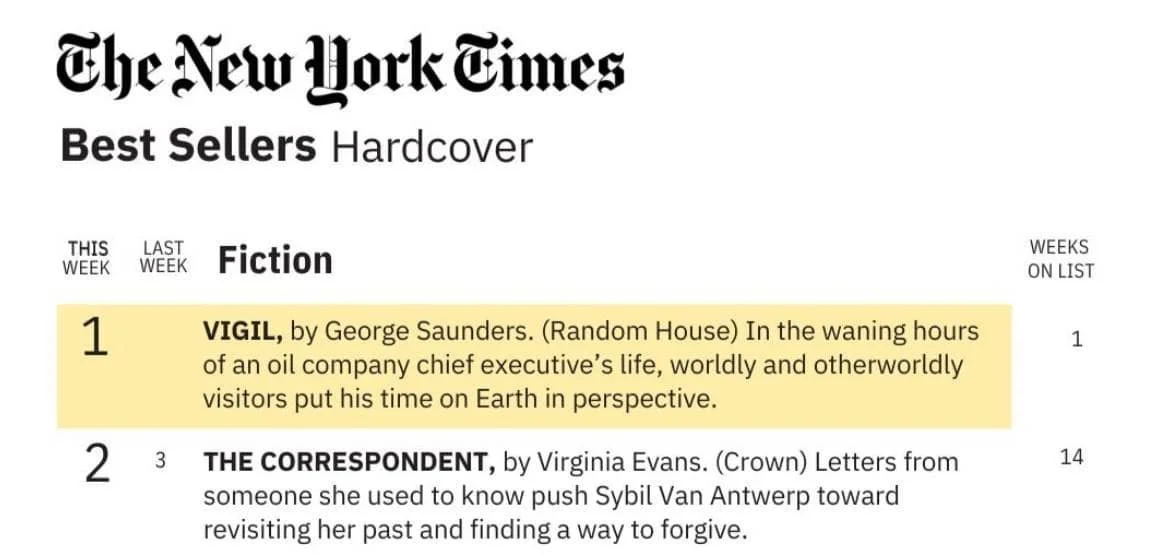
Plus, they just announced Tom Hanks is going to play Abe Lincoln in the movie adaptation of ‘Lincoln in the Bardo’ (04/18) and suddenly it’s Saunders, Saunders, everywhere. Now, I of course got my pre-ordered copy of ‘Vigil’ but am still in its early intoxicating mental whirligig. So I stepped away for 15 minutes to reread this pithy yet big-picture 2013 Syracuse commencement speech by the man the NYT recently dubbed a “secular saint.” Saunders gave this speech when he was 54, before he was as openly Buddhist as he is now at 67. (When he sat down with us on 3 Books in 2021, he seemed more Buddhist-leaning but now—full throttle Buddhist! Assuming Buddhists go full throttle.) In this speech, he exalts us to do what we, and graduates in general, plan to do in our lives—you know, “travel, get rich, get famous, innovate, lead, fall in love, make and lose fortunes”, and on and on. But then, as we do, to the extent we can, he says to “err in the direction of kindness”. Why? Because, no biggie, nothing else matters. This framing helps bring out our most “loving, generous, and unafraid” selves—we see that life is finite, how unimportant we are to the universe, and how we are all connected … all the same … all one … all love. He quotes the great Syracuse poet Hayden Carruth who said, near the end of his life, that “he was mostly Love, now” and this also seems to be what’s happening to Georgie. I love his 2025 New York Times Op-Ed piece about the Trump Administration’s firing of the Librarian of Congress, his wonderful Substack “Story Club”, his great interviews (like this recent one in The Guardian), and reading his brain-twisting short story collections like ‘Pastoralia' (01/21), ‘Tenth of December’ (03/21), and ‘Liberation Day’ (11/22). And, yes, of course, revisiting this commencement speech. The book makes a great gift but you can also watch it here or read the full transcript here, too.
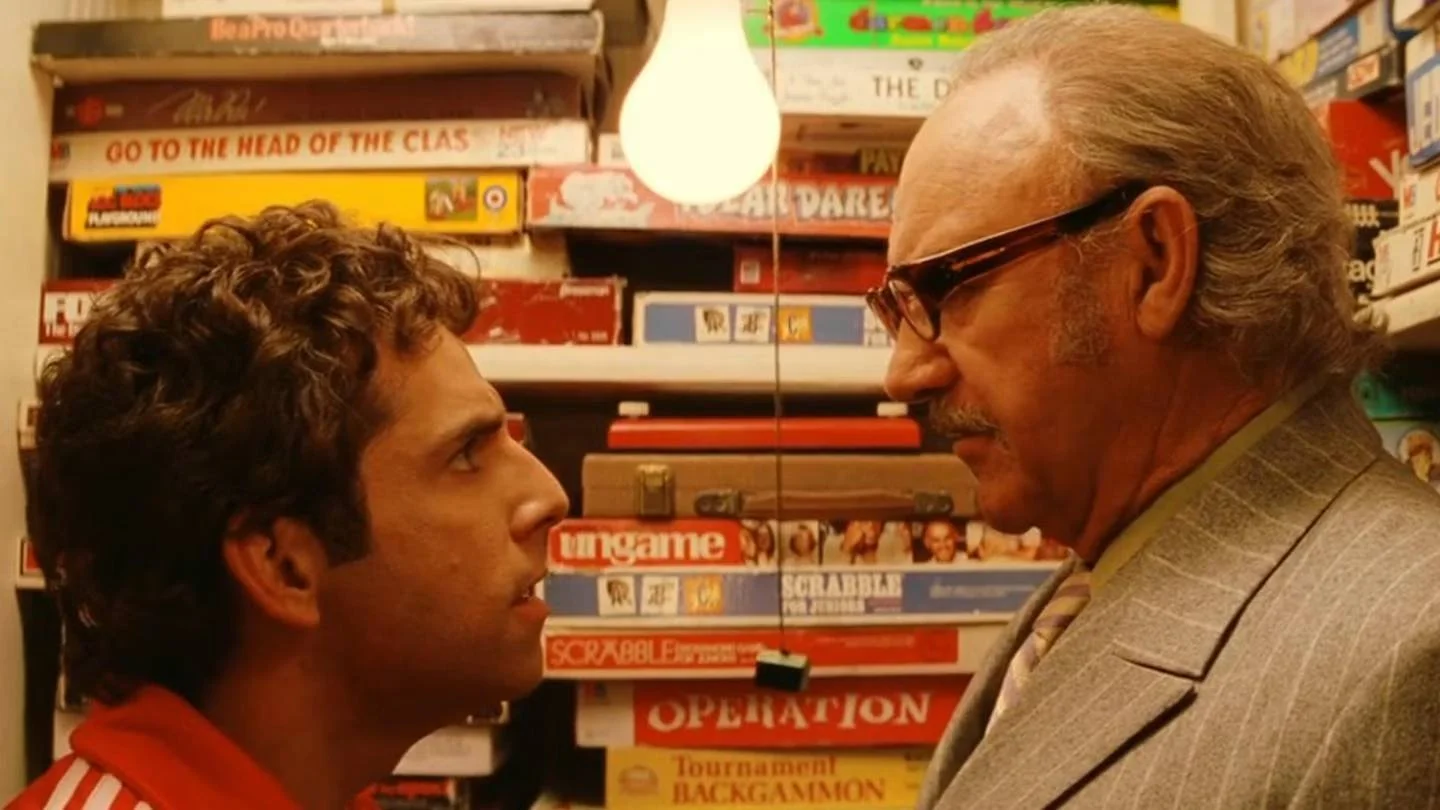
3. Rejection by Tony Tulathimutte (b.1983). Tony Tulathimutte (“TOO-lah-tim-OO-tee”) has the loudest new voice I’ve read in fiction since ‘Cherry’ (10/18) by Nico Walker. Brutal, hilarious, sinister, stomach-churning. But no violence! No blood! Plenty of other bodily fluids, though. This book had me tighten up more than when I was in my 20s and read ‘American Psycho’ by Bret Easton Ellis or ‘A Clockwork Orange’ by Anthony Burgess. But no matter which way the seven slightly-tangential short stories that fill up this 258-page masterpiece swerved, one thing was clear: I could not stop flipping. It’s like glue. A magnet! Simultaneously realistic, urgent, depraved, illuminative. A Black Mirrory book channeling contemporary millennial and Gen Z sexual anxiety into realistic-till-they’re-not worlds that call to mind other jussssst-slightly-ajar fantasy worlds like something created by, say, Wes Anderson:
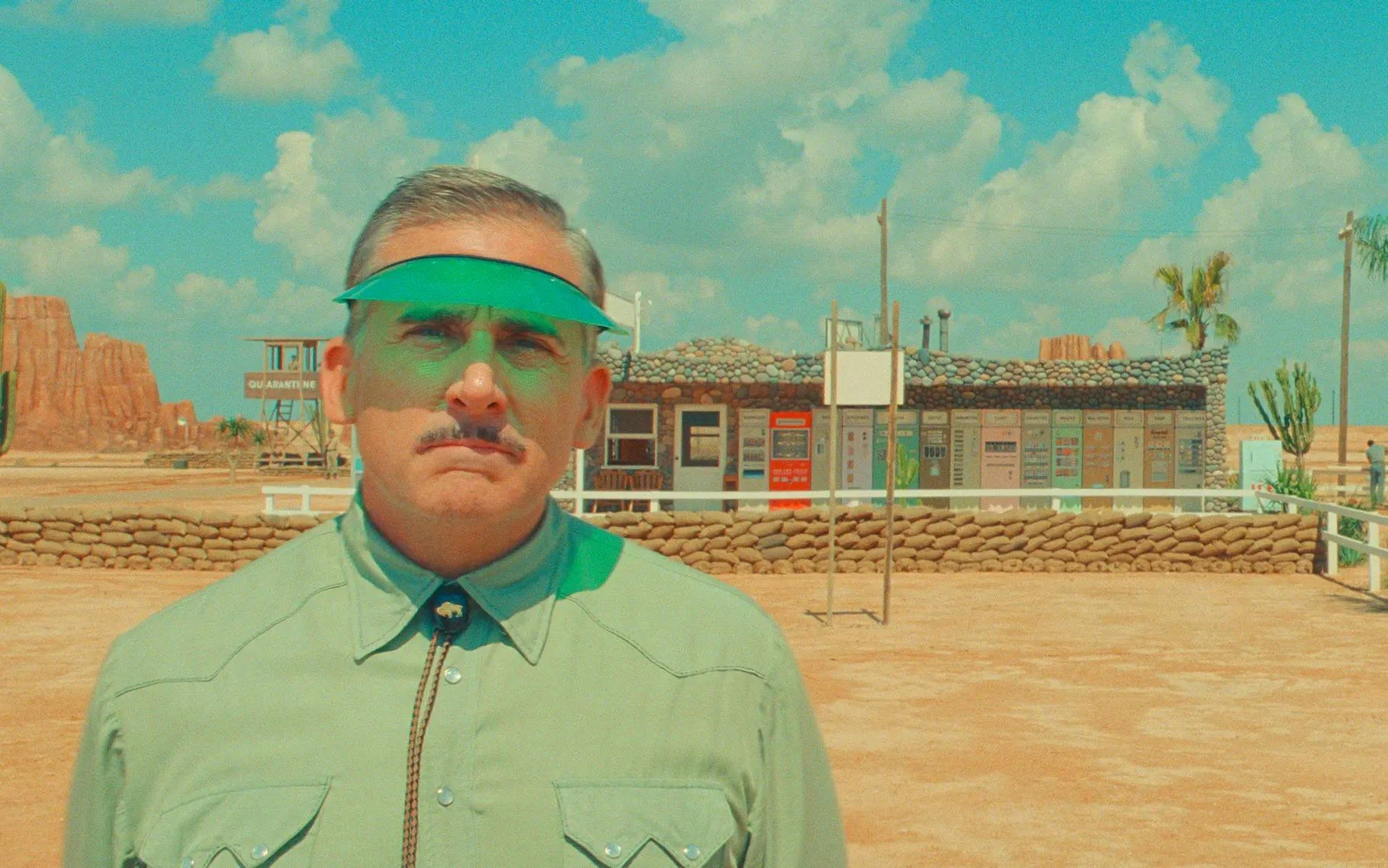
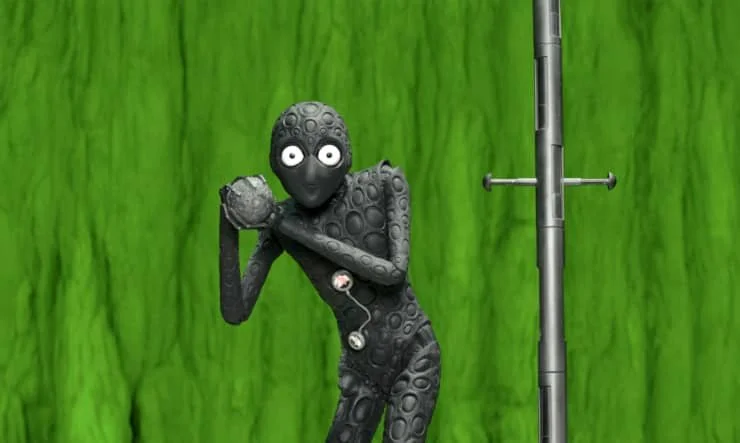
The opening story is about how a young man’s passionate feminism endlessly crushes his dating life for “thirty lonely years”. Can you read a story about someone being lonely for thirty years? Tall order! But if you can handle it, the sentences will hit you harrrrrrrrd. Jia Tolentino, New Yorker Staff Writer and author of the phenomenal ‘Trick Mirror’ (09/20), calls this book “a thrill for the sickos among us” and says until she read it she had no idea “how fun it could be to read a book about a bunch of huge fucking losers.” The majority of the book is written in a seductive second person where you feel like you’re hovering in a drone camera just above the scene. Back to that first story: we start by following the teenage protagonist as he’s one of the first (cis hetero) male students at a modern day progressive formerly-all-girls private school. Unfortunately, the snowball begins tumbling downhill right away. From page 1: “… the school ingrained in him, if not feminist values per see, the value of feminist values. It had been cool, or at least normal, to identify as asexual. And though he didn’t, he figured it was a better label than ‘virgin.’” On page 2 we continue into college where “… he encounters the alien system of codes and manners…Learning in high school about body positivity, gender norms, and the cultural construction of beauty had led him to believe that adults aren’t obsessed with looks. This turns out to be untrue, even among his new female friends, who complain about how shallow men are. Now that he’s self-conscious, he realizes he can’t compete along conventional standards of height, weight, grip strength, whatever. How can he hope to attract anyone with his narrow shoulders?” This continues for 28 more pages, and every time you think you’re at a new low, the bottom suddenly splinters and falls out once again. Sort of feels like you’re in the music video for Turn Down For What (directed by Daniels, btw!) except instead of increasingly wild ecstatic dancing, it’s just increasingly lonely emotional fracturing.
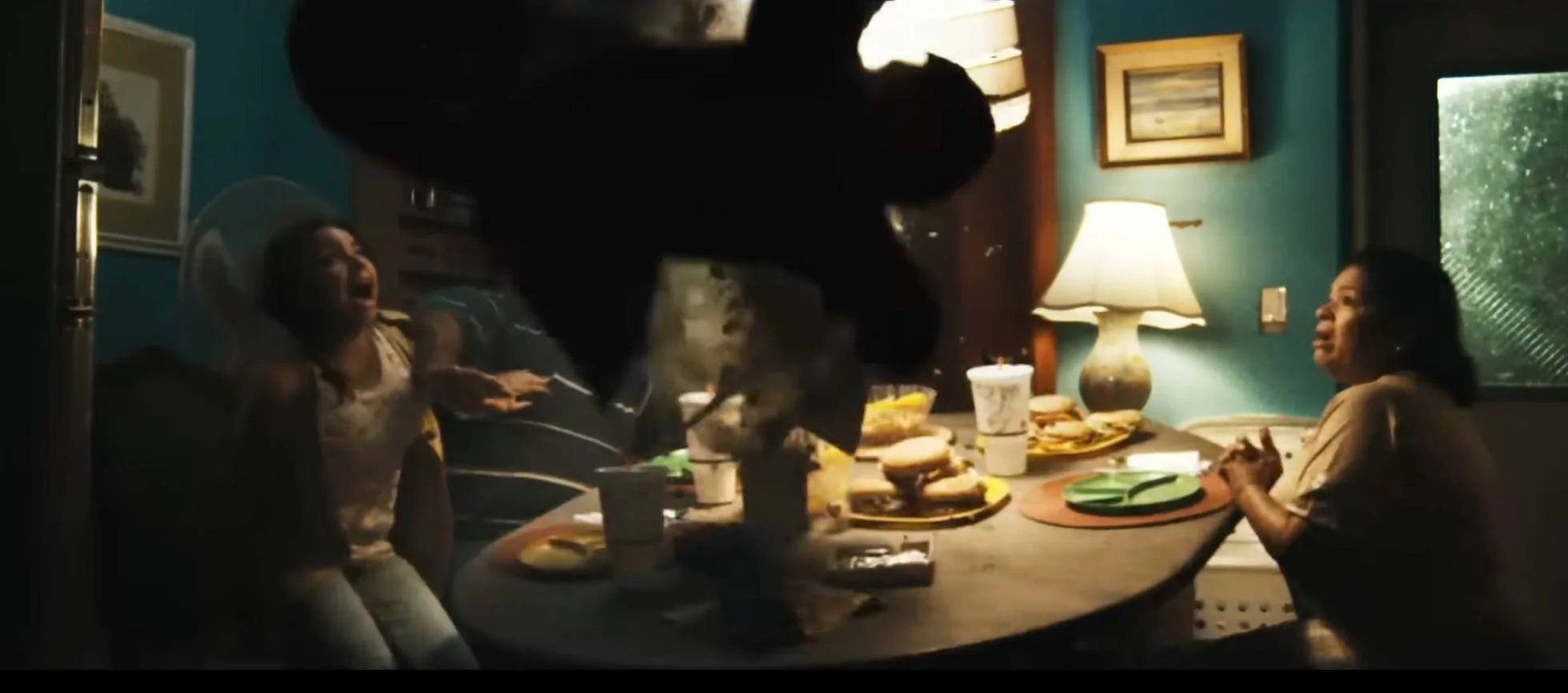
The second story is a 61-page Shame Meteor burning past your face as it flares and shrivels into a fiery rock of acid. You basically play the role of a college woman who falls in love with her best (male) friend. They hook up one night and she gets a blowjob selfie texted to her afterward and … uh, things get awkward. Though not how you’d expect. Nothing is predictable here and yet it feels so hyper realistic. The stories get more outlandish as they go. Scenes begin feeling comic-book stylized. There are people with abs “… as craggy and segmented as a prizewinning pumpkin” and random-app-hookup gay spanking scenes where the main character begins “… monitoring the man’s grunts for feedback, and in his distraction, he swings low and accidentally smites the man’s balls at maximum force, causing him to shout and roll onto the floor into a shrimpy curl.” As then, right when a scene feels like it’s at its wincing, maximum throttle, there is Tulathimutte, on the sidelines, a maniacal grin on his face, turning the screws just a bit tighter. TOO-lah-tim-OO-tee may be the new Tare-AN-teen-OH of high-low art. A wow on ten different levels.
4. Dominic by William Steig (1907-2003). Joanne, the strong-minded children's book librarian at the Lillian H. Smith branch of the Toronto Public Library, was agog when I told her I’d never heard of William Steig (“STY-g”). We had been rapping about picture book authors we loved as she loaded up my arms with books—lots of Paulette Bourgeois, lots of Shirley Hughes—so I guess the fact I hadn’t even heard of the guy who wrote ‘Shrek’, ‘Brave Irene’ (04/23), or ‘Pete’s A Pizza’ (05/23), struck her as curious. Clearly I was pretending to be some kind Periodic Table of Children’s Literature yet knew nothing of Beryllium. She then led me around the corner in E (for Easy Readers) to S (for Steig) where an Aladdin-like cave of riches awaited. I have loved every jewel from the cave so far and many more await. Dominic is a delightful romp. Here are the first 71 words of the book which quickly curtain-lifts to Steig’s unique twang in its full glory:
Dominic was a lively one, always up to something. One day, more restless than usual, he decided there wasn’t enough going on in his own neighborhood to satisfy his need for adventure. He just had to get away.
How owned an assortment of hates which he liked to wear, not for warmth or for shade or to shield him from rain, but for their various effects—rakish, dashing, solemn, or martial.
Dominic’s itchy nomadic pulse leads him to skip town and turn into a wandering flâneur. Adventure! Challenges! Pains! Surprise! Perfect for children of any age—as a read-a-loud or (if your kid is up for learning new words like “rakish”) a read-a-lone. If you’ve never heard of Steig, I recommend starting with ‘Pete’s A Pizza’ which is a 30-second read (watch it on YT here!) and then that’ll warm you up for picture books like ‘Brave Irene’ (04/23) and then meatier chapter books like this 146-page gem.
5. Atmosphere by Taylor Jenkins Reid (b.1983). And now it is time for this month’s Leslie’s Pick, a book personally chosen and reviewed by my beautiful wife. For a full list of Leslie’s picks click here and if you’d prefer listening to her (as I do) check out our interviews with Brené Brown, Kristen Neff, or The Holderness Family. Over to you, Les: “I know I’m not the only one who got swept away and binge watched the epic love story Heated Rivalry. I knew what I was getting into after hearing the teachers at my school squeal ‘I’m going to the cottage!!’ and gush over how much they loved it! AND I was pleasantly surprised by how incredibly beautiful the last episode was. If you’d held back watching it for whatever reason, I highly recommend at least the final episode, especially for all parents, educators, and practitioners who work with youth. I have been inspired to speak openly to my children and students about how sad it is that the world, in hockey or otherwise, communicates to young people that they need to hide a part of who they are if they do not fit clearly into the heteronormative box (or any other box for that matter). And that parents, even without intending to, make their children feel that they have expectations of who they want them to be, think they are, or expect them to become. There is so much work to do as a society to support each individual to feel safe, supported, and comfortable to be JUST who they know they are. When I picked up ‘Atmosphere’, simply subtitled “a love story”, I naively and admittedly heteronormatively assumed, (especially after having LOVED the many heterosexual relationships explored in ‘The Seven Husbands of Evelyn Hugo’ (08/23) by the same author) that it was a love story between Joan, the female protagonist, and a male character. I was then delightfully surprised that I was able to reflect on my bias and assumptions when it turned out to be a love story between Joan and Vanessa, a fellow female astronaut. Not dissimilar to young boys playing hockey, Joan and Vanessa, as female astronauts in the 1980s, also felt as though they had to hide who they were. My sons are beginning to tire of me telling them how incredibly wrong it is that young gay male (or non-binary, non-white, transgendered, two spirited, bisexual or otherwise) hockey players feel as though they have to hide parts of themselves just as it is wrong that female astronauts (or lawyers, doctors, CEOs, or otherwise) have to hide that they are pregnant! Or maybe, thanks to shows and books like these, we’re starting to replace subtle judgments with open-minded conversations, allowing young people to share all aspects of their identities with the world! Getting off my soapbox: I highly recommend this book for its beautiful reflections on science and faith, the power of love, how we don’t get to choose our family (it chooses us), along with the immaculate, astonishing, risky, courageous thing of bravely leaving our planet to explore space!!”
6. Tales Of A Fourth Grade Nothing by Judy Blume (b.1938). I got an email from Judy Blume’s assistant saying she had to cancel. We had set up an interview weeks before and I was in Miami waiting for a puddle-hopper plane to fly me to Key West where Judy owns and operates her wonderful Books&Books bookstore (an offshoot of Mitchell Kaplan’s wonderful Florida indie bookstore chain.) I had just given a speech for Volvo and was in a suit and my plan was to change into shorts and a T-shirt on the plane. But the interview! Cancelled? Ack! What should I do? What could I do? Beg? Yes. In fact that’s what I did. I begged. And Judy’s assistant said okay, freaky anxious podcaster, get on the damn plane. So I got on the plane. Then hailed a cab. And met dear Judy, 82 years young at that time, and had a delightful chat.
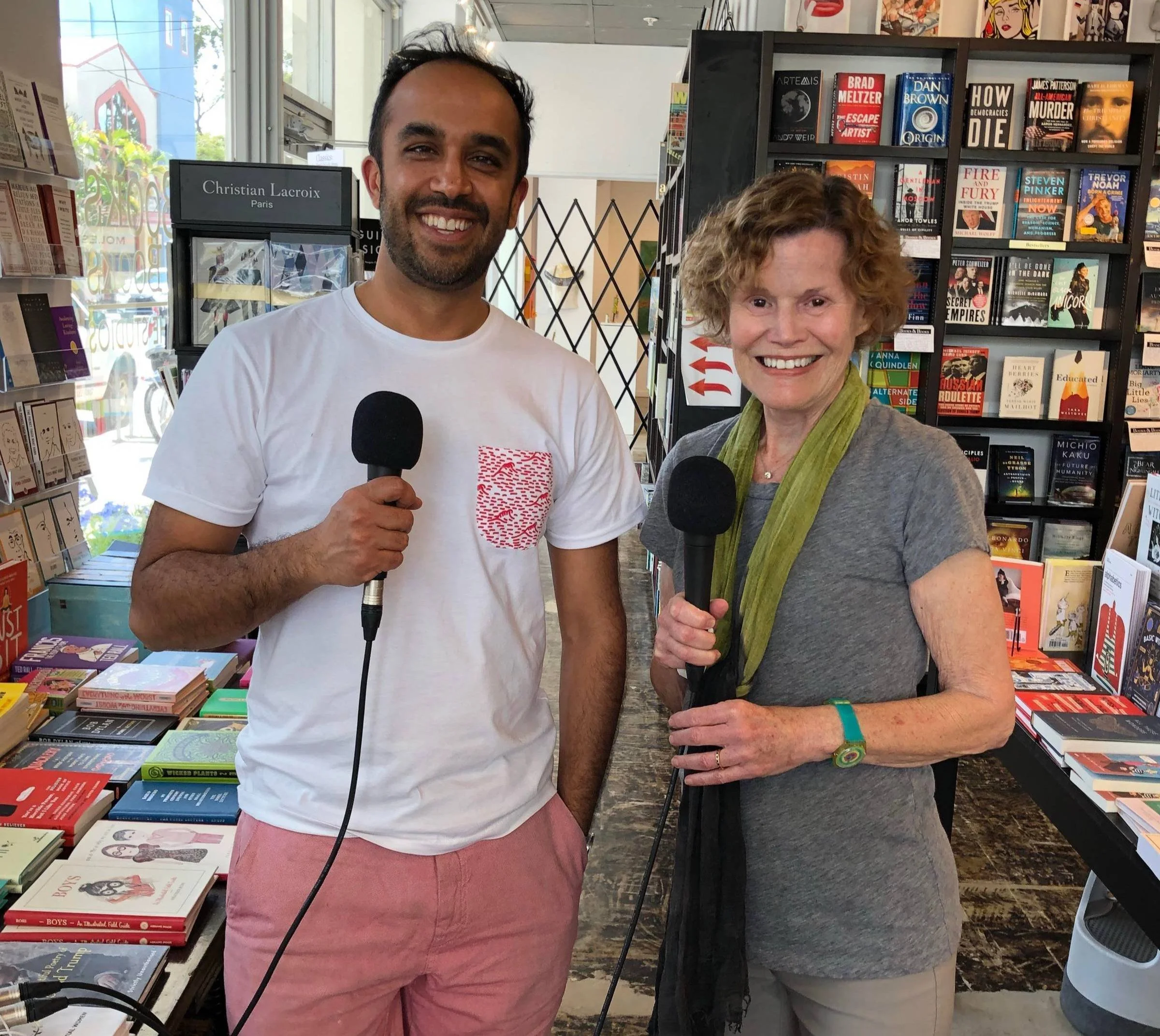
I got a chance to tell her how much ‘Tales Of A Fourth Grade Nothing’ meant to me as a kid and she even signed it in marker!
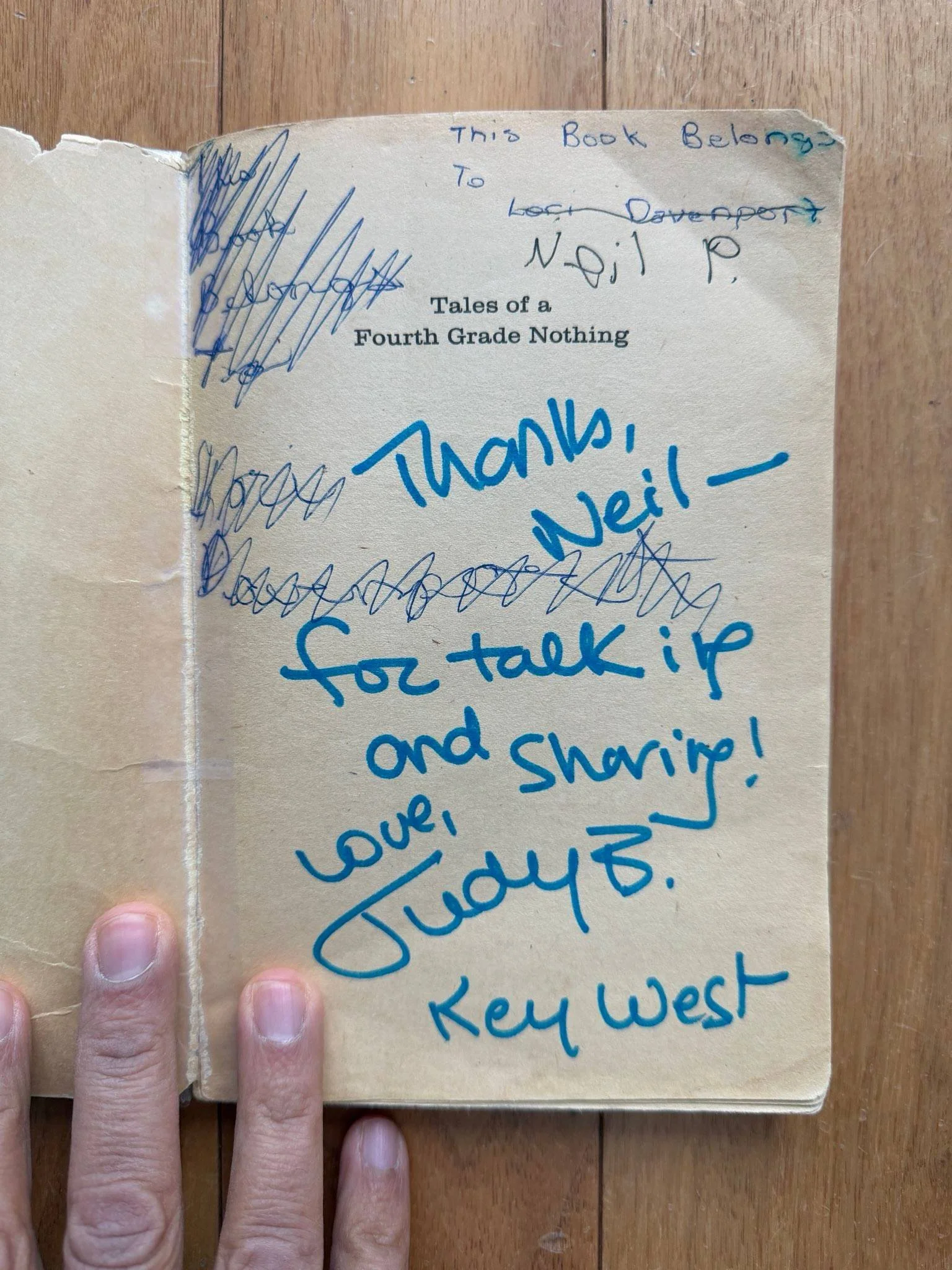
This might be my favorite signed book: the juxtaposition of me writing my own name in the corner in 6-year-old handwriting, after my parents clearly bought this at a garage sale from some mysterious Lori Davenport, combined with Judy’s below. I have taped and re-taped the spine so it barely holds together and just finished reading it to my 9, 7, and 5-year olds who all loved it. Why is this book so good? Why is it so much better than ‘Superfudge’, ‘Double Fudge’, and all those other Fudge books that followed? The curve of the protagonist. That’s my thinking! Judy has a marvellous way of detailing (fourth-grade) Peter Hatcher’s inner life as he navigates the world through 9-year-old eyes. From page 60: “Mine was root-beer flavored. I hate root beer. But I thanked Mr. Berman anyway.” From page 61: “I wiggled my sock around trying to rearrange my hole. My mother sure worries about silly things!” I absolutely love the realistic cover in this old version and, indeed, decry the modern tendency of children’s book publishers to put such cartoony images of the cover. Like just compare my cover to the one on sale today (yuck!):
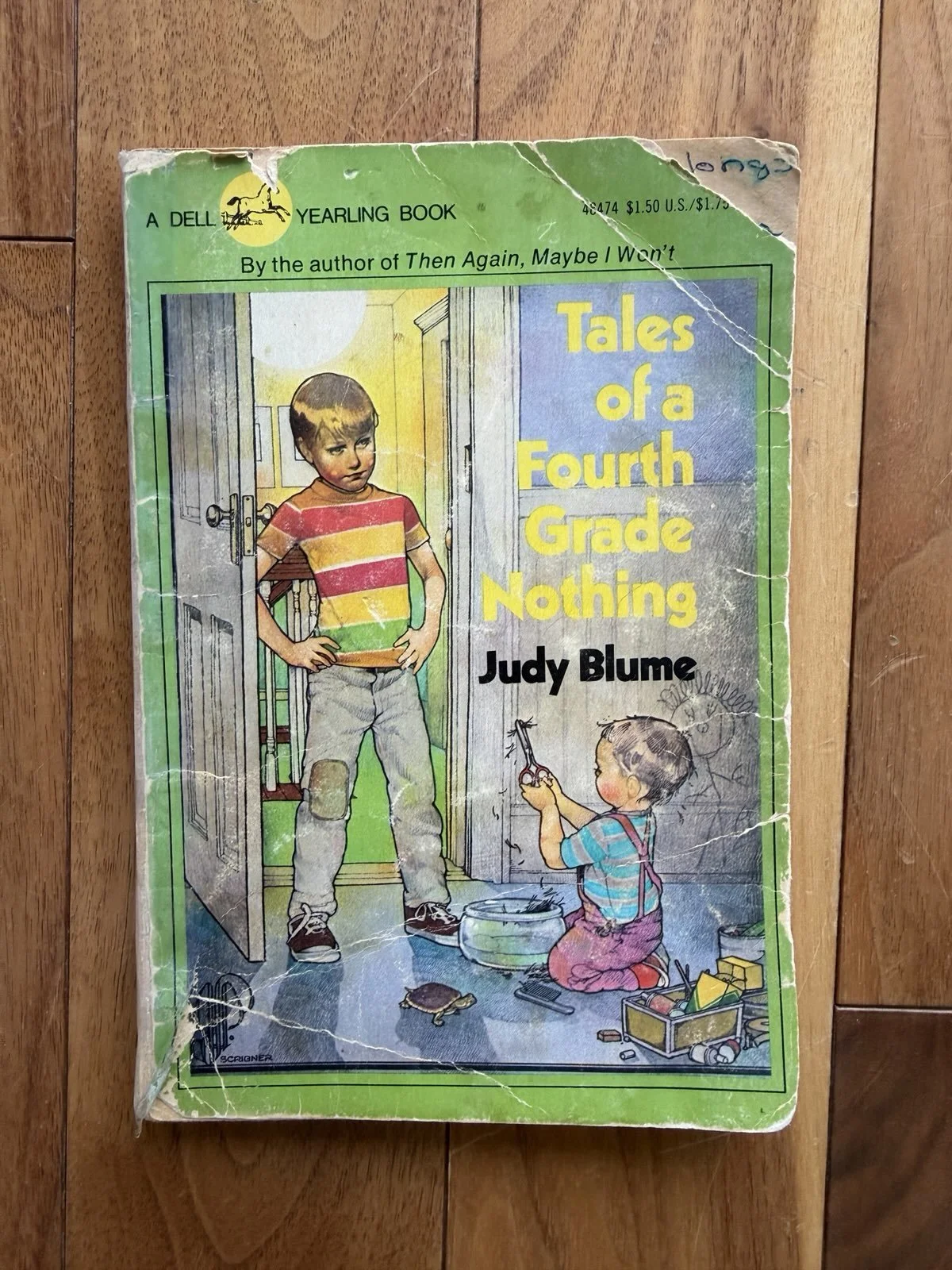

Give us realism that feeds our imagination! This book is now 54 years old and we are still right there—living in a New York City apartment (while the city is still gritty and Peter has to keep away from muggers in the park), hanging out with Jimmy Fargo after school, finding Sheila completely annoying, and being generally irritated by our mom and the turtle-eating Fudge. A classic!
7. The Little Trilogy by Anton Chekhov (1860-1904). Have you read much Russian Literature? Any? I read precisely zero Russian literature books until David Mitchell picked ‘The Duel’ by Anton Chekhov (06/20) as one of his most formative. Then I read George Saunders’ writing book ‘A Swim In The Pond In The Rain’ (06/21) and got a lot more Chekhov, some Bulgakov, and Tolstoy. Then a little more Tolstoy when Saunders picked ‘Hadji Murad’ (02/21) as one of his most formative. Now this. I still haven’t cracked any of the classic classics like ‘War and Peace’, ‘Anna Karenina’, and ‘Crime and Punishment’, but I feel like I’ve successfully dipped my toe in the Russian literature pond (in the rain?). This book is 3 somewhat interrelated stories: ‘The Man In A Case’ tells the story of an uptight teacher so afraid of life he creates incredibly conservative rules that he forces everybody in his orbit to live by…until he eventually nearly marries a happy-go-lucky woman who changes his personality…but then doesn’t, and dies, and then everybody breathes a sigh of relief. In ‘Gooseberries’ (where the Saunders book title comes from!) a man named Nikolai spends his life dreaming about owning his own estate, but when he does he becomes super smug. In ‘About Love’ we get a backstory about unfulfilled love between the narrator and a married woman. Emotional! A bit stiff. But a lot going on. As David Mitchell told me long ago “If there’s a book over a hundred years old and it’s still in print today there’s a very good reason.” There’s a very good reason why this one is still coming out the front door of the book factories! A short, accessible, reflective read.
8. Walking On Water: Reflections On Faith And Art by Madeleine L’Engle (1918-2007). I admit, whenever I hear a book described as “a meditation on…” I hear it as “a bunch of loose, semi-coherent rambles on…” How silly! Because this book is indeed a meditation on faith and art but it is the furthest thing from loose and semi-coherent. The high-beamed mind of Madeleine L’Engle (‘A Wrinkle In Time’) dives into the deeper, colder, darker waters to explore, really meaningfully explore, the murky depths underpinning those massive overlapping circles of faith and art. On page 5, she reminds us via Plato that “All learning which is acquired under compulsion has no hold upon the mind” and talks about the seriousness of craft on page 8 when she says, “Obedience is an unpopular word nowadays, but the artist must be obedient to the work, whether it be a symphony, a painting, or a story for a small child.” In some ways, this is L’Engle’s own “commonplace book” about writing. She pulls out gem after gem, many from her own mind, but many quoted too. Like on page 14 when she quotes Jean Rhys in a Paris Review interview saying, “Listen to me. All of writing is a huge lake. There are great rivers that feed the lake, like Tolstoy and Dostoevsky. And there are mere trickles, like Jean Rhys. All that matters is feeding the lake. I don’t matter. The lake matters. You must keep feeding the lake.” She’s a wise, patient, enlightened guide calmly showing you the meaning of all things. I say this is a powerful read for anyone creating art in any way. So, most people! Closest book I can compare it to would be ‘The War of Art’ by Steven Pressfield (11/16), but this gets a lot deeper. And you leave feeling enriched and inspired about books, and words, in so many new ways. I have over 100 highlights in this book and I’ll leave you with this gem: “The reader, viewer, listener, usually grossly underestimates his importance. If a reader cannot create a book along with the writer, the book will never come to life. Creative involvement: that’s the basic difference between reading a book and watching TV. In watching TV we are passive; sponges; we do nothing. In reading we must become creators … The author and the reader ‘know’ each other; they meet on the bridge of words.” Meet on the bridge of words! I love that. So much. That’s where we are right now, me and you. On the bridge of words. What a glorious place to be! Together, me and you, right here.
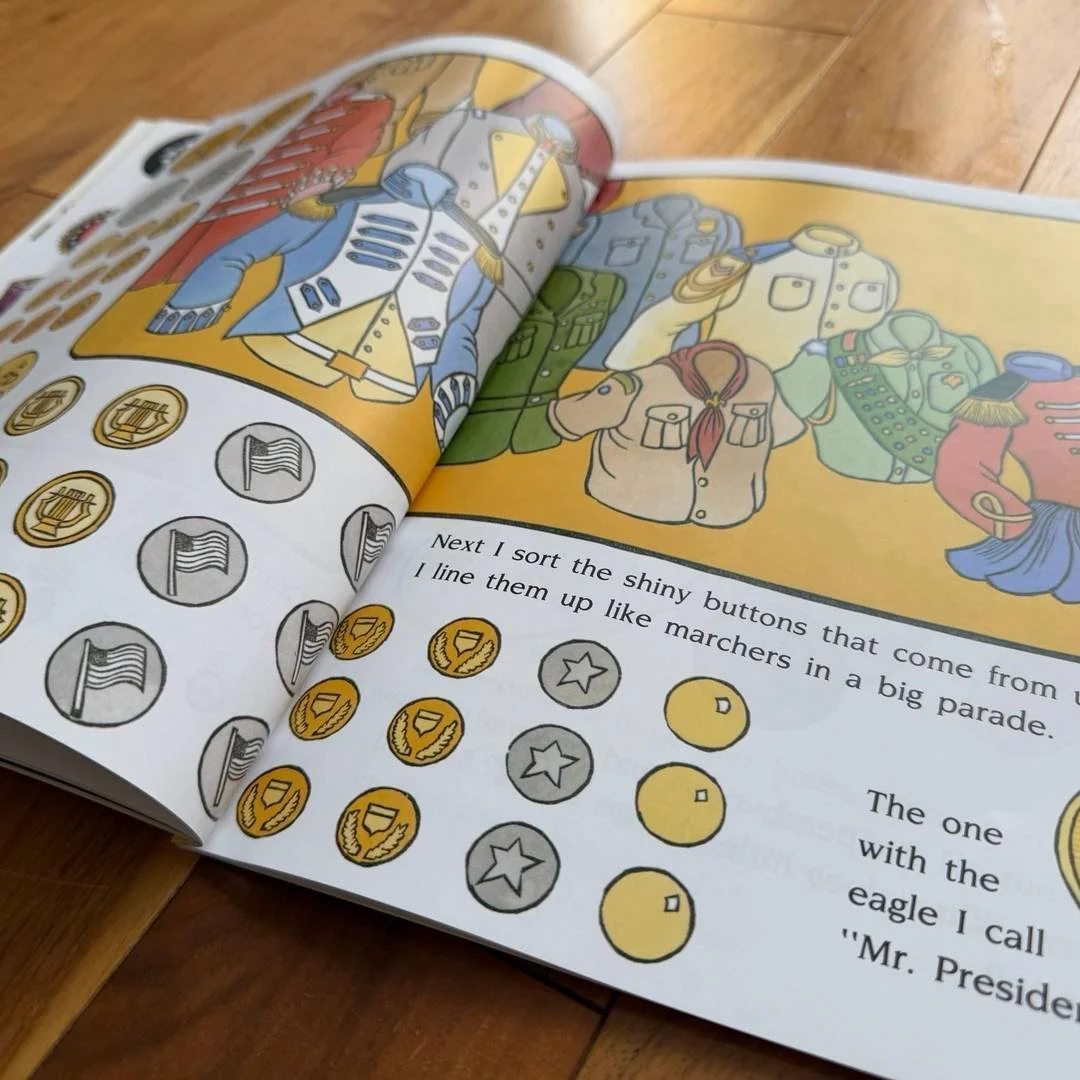
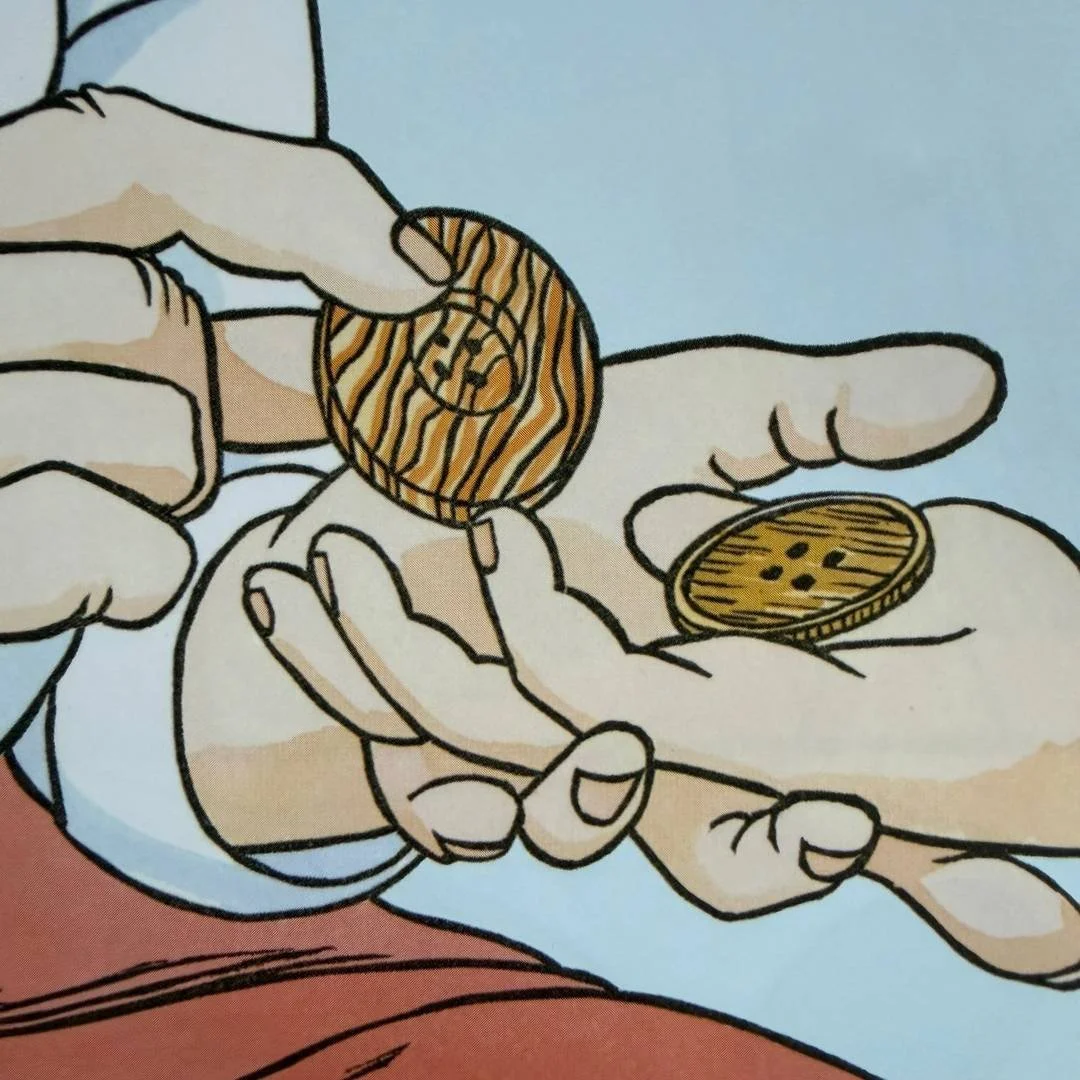
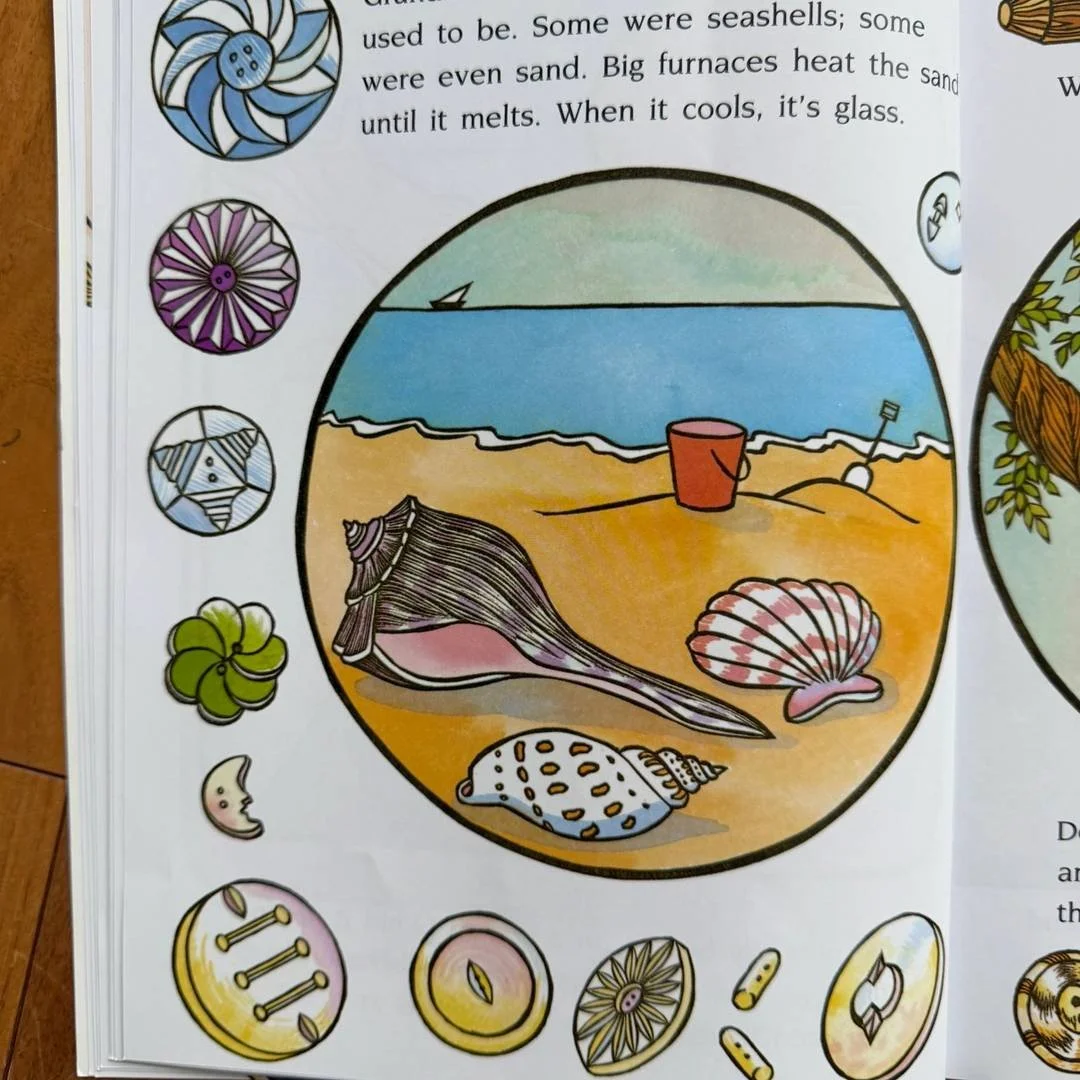
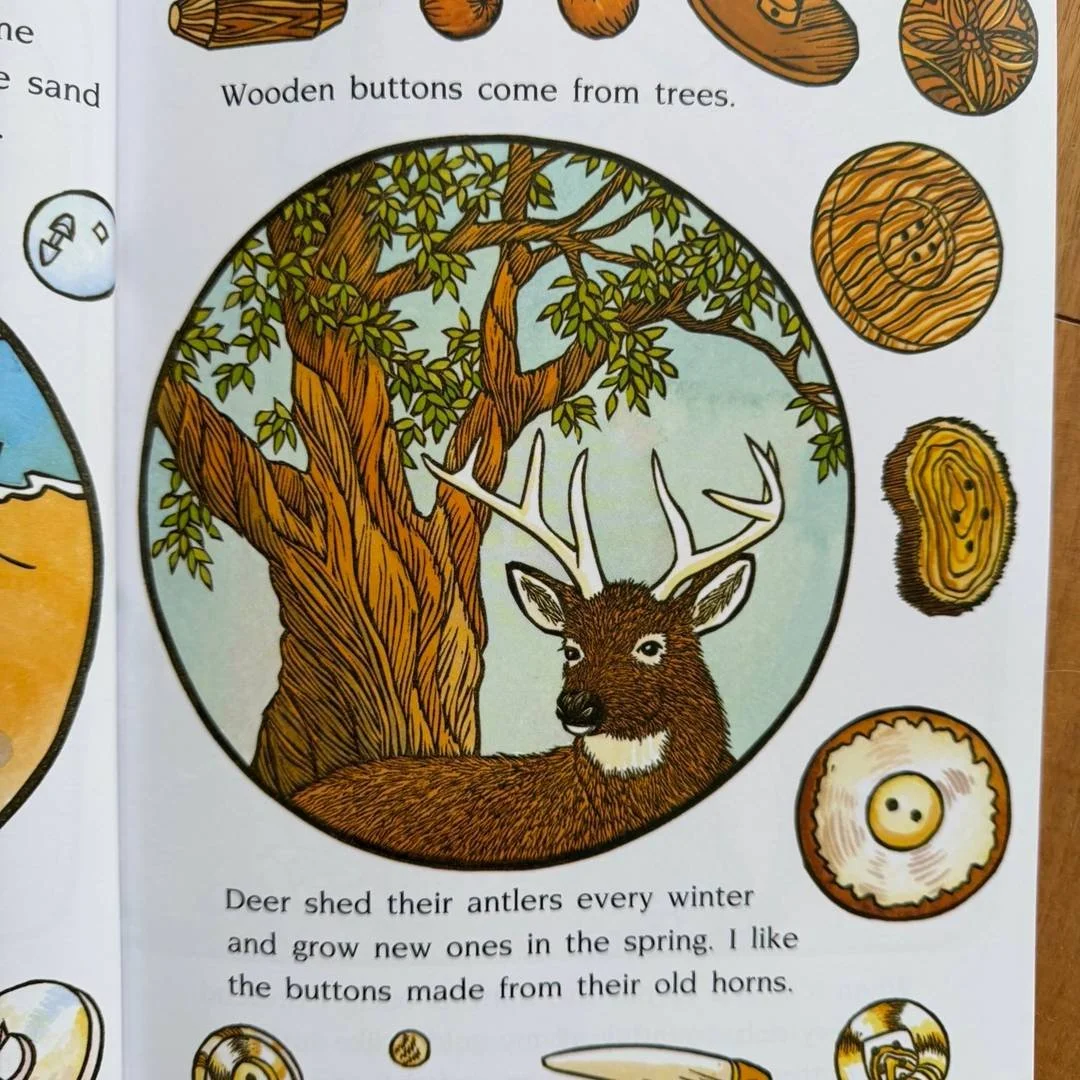
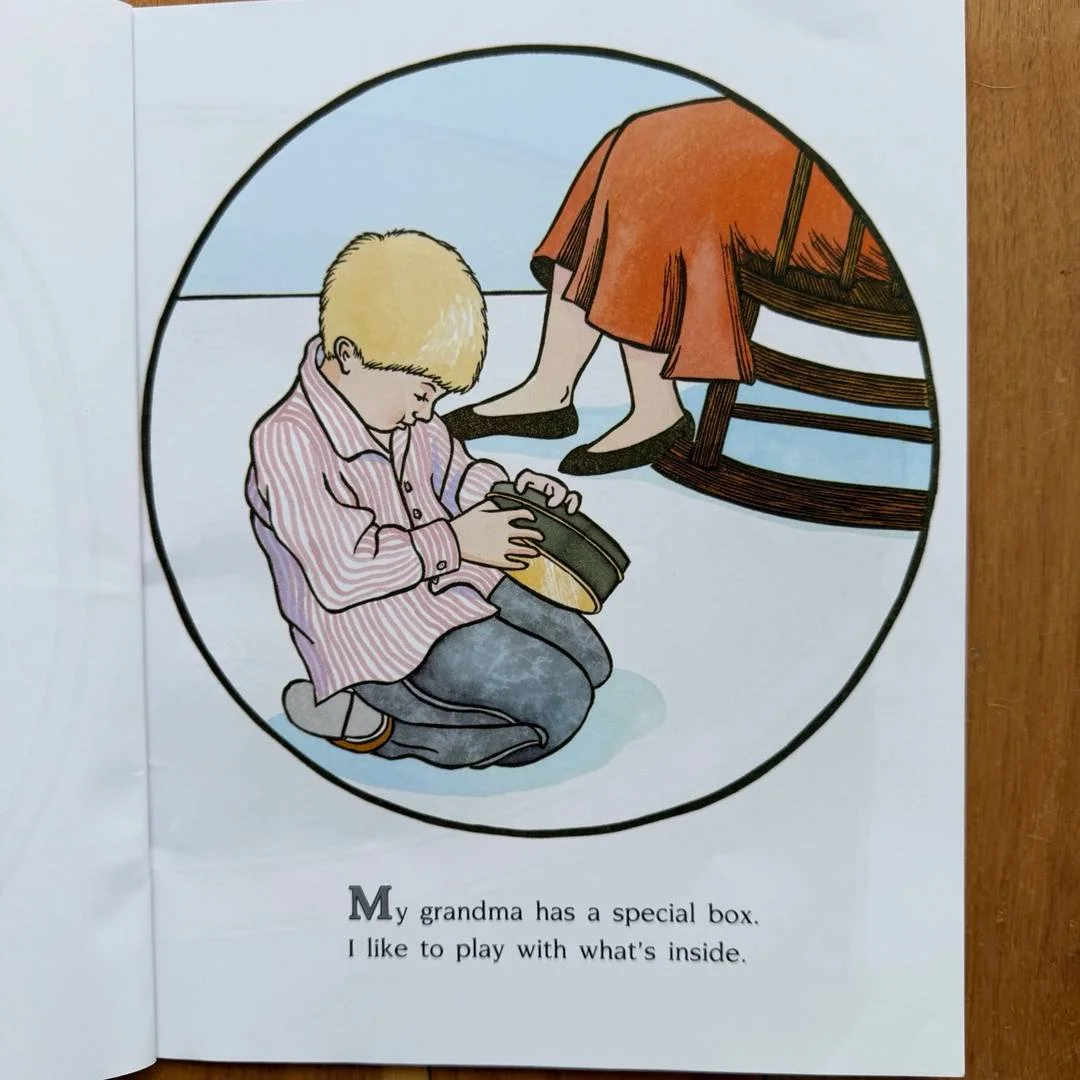
9. The Button Box by Margarette S. Reid (b.1923). Illustrated by Sarah Chamberlain. I love old ladies! They’re my favorite demographic. Second is old men. Leslie always jokes that at any big party I’m most likely to be found on a couch chatting to the oldest women around. They’re oozing with wisdom! (And they sure can cook, too.) Last month, I was sitting in a coffee shop writing this book club when a couple old ladies beside me asked what I was doing—given I had a pile of books beside me, including the picture book ‘Mama’s Roti’ (01/26). When I told them, they started gushing about their favorite picture books. Both had one! Start with that. I got these gorgeous three minute soliloquies about two picture books I had never heard of! Then one woman pulled out a pencil and notebook, wrote down both titles, ripped out the page, and handed it to me. I went home and ordered both books. Both took a long time to arrive. Gems lost in the annals of Life Before The Internet! The Button Box is one of the books and it's a 1990 masterpiece about a little boy playing with a button box at his grandma’s house. Starts off simple! “My grandma has a special box. I like to play with what’s inside.”
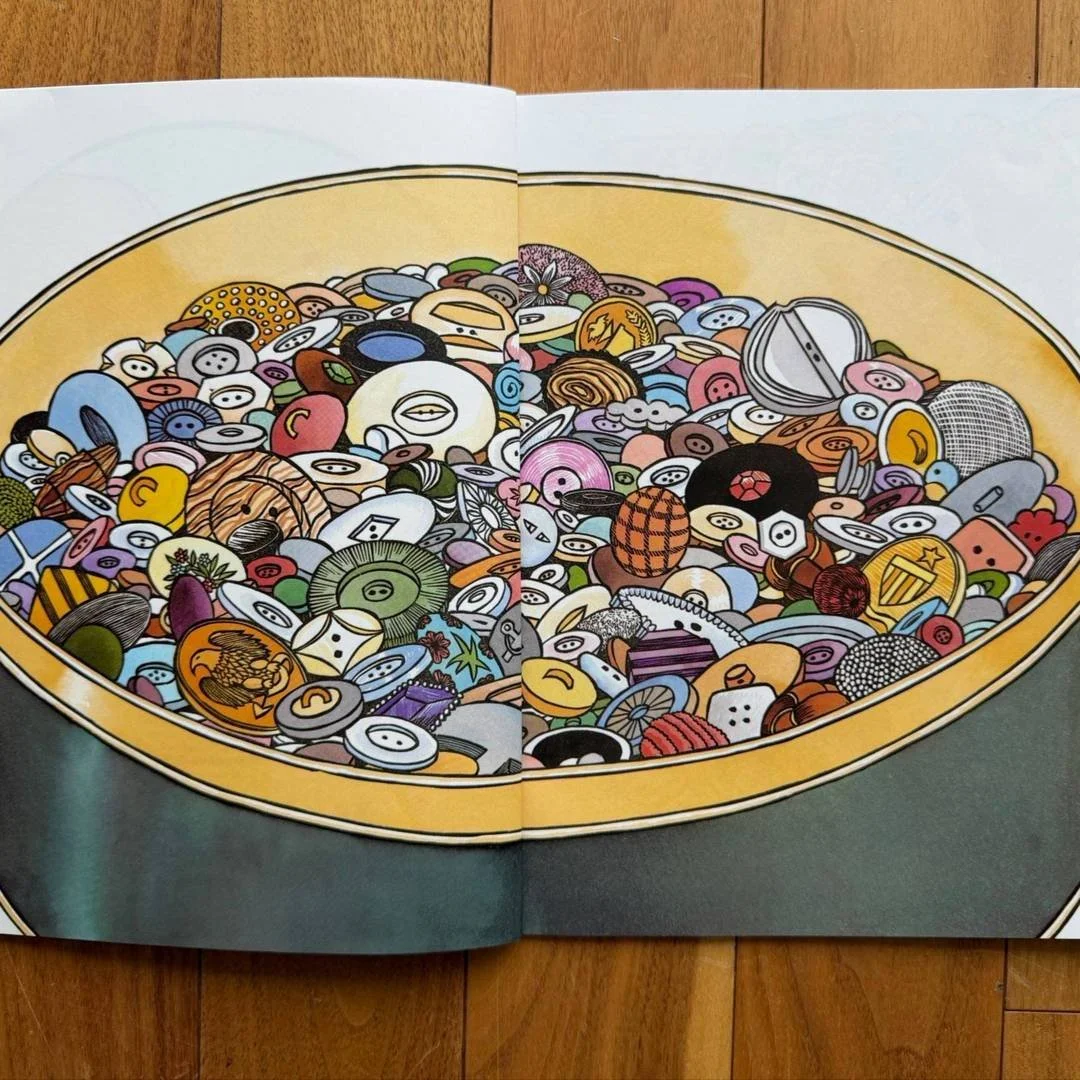
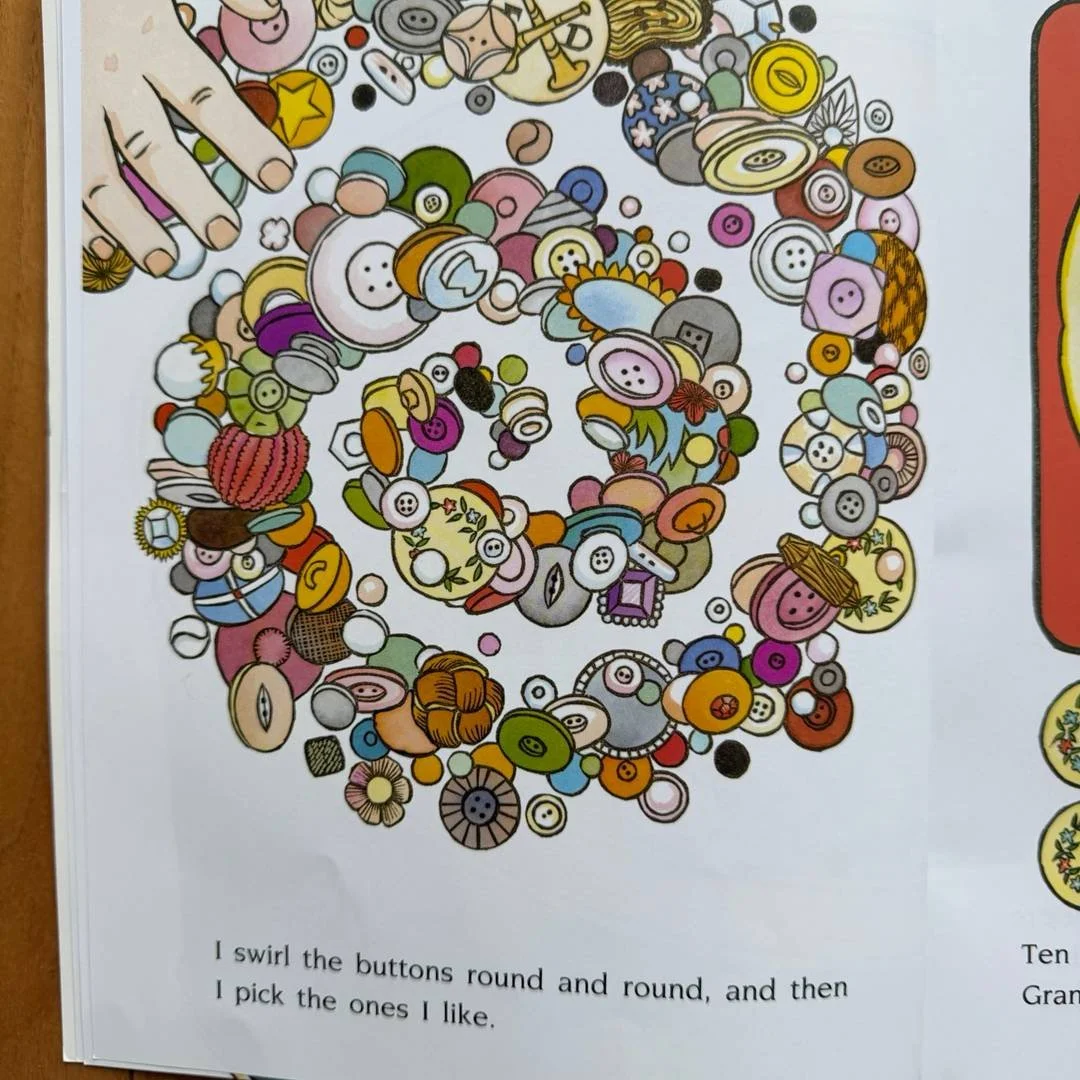
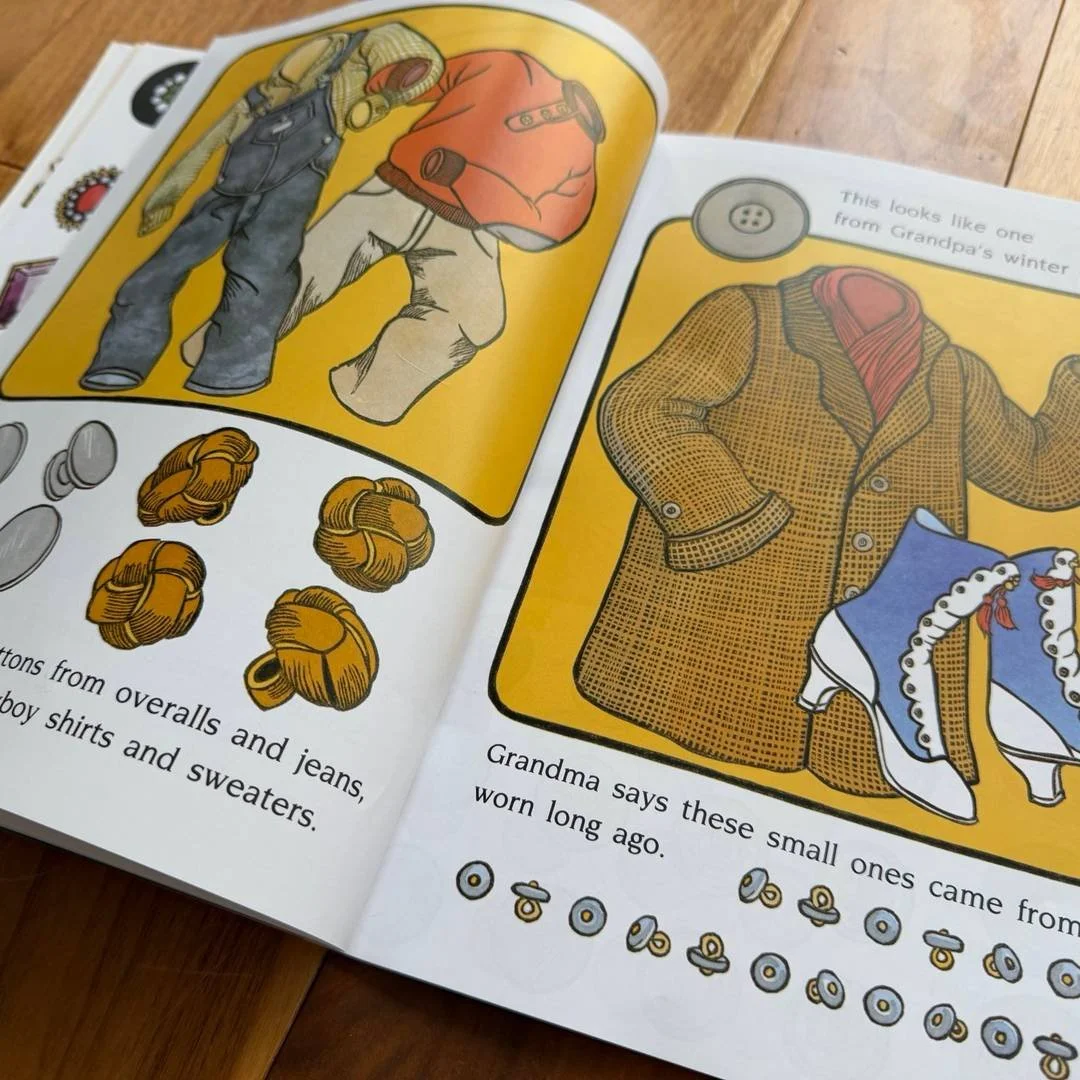
What emerges is a reflective and powerful meditation on the power of curiosity, play, and imagination. Huge feelings with this book! And all my boys loved it—ages 11, 9, 7, and 5—as did Leslie.