Neil Pasricha's Monthly Book Club - May 2024
Neil's Monthly Book Club is my oldest and most popular email newsletter. Click here to subscribe.
Hey everyone,
It's hot and drippy in Toronto and I've been thinking again about what it means to live intentionally and at a more human pace. I just wrote a new post about escaping the algorithm and revisited the wonderful 'Team Human' by Douglas Rushkoff as you'll see in the reviews below.
I also spent time this month with wonderful souls in new places. One goal we've had for 3 Books since we started six years ago was tapping into street smarts—street wisdom!—from everyday people like bartenders, variety store owners, Uber drivers, and nurses.
In that spirit I just released a This American Life-ish conversation on 'bullets, bruises, and babies' with three people I met driving around St. Louis and also spoke this week to a room of 6500 ICU and ER nurses in Denver. Stretched to the brink in a broken system I heard tales of heartbreak, overwork, and overwhelm on the front lines. It feels more important than ever we keep talking to each other—through books, in-person chats, and any rich veins of conversation we discover on our own journeys.
I hope this monthly book club—coming to you the last Saturday morning of the month for 90 months in a row now—can be a rich vein for you as it has been for me. Reply anytime to let me know what rich veins you're trusting and relying on in your own life these days.
And now—let's get to the books!
Neil

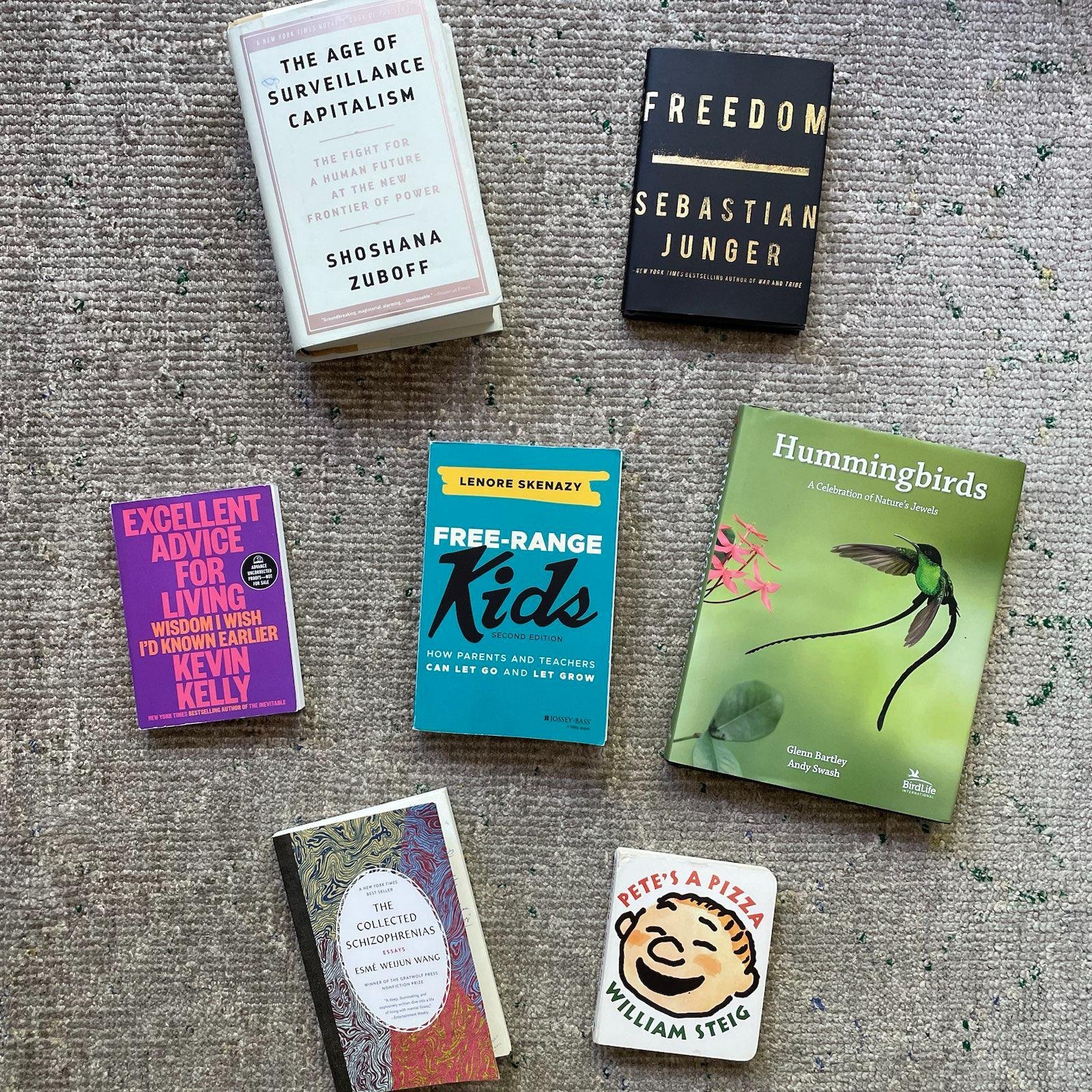
1. Martyr! by Kaveh Akbar. See if the opening paragraph of this debut novel by Iranian-American poet Kaveh Akbar grabs you like it did for me: “Maybe it was that Cyrus had done the wrong drugs in the right order, or the right drugs in the wrong order, but when God finally spoke back to him after twenty-seven years of silence, what Cyrus wanted more than anything else was a do-over. Clarification. Lying on his mattress that smelled like piss and Febreze, Cyrus stared up at the room’s single light bulb, willing it to blink again, willing God to confirm that the bulb’s flicker had been a divine action and not just the old apartment’s trashy wiring.” The first third of the book flew by for me in a wonderfully told story of a wannabe-writer in Indianapolis whose mom died in a senseless military-trial-gone-wrong type of plane explosion over the Persian Gulf and whose dad skirted by in America killing chickens on a factory farm. What happens after the first third? The book got … heavy. Akbar started weaving in all kinds of chapters from new perspectives: Cyrus’s mom’s lesbian encounters in the 80s, dream sequences with Rumi, and little bits of Cyrus’s novel-in-progress throughout. Still, I recommend this book for the sentences. So many glorious sentences. Akbar clearly chipped away at it for a long time as it has a Steve Toltz 'A Fraction of the Whole' (2/2023) style of wordy acrobatics. And, I will add without giving anything away, the book does 'pay off' nicely in the end.
2. Team Human by Douglas Rushkoff. I’m in a Douglas Rushkoff mood lately. I just wrote about him in a new blog post and revisited our conversation in Chapter 83 of 3 Books before pulling his wonderful 2019 manifesto ‘Team Human’ off my shelf. This book has the force of a train. A fiery, breathless, culture-shifting manifesto told in 100 tight, short essays, which I learned he modeled after the wonderful ‘Finite and Infinite Games’ (8/2022). It all ultimately adds up to a takedown of “the antihuman agenda embedded in our technology, our markets, and our major cultural institutions" and, for me, is a reminder to "find the others" and seek out deep human connection in the face of an increasingly anti-human world. We need Douglas’s voice right now. Check out his podcast Team Human, his eponymous Substack and, of course, this wonderful book. Highly recommended.
3. Figuring by Maria Popova. “How, in this blink of existence bookended by nothingness, do we attain completeness of being?” That’s a question that comes up early in this book and it sort of umbrellas over everything Maria Popova puts out—from this book to her live sciencey-poetry Universe in Verse events to her wonderfully 18-year-running, flowering-in-all-directions site The Marginalian (formerly called Brainpickings). In this book she zooms up a level and tells a fascinating history of arts and science told through deeply engaging and endlessly braided tales of the artists and scientists themselves. They’re not linear stories, though, because as she writes: “Lives are lived in parallel and perpendicular, fathomed nonlinearly, figured not in the straight graphs of ‘biography’ but in many-sided, many-splendored diagrams.” So we get many-sided diagrams of figures like Johannes Kepler, Maria Mitchell, Rachel Carson, Emily Dickinson, and Ralph Waldo Emerson, told with an entrancing spell of Maria’s particular brand of poetic narrative with endless snips and clips of letters, speeches, and writings weaved in. I love the posture of this book. It's like Maria herself: fiercely intelligent, deeply humanist, very… macro-orthogonal. Maria has often called literature “the original Internet” and her ability to dive deeper and wider than anyone else is on full display here. The book gave me wonder, perspective and, like everything Maria, a great deal of heart.
4. Smithsonian Field Guide to the Birds of North America by Ted Floyd. I have a lot of field guides “to the birds.” My favorites are my hyper-regional 'Birds of Ontario' (6/2020) and the completist masterpiece 'Sibley Birds East' (3/2021). But I have a lot of others: guides for places I want to visit ('A Guide to the Birds of India, Pakistan, and Nepal'), guides I’ve received as gifts, and even a wonderfully water-stained copy of Roger Peterson's ‘A Field Guide To The Birds’ which Leslie’s grandmother left me. (Side note: I recently learned Peterson is credited with starting “field identification,” like as a thing, with the original 1934 ‘A Field Guide To the Birds.’) If you’re new to birding, you need a field guide. If you’re new to field guides, it’s easy to take J. Drew Lanham’s advice and grab one at a second hand shop. The birds don’t change—even if their names may soon! So what is it about this field guide that I love? Photos! That's it. This one has photos. Every single other field guide I have has drawings or paintings, but this has over 2000 photos of all 730 North American species! A must-add to the field guide collection.
5. It’s Perfectly Normal: Changing Bodies, Growing Up, Sex, and Sexual Health by Robie H. Harris and illustrated by Michael Emberley. And now it’s time for this month’s Leslie’s Pick! Over to Leslie: “What I would give for a landline in the kitchen and cable TV in the living room over this technologically-charged-matrix our kids are growing up in!! One area we're trying hardest to protect our kids from an ‘internet education’ is sexual education. I remember learning so much about how my body, hormones, emotions, and relationships were changing from books my Mom got me and so I’m trying to do the same for our kids. This book is geared to children 10 and up and gives details about both male and female puberty, how to understand strong feelings and sexual desires, why it’s important to talk to your doctor about sexually transmitted diseases, laws around abortion and the importance about talking about sexual abuse. It even dives into how to get information AND stay safe on the internet. If you’re thinking these topics feel too advanced to discuss with your 10-year-old, as someone who teaches health to elementary school students, I’m here to tell you they’re not. My best advice is to start the sex conversations early and just keep them short and sweet. Many tiny honest questions grow into bigger conversations and help keep the doors open. From the same authors, there is ‘It’s Not The Stork’ (for 4 and up) and ‘It's So Amazing’ (for 7 and up). If you need inspiration on what to talk about when, check out this resource. If we wait until the teen years it’ll be harder and more awkward for everyone and our kids will likely look somewhere else like (ugh) unsafe corners of the internet. So, if you have a 10 to 14-year-old and want to dive into giving a sex education at home, reading this together is a great place to start.”
6. ‘What A Major Solar Storm Could Do To Our Planet’ by Kathryn Schulz. A few weeks ago a friend of mine who lives in suburban Ontario sent our grouptext pictures of the Northern Lights…from his backyard. He’d never seen them from his place before but it was the same day as that news report surfaced warning people of a “solar storm.” What’s a solar storm? Exactly! What is a solar storm? I had no idea till I waded into this epic 8200-word New Yorker feature from Kathryn Schulz which helps explain. Basically, five years ago FEMA made a list of possible disasters and found that only two could simultaneously affect the entire nation. One is pandemics (they nailed that one!) and the other is a severe solar storm. Schulz reminds us that “the sun is an enormous thermonuclear bomb that has been exploding continuously for four and a half billion years” and whose inner workings we’re only figuring out now. She tells a compelling history of notable solar storms throughout history (all before our now-susceptible power and satellite grids were in place) through the profile of the “space-weather forecaster” Ken Tegnell. A great primer on an issue that feels soon-to-be-frequently-discussed.
7. Be Prepared: A Practical Handbook for New Dads by Gary Greenberg and Jeannie Hayden. Before we had kids Leslie read a pile of parenting books. Me, I read … just this one. Somebody passed it along and the opening spread made me laugh. (Click the pic on this page to see it.) On the left: “What Your Newborn Won’t Look Like,” with a drawing of a cuddly, giggling 3-month old baby and, on the right, “What Your Newborn Will Look Like,” with a dark, crying newborn with labels like “cone-shaped head from squeezing through the womb,” “lanugo—fuzzy hair on face, back, and shoulders. This will eventually disappear,” and “skinny, structurally unsound legs.” I have bought so many copies of this book and passed it along to any dad-to-be. It’s so eminently readable and has a lot of tidbits and advice I used for months and years after. The book divides up the the first year of baby and 0-3 months includes topics like “Coping with Crying,” which explains how to tell between six different types of cries, “Wrestling The Breast Pump,” and “A Guy’s Guide to Strollers.” By the time you get to 10-12 months there are advanced topics like “Babies and Restaurants,” “Advanced Changing” and, my favorite, “The Decoy Drawer.” Greenberg writes: “Somehow the baby senses the power your electronic gear possesses and will take every opportunity to seize and/or destroy them. You decide to buy the baby colorful plastic versions of their own but, of course, the baby immediately throws aside the imposters and goes back to the genuine articles. That’s why you need to create a decoy drawer full of old phones, remotes, wallets, keys, and credit cards. The drawer should be at a good baby height and all items need to be real but non-functioning. That way when baby opens the drawer they think they found the mother lode.” Surprisingly rich with a light and funny tone throughout.
8. City Parks: A stroll around the world’s most beautiful public spaces by Christopher Beanland. Have you heard of ‘The Crane Index’? It’s a construction industry-produced metric to track the number of active cranes in 14 major cities across North America. Guess what city is number one and has been for years? My hometown! Toronto’s skyline is currently dotted with 221 operating cranes. To put that in perspective numbers 2, 3, and 4 on the list are LA with 50, Seattle with 38, and Calgary with 20. “They paved paradise and put up a parking lot,” sang Joni Mitchell in ‘Big Yellow Taxi,’ and sometimes walking around Toronto these days you can almost feel the grass screaming. It was in that spirit I picked up this gorgeous visual escape into the greatest, grandest, grassiest city parks around the world. Organized by continent, the book gives lush 2-4 page spreads of each park along with a quick view of each from strong voiced globe-trotting park lover Christopher Beanland. When I first cracked open the book I checked my home country for credibility. There are precisely two Canadian parks in the book: Stanley Park in Vancouver and Mount Royal in Montreal. Biggies! Not a single park from Toronto but maybe that’s just how high the bar is here. Central Park in New York, Millennium Park in Chicago, Griffith Park in LA, that’s the scope of things. Here’s a snip of Beanland writing about Peace Memorial Park in Hiroshima, Japan, one of the few in the book I’ve actually visited: “Cemeteries are the most obvious examples of parks dedicated to death, but many memorial and peace parks dot the world too. Hiroshima’s brings together a collection of formal landscapes and tranquil gardens to memorialize that which was the opposite of both of those things: horror and slaughter on a previously unimaginable scale. But the language is telling: this is a Peace Park where the catastrophe of the atomic explosion of 1945 is seen as a warning to future generations, that the way and weapons of mass destruction must be avoided. Contains modernism museums and sculptures surrounded by lawns and trees. A mound at the centre contains the ashes of tens of thousands, peace bells toll to remind us, and the miraculously surviving A-Bomb Dome stands as a kind of monument to a human spirit that could not be crushed.” A wonderful coffee-table book to zoom us out of concrete jungles.
9. There is no 9! Just a little loot bag of links. Adam Grant reports on a study showing 'banning smartphones in schools is good for learning and well-being.' We have to keep the pressure on to pull back from the tipping point. I didn't realize US birth rates are at the lowest level ever recorded. I've been thinking on a parenting blog post Book Clubber Debbie S sent me called 'Pirates and Kings' and enjoyed escaping this month listening to 'Living Proof' by The War on Drugs and watching Jerry Seinfeld's funny and wise commencement speech to Duke University grads.
Interested in more of my reviews? Read my monthly book clubs or visit my Goodreads page.
Click here to join the Book Club email list.
Neil Pasricha's Monthly Book Club - April 2024
Neil's Monthly Book Club is my oldest and most popular email newsletter. Click here to subscribe.
Hey everyone,
Happy April!
The world is tilting away from social media. Can you feel it? It feels good. It feels so good.
Let’s get to the books!
Neil
PS. If you’re new to book club, sign up right here.

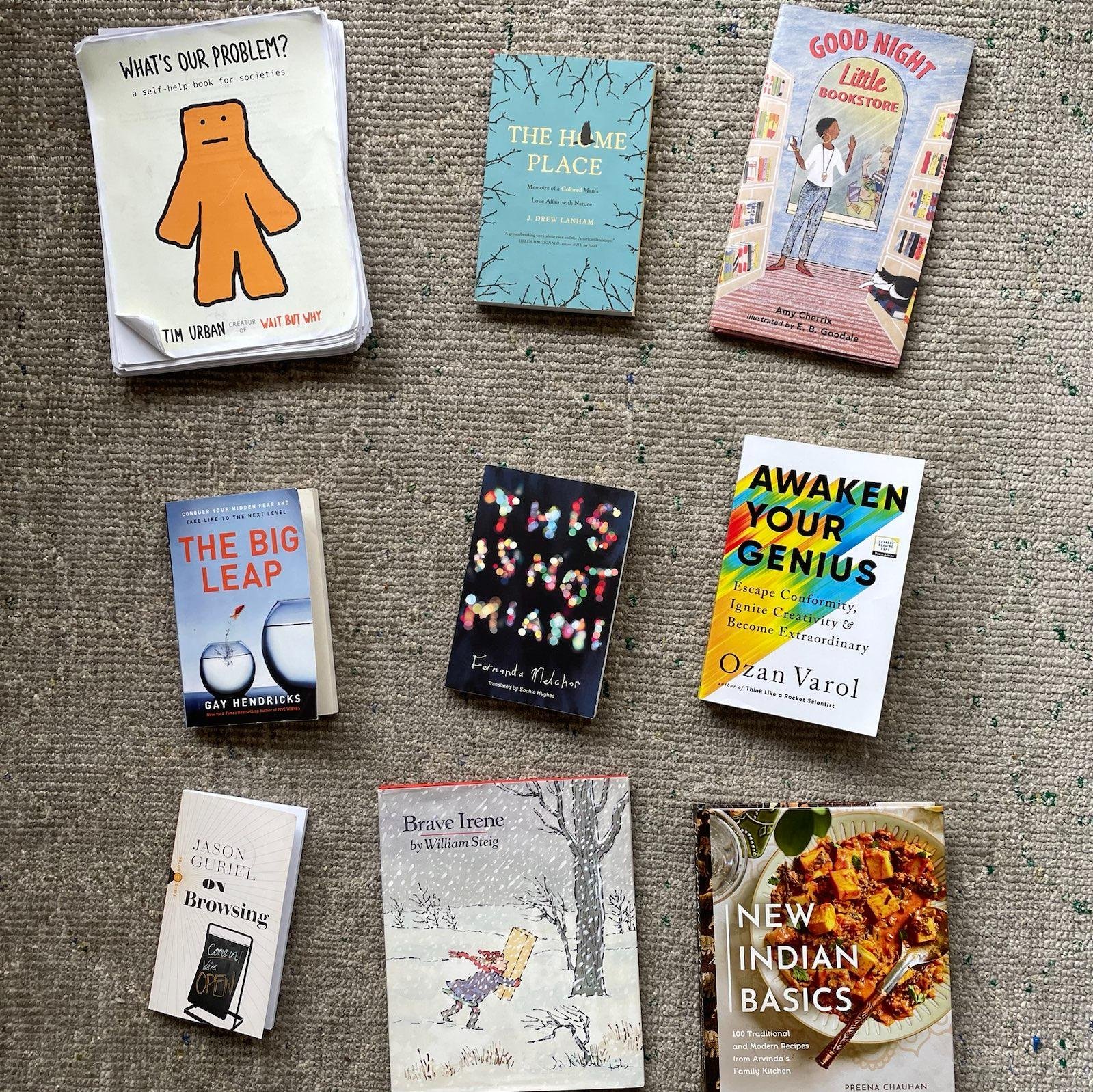
1. The Anxious Generation: How the Great Rewiring of Childhood Is Causing an Epidemic of Mental Illness by Jonathan Haidt. Do you remember when nobody had cell phones? You’d spend half an hour at dinner trying to remember the name of that guy from that movie. You had to actually whistle at the corner of the street to get a ride home. And, my favorite, you just never knew where anyone was—pretty much ever. Pre-tracking, pre-surveilling, pre-obsessing-over-your-kids-whereabouts. Then twang! Culture snapped backwards. Partly because of the well-catalogued rise in the 1980s of 24/7 news and fear-based child abduction stories to hook us to the screens. Ensuing protectionism was accelerated by smartphones, then a pandemic, and now: we got issues. Higher than ever anxiety, higher than ever depression, higher than ever loneliness. If we’re not careful we’ll end up like that scene in WALL-E, riding our fat ships, sipping soylent, while being endlessly titillated by total entertainment forever. But once in a while, once in a moment, a culture-defining book shows up at a culture-defining time to pull us back from the brink. To pull us back from fully hard-wiring ourselves into the matrix. That book is the wonderful ‘The Anxious Generation’ by NYU professor and brilliant thinker Jonathan Haidt (pronounced "height"). Yes, I said as I read this book, yes, yes, yes, yes. This is it! A deeply clear, deeply researched, deeply, dare I say, obvious clarion call for no smartphones before high school, no social media before 16, entirely-phone-free schools, and a callback to open play for our kids instead of programmed safe-robot childhoods. (Jon even does a three-page photo spread on the value of old, dangerous playground equipment. His rant on rusty merry-go-rounds was speaking my looooooove language.) I love this book. I think you should buy it. By the dozen! By the skid! I am writing right now at my local coffee shop with the book sitting beside me and so far three people have come up asking me about the book. It’s hitting the zeitgeist hard—bang!—right when we need it most. Two people have just flipped through the book reading some of my highlights and I’d love to invite you to do the same. Here is part one of my highlights. Here is part two. I might post another. The whole book will be yellow soon! I just love Jon’s thoughts in here and, TBH, I think they could be stronger. I think a smartphone—like, access to the entire unfiltered world of anything and everything—should be age 16 not 14, so I’m arguing for eleventh grade not ninth grade as he is proposing. (Cal Newport agrees, btw.) But let’s start somewhere! This book delivers many things including a much-needed slap to the face of tech companies who inadvertently, then advertently, began messing up our kids. Started innocently! On page 3 Jon writes: “… in 2008 my two-year-old son mastered the touch-and-swipe interface of my first iPhone. Many parents were relieved to find that a smartphone or tablet could keep a child happily engaged and quiet for hours. Was this safe? Nobody knew, but because everyone else was doing it, everyone just assumed that it must be okay.” But then, looking back from years later: “Companies that strive to maximize ‘engagement’ by using psychological tricks to keep young people clicking were the worst offenders. They hooked children during vulnerable developmental stages, while their brains were rapidly rewiring in response to incoming stimulation. This included social media companies, which inflicted their greatest damage on girls, and video game companies and pornography sites, which sank their hooks deepest into boys.” Wait, did they know what they were doing? They did! On page 227 Sean Parker, first president of Facebook, says “How do we consume as much of your time and conscious attention as possible?” and then goes on to share how he, Zuckerberg, Systrom et al “understood this consciously. And we did it anyway. God only knows what it's doing to our children’s brains.” On page 230 Jon shows us Zuckerberg’s market-based approach. He writes: “In August 2019, I had a video call with Mark Zuckerberg… I told him that when my children started middle school, they each said that most of the kids in their class (who were 10 or 11 at the start of sixth grade) had Instagram accounts. I asked Zuckerberg what he planned to do about that. He said, ‘But we don’t allow anyone under 13 to open an account.’ I told him that before our call I had created a fake account for a fictional 13-year-old girl and I encountered no attempt to verify my age claim. He said, ‘We’re working on that.’ While writing this chapter (in August 2023), I effortlessly created another fake account. There is still no age verification, even though age verification techniques have gotten much better in the last four years, nor is there any disincentive for preteens to lie about their age.” Go get ’em, Jon! Get ready to smash your router with a hammer and take your kids to the park after reading how our social interactions have, for millions of years, been embodied, synchronous, one-to-one or one-to-several, with a high bar for entry or exit. Whereas now we have slathered ourselves so deeply digital that social relationships have become disembodied, asynchronous, one-to-many, with a low bar for entry and exit. No wonder we are lonely! (Which is, no biggie, worse for our health than smoking 15 cigarettes a day, according to this report from Surgeon General Vivek Murthy.) Paraphrasing Esther Perel: 'We got a thousand friends online but nobody to feed our cat.' Tightly written, endlessly punctuated with charts, with every chapter nicely summarized with a perfect bullet-point one-pager, this book is designed for max skimmability. You could honestly just flip past the 100 graphs and get the story. This is a rallying cry and anti-tech manifesto which offers new ways of living that look an awful lot like old ways of living. I am continuing to work with my school and public school board to get cell phones out of schools. I am asking my city councillor for more ‘loose parts’ playgrounds instead of neon-red Safe-T-Shapes that no one likes. I am sending the wonderful work from the Let Grow movement to my public school board's Director of Education while also working hard with Leslie to give my kids longer and longer ranges so they can grow up untethered and antifragile. I have a long way to go but this book is nitro to get there. As Jon says in the very last three sentences of the book: “The Great Rewiring of Childhood, from play-based to phone-based, has been a catastrophic failure. It’s time to end the experiment. Let’s bring our children home.” Amen. Listen to my 2022 chat with Jon in his kitchen, over his wife’s delicious Korean food, right here. Read my favorite pages from the book here and here. Tell your neighbors about the book. Tell your friends! Tell your principals! Let’s keep the movement building. This book has been at the top of The New York Times bestseller list every single week since it came out a month ago and is currently #1 overall non-fiction book in the world on Amazon. WE HAVE LIFTOFF! Get a copy from your local indie bookstore, from the library, from Jon's site directly, from my non-commission-link-splitter. Just get it! Highly recommended.
2. Goodbye, Galleria by Shari Kasman. I’ve been feeling mall-nostalgic lately. They’re bashing them down all around me. The people demand luxury condo skyscrapers! The $3 million dollar condo crowd simply will not rest till they get brand-name sinks on the 37th story! So malls are going. Fare thee well. Headed the way of the Passenger Pigeon. Mall loss makes me sad. Not just for nostalgia! For community. Malls fostered and made deeply inclusive space for warmth, rest, and connection across society. The malls I grew up with were always strata-slicing not disparity-amplifying. They weren’t for rich people. They weren’t for poor people. They were for people. When we were little my sister and I would be led by our parents through Eaton’s or The Bay, past the perfume-sprayers, out onto the embossed-brown-circles-on-brown-vinyl long ramp up and into a world of Fabriclands, Grand&Toys, and Coles Bookstores, before getting Manhattan Fries in a paper box with a tiny wooden fork or, sometimes, sitting on Santa’s lap. I miss the Rave Rave Rave in the Five Points Mall, the dark and long Oshawa Centre, and the forever-sandy floors at the Whitby Mall. We’d walk past old men with hairy shoulders in white tank tops on wooden benches outside the barber shop while moms with their hair in buns and open-buttoned winter jackets swerved strollers with big plastic bags hanging off the ends. This evocative photo journal by Shari Kasman gave me rushing wistfulness, blurry memories, and bittersweet nostalgia as she catalogues a two-year Halcyon Day period in the life of the Galleria Mall, which opened at the corner of Dufferin and Dupont in downtown Toronto in 1972. She writes: “Arcade games, rides, and candy dispensers that once lined the corridors are gone, and sheets of paper cover store-front windows formerly inhabited by fashionable mannequins. The food counter has vanished, and parts of the ceiling have been torn down, revealing the mall’s guts: wiring and ductwork. Even the iconic brown floor tiles have started to disappear.” There are shots of faded Zellers signs and we cruise past stores with names like Smoker’s Choice, Vic’s Fashion Jewelry, Health Food, and !nk Smart. The book is a twinge mocking but the tone wasn’t strong enough to negatively affect my read-feel. I know I’ll keep picking it up for the rest of my life whenever I suddenly feel like walking through a mall of my childhood. Thank you for this gift, Shari. And thank you to new downtown Toronto indie bookstore Flying Books for displaying it at the cash. Highly recommended.
3. Born Standing Up: A Comic’s Life by Steve Martin. I walked over to visit my friend Michael Bungay-Stanier (The Coaching Habit) the other night and got there early. There was a Little Free Library across the street so I snapped open the magnet-attached door and found a pristine copy of this book inside. I have never seen a Jerry Seinfeld blurb on a book before and this one jumped out: “One of the best books about comedy and being a comedian ever written,” says the comedy king. So I picked it up! What is the book? A 17-year-old memoir by then-62-year-old Steve Martin, entirely written with a comic’s keen eye for economy. Short, tight sentences from The School of Cormac McCarthy. Steve tells a straight-faced, occasionally funny, always honest story of what might seem like a relatively benign life ordering magic tricks out of the back of a magazine and getting a job at the joke shop and, later, having panic attacks on weed and reconnecting with his family. But nothing sounds benign through Steve Martin’s lens. And what helps make the book special are endlessly weaved in morsels of from-my-later-years wisdom. He sounds a bit like the invisible narrator of ‘The Wonder Years’ and always comes across as humble and open-hearted. On page 27: “… my mother grew more and more submissive to my father in order to avoid his temper. Timid and secretive, she whispered her thoughts to me with the caveat ‘Now, don’t tell anyone I said that,’ filling me with a belief, which took years to correct, that it was dangerous to express one’s true opinion.” He shares his values. On page 34, after getting the job at the joke shop: “I harbored a secret sense of superiority over my teenage peers who had suntans, because I knew it meant they weren’t working.” He shares regrets. Page 46, after hitting the road as a struggling weird-magician playing to near-empty rooms: “When I moved out of the house at eighteen, I rarely called home to check up on my parents or tell them how I was doing. Why? The answer shocks me as I write it: I didn’t know I was supposed to.” He shares thoughts on comedy: “All entertainment is or is about to become old-fashioned,” and, “The more physically uncomfortable the audience, the bigger the laughs.” He talks about non-obvious ingredients to success: “Despite a lack of natural ability, I did have the one element necessary to all early creativity: naïveté, that fabulous quality that keeps you from knowing just how unsuited you are for what you are about to do.” And his later chapters on wrestling with fame are spectacular and must-read for anyone navigating dynamics of public attention. Tightly squeezed, highly concentrated, and double-spaced with lots of photos so the 204 pages feel breezy. Sometimes when you’re walking across town to your buddy’s place and completely mistime it you are lucky enough to discover a wonderful book. Highly recommended.
4. Five Little Indians by Michelle Good. And now it’s time for this month’s Leslie’s Pick, a book personally chosen and recommended by my wife. Over to you, Les! “Five Little Indians is a heartbreaking, hope-filled, empathy-expanding book about five survivors of Canada’s residential schools. The story follows Kenny, Lucy, Clara, Howie, and Maisie’s lives as they are released from their detainment and struggle, with great determination, to find safety and some way forward. Their lives weave and interconnect through themes of resilience, the dire impacts of childhood trauma, healing, and perseverance. Since I closed the book I haven’t stopped thinking about each of them and how their stories represent so many other people whose childhoods were stolen from them, so many others who are struggling today because of how they were mistreated as children, and how incredibly damning childhood trauma is. This book should be required reading for every Canadian as we work to come to terms with the horrors that happened here in Canada and somehow use the lessons of the past to work toward protecting children around the world from violence, control, and mistreatment.”
5. Sideways Stories from Wayside School by Louis Sacher. I remember being 8 years old thinking I didn’t like books. I remember I used to! But suddenly I didn’t like reading anymore. My librarian at Sunset Heights Public School, Mrs. Farrell, had shocks of wild maroon and black hair and thick glasses, and she said “Neil, you just haven’t found the right book.” She guided me through the metallic wire bookshelves full of crinkly laminated paperbacks and picked up ‘Sideways Stories from Wayside School’ and handed it to me. The book blew my mind! Funny, absurd, transgressive, a bit deranged, it represented a way I was coming to see the world. I loved it right from the four sentences on the back cover: “There’d been a terrible mistake. Wayside School was supposed to be built with thirty classrooms all next to each other in a row. Instead, they build the classrooms one on top of each other … thirty stories tall! (The builder said he was very sorry.)” One important note: If you get the book I recommend the version illustrated by Julie Brinkloe. Each of the 30 chapters, for each of the 30 students on the 30th story of Wayside School, is opened with a cherubic, Fox Trotty-style cartoon from Julie that (to me) perfectly matches the tone of the book. The book was written in 1978 and the Brinkloe art was commissioned by Avon Books for this 1985 edition. Later editions make the art too abstract and surreal. So I say find Sideways Stories from your local used bookstore—or from online used seller Abe Books! Btw, I put Louis Sacher and this book in the Acknowledgements for The Book of Awesome in 2010 and was lucky enough to meet him in 2020 when we sat down for a 3 Books interview. (Turns out a lot of his absurdism was inspired by ‘Nine Stories’ by J.D. Salinger! (6/2020))
6. Alphabetical Diaries by Sheila Heti. This is not a book. It is a piece of modern art…wrapped in a book. Sheila Heti, author of Pure Colour and Motherhood, has pulled off an incredible feat: She typed up 500,000 words from a decade’s worth of journals in Microsoft Excel, kept them all in their original ‘sentence form’ but ignored all paragraphs and dates, and then—poof, magic!—sorted all the sentences … alphabetically. “How much I enjoy pleasure. How much pleasure there is in just sitting around, writing, eating and reading. How nice it is to contemplate new things for a change, and how good it would be to do that every day, just as last night we contemplated the stars, another day it could be a tree; how many experiences are available to us in the nearest vicinity that we do not grasp hold of, let alone all those experiences at a further distance. How nice it is to have all these lovers, whatever happens with them. How nice it would be if one could actually rely on them. How random life is!” Um…wow, Sheila, you keep good diary. Flip this magic trick open to any page and you are met with a twisted sour-sweet combination of banality, wisdom, sultriness, and little confessions or ideas towards ever-so-slightly better living. Everything is mixed together and shared unflinchingly through the cloak provided by the alphabetization. Here are the book’s opening 3 sentences: “A book about how difficult it is to change, why we don’t want to, and what is going on in our brain. A book can be about more than one thing, like a kaleidoscope, it can have many things that coalesce into one thing, different strands of a story, the attempt to do several, many, more than one thing at a time, since a book is kept together by its binding. A book like a shopping mart, all the selections.” There are 25 chapters in the book because she didn’t start a single sentence in 10 years with the letter X. Here’s how ‘chapter’ B starts: “Back at his place, he showed me pictures of his ex-girlfriend, and I talked to him about Lars. Back home, I just lay in my room alone and masturbated, content with my mediocrity. Bad metaphor, humans as machines.” Now while it may sound like putting together this book was a simple task it was clearly lonnnnnng-simmered—boiled down, down, down for years, years, years. By my count this book is around 50,000 words which means 90% of the diary was thoughtfully chiseled away to leave the glittering silhouettey-statue that remains. Brave, daring, vulnerable, tender, funny, sexy and always a little wonderfully askew, this is a deeply insightful, Instagram-fracturing diary of a novelist thoughtfully coming of age downtown in the 2010s. Highly recommended.
7. The Log from the Sea of Cortez by John Steinbeck. This is one of the most wonderful and wonderfully unusual books I have ever read. First up, Steinbeck! You know Johnny Steinbeck. Pulitzer-Prize winning author of 'East of Eden' (03/2017), 'Of Mice and Men', and 'The Grapes of Wrath'. But did you know that in 1940, after controversy erupted around The Grapes of Wrath (“Communist! Labor-sympathizer! Socialist!”), Johnny decided to say eff y’all and ship out. Literally. He and his pal Edward F. Ricketts (the basis of the character ‘Doc’ in ‘Cannery Row’ five years later) hailed a little sardine boat called the Western Flyer, together with its hilarious never-working-properly side boat, and then went on a slightly bizarre, world-connecting, animal-collecting, pattern-seeing, often meditative, and occasionally brain-burstingly philosophical 4000 mile voyage around the Baja peninsula (aka the big long pinky-finger down the left side of Mexico), into the Gulf of California which, I learned, is also known as The Sea of Cortez. The book is arranged in a series of vivid diary entries through March and April 1940. There are so many wonderful pull-quotes I want to share with you that I turned them into an entirely separate blog post and posted it right here. Steinbeck’s thoughts on pelicans, sea lions, the military complex, the turning tides of time, teleology (which was our Word of the Chapter with Cal Newport!), and much, much more. The book is coated in all kinds of intros, outros, and appendices, none of which I read. But the journal entries—wow, they take you right there. If you want to sail a boat around Baja eighty years ago, this is the book for you. Highly recommended.
8. Little House in the Big Woods by Laura Ingalls Wilder. I first came to this book via Gretchen Rubin, who called it one of her 3 most formative books way, way back in the Paleolithic era of the podcast. I’ve since found it to be the perfect chapter book to read aloud with burgeoning brains. I just read it with my five-year-old who was enraptured throughout. It begins: “Once upon a time, sixty years ago, a little girl lived in the Big Woods of Wisconsin, in a little gray house of logs. The great, dark trees of the Big Woods stood all around the house, and beyond them were more trees. As far as a man could go to the north in a day, or a week, or a whole month, there was nothing but woods. There were no houses. There were no roads. There were no people. There were only trees and the wild animals who had their homes among them.” Sounds like not much goes down! But ah, that’s where you’re wrong. Panther attacks and smoking fish in trees and playing catch with pig bladders—it all goes down in the very first volume of the nine-book “Little House” series which begins with this 1932 classic. Make sure you get the version illustrated by Garth Williams! We just made that mistake with the sequel ‘Little House on the Prairie,’ which we’re reading now. Had to exchange our tiny, fine-print edition for 18-point font version with good ol' Garth’s drawings. (Who, I just learned, did ‘Charlotte's Web’ (2/2020) and ‘Stuart Little,’ too!). Anyway, back to 'Little House in the Big Woods': A vivid, highly detailed, unforgettable photo tableau of life in Wisconsin in the 1800s. Highly recommended.
9. There is no 9! Just our regular loot bag of links. First up, I just released a long-form chat with Cal Newport and it’s one of my early experiments on YouTube. (You can listen on Apple or Spotify, if you prefer.) An interesting way to look at ‘2000 years of economic history in one chart.’ 'Nature' writes a critical review of Jon Haidt's book and he responds on Twitter. A few smart things Morgan Housel has read lately. 10 hidden Mac features you didn’t know existed. One more shoutout to check out the Let Grow movement and, of course, ‘The Anxious Generation.’ I am getting more into street art and street love and am enjoying the Toronto Sign Reimagination Unit, the wandering exploits of Toronto-based street artist Lewis Mallard (who dresses up like a duck and quacks across the city), and the incredible street murals created by fellow bird aficionado Nick Sweetman (I mean, come on!).
Neil Pasricha's Monthly Book Club - March 2024
Neil's Monthly Book Club is my oldest and most popular email newsletter. Click here to subscribe.
Hey everyone,
Are you finding any time to read these days?
If yes, kudos! You're a reader. You're ahead of the pack! If not, you came to the right place. You're already reading this. The cultural push against social media and cell phone addiction is growing into a fierce tidal wave. The solution to much of what ails us? Getting outside, hanging IRL with friends, and, of course, getting back into reading books.
I read 5 books a year, tops, before I started this book club. This is one of 8 habits I use to keep pushing against our endlessly-cajoling algorithmic overlords.
You help me read more.
I help you read more.
It's a simple trade.
Let's keep at it!
Neil
PS. If you have a friend who wants to read more they can join us right here.

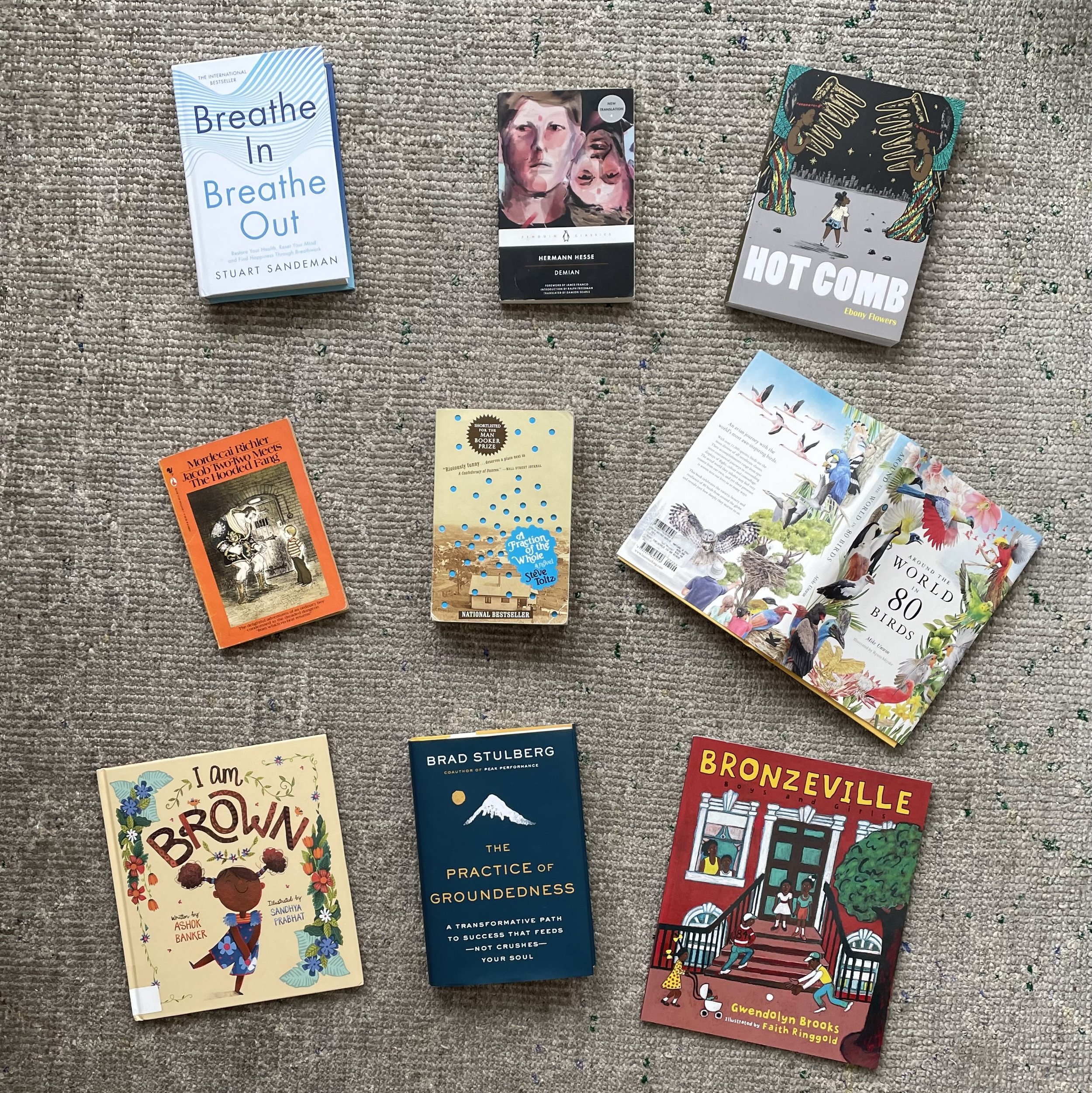
1. Slow Birding: The Art and Science of Enjoying The Birds In Your Own Backyard by Joan E. Strassmann. I went to St. Louis for the first time ever a couple weeks ago. I made sure to see the Eurasian Tree Sparrow (a St. Louis species!), the 630-foot-tall and 630-foot-wide Gateway Arch, and, of course, the famous Left Bank Books. Founded in 1969, it’s an incredible bookstore with the mission to ‘spark public conversation by curating an intelligent, relevant, culturally diverse selection of books.’ That they do! When you walk in there’s a giant Book Club Wall with an immaculate grid of front-facing ‘Current Reads' from a host of store-sponsored + local book clubs. They host a Gay Men’s Book Club, a Lesbian Book Club, and a Well-Read Black Girl Book Club, among many others. They have a wonderful Used / Rare Books basement with a (potentially used / definitely rare) POS system! And there is (of course) the loveable bookstore black puffy cat Orleans, who curls up in a basket under the front table. Oh! And no joke: they host over 300 free public events a year! Those are Books&Books-sized numbers. Since you are not allowed to leave a bookstore without buying a book, I wandered and browsed and asked for some uniquely local books. I ended up with ‘The Twenty-Seventh City’ by Jonathan Franzen (with the Gateway Arch on the cover!) as well as this autographed copy of a wonderful book by St. Louis author Joan Strassman, a professor at 1853-founded (!) St. Louis-based Washington University. What’s the thesis? “If you tie in the biological stories that go with the birds, they will be much more rewarding to watch.” Amen! She splits the book into chapters focusing on 'backyard birds' — Blue Jay, European Starling, Cooper's Hawk, etc. — and then goes wonderfully and meditatively deep on each one, taking us through important research that have helped us learn about their behavior (Cooper’s Hawks in BC have bigger feet than in the Midwest because in BC their diet is mostly caught in mid-air whereas in the Midwest it's more off-the-ground), showing how the birds fit into our culture (“Did blue as a color of law enforcement first come from Blue Jays?”), and then giving us tips to become better ‘slow birders’ for each species (like how to use feather color to guess the age of Starlings). A book to deepen the love of backyard birds and to perhaps help take J. Drew Lanham’s advice to us to wean ourselves off compulsive listing.
2. Wild About Books by Judy Sierra. This is one of the very best books I know to get a kid excited about reading. “It started in the summer of 2002, When Springfield librarian Molly McGrew, By mistake drove her bookmobile into the zoo.” What follows? The animals go wild, simply wild, for books, of course. “Giraffes wanted tall books and crickets craved small books, While geckos could only read stick-to-the-wall books. … She even found waterproof books for the otter, Who never went swimming without ‘Harry Potter.’” Marc Brown of ‘Arthur’ fame does the art and Judy channels her PhD in Folklore (!) into a Seussian-inspired passion for fast-paced rhymes in this delightfully energizing and reading-reaffirming romp through the wide world of books. I noticed online this book has sold over 500,000 copies. That's zillions in the contemporary kids book category! (My kids book sold 50,000.) 20 years later this book is still incredibly popular for good, good reason. Highly recommended.
3. Slow Productivity: The Lost Art of Accomplishment Without Burnout by Cal Newport. Cal feels like a bit of a kindred spirit. He was editor of his campus comedy paper. I was editor of my campus comedy paper. He has no social media apps on his phone. I have no social media apps on my phone. He writes about deep work. I write about untouchable days. He makes books and podcasts. I make books and podcasts. Are we both banging the same drum? Perhaps merging identities? Maybe! So what is ‘slow productivity’? Cal said he first tested the phrase in a February 2022 episode of The Tim Ferriss Show and noticed it had strong resonance with the fractured-attention set. Basically, it boils down to three principles: 1) Do fewer things, 2) Work at a natural pace, 3) Obsess over quality. Sounds simple, right? Trite, even! But that’s when you raise your head and realize the world is conspiring against you doing any of these. I mean, capitalism (or perhaps what Cal coins 'pseudo productivity') tends to reward ... doing more things, working at an unnatural pace, and obsessing over quantity. This is a slim read and it’s full of lengthy deep dives on people like Emily Dickinson, Marie Curie, and Lin-Manuel Miranda, which will hopefully help charge you up to live a slowly productive life. I will add that while I’m not perfect at this I am completely into it and have been for a while. I don’t have any employees — no big team, no big office — and yet in the past 15 years I’ve put out 10+ books, 100+ podcasts, 500+ speeches, and have 4 newsletters, including the daily awesome thing I’ve written since 2008. What are tradeoffs? Lots! Small ones and big ones. On the smaller side: no social media apps, no video games, no Netflix, no ... uh, relaxing? At least it's something I've struggled with. And then, on the bigger side, at least in my experience, by not managing a team, I also, in some sense, trade impact. Scaling, growth, changing a billion lives — yeah, uh, not sure I'll get there. This book did that thing that great books do: It made me think. Helped me wonder and self-examine. Cal is swinging hard here. He's saying: "I've thought a lot about this. I'm idiosyncratic. Now lemme tell you all my ideas." I think with his growing profile as a New Yorker writer and the fact he's only 41 years old we are inching closer and closer to Peak Cal. I highly recommend his podcast Deep Questions and exploring the treasure trove of his bibliography — including long-ago written gems such as 'How To Be A High School Superstar.' Be sure to check out this wonderful book.
4. Dark Age Ahead by Jane Jacobs. I first ‘met’ Jane Jacobs through her 2006 obituary. Now almost twenty years later I find myself increasingly drawn to her voice. In obits The Economist called Jane an “anatomiser of cities” and The New York Times said she was a “writer and thinker who brought penetrating eyes and ingenious insight to the sidewalk ballet…” She is perhaps most famous for helping thwart Robert Moses’ plans to build the Lower Manhattan Expressway, which would have carved up SoHo, Little Italy, and Chinatown, and then she followed that Finishing Move by moving to Toronto and … doing it again! Thwarting the Spadina Expressway which would have shredded our downtown. Jane The Double-Thwarter! When we sat down with Jeff Speck, author of ‘Walkable City’ (3/2020), we fell into a rabbit hole of Jane Jacobs quotes including one of my favorites: “By its nature, the metropolis provides what otherwise could be given only by traveling; namely, the strange.” Well, I recently found a used copy of this book — written at age 88, one year before she died — and found it gripping. In Chapter 1 she writes that “the purpose of this book is to help our culture avoid sliding into a dead end, by understanding how such a tragedy comes about, and thereby what can be done to ward it off ….” She speaks with giant scope and discusses cultures all hitting Dark Ages, including the Roman Empire which crumbled in the fifth century, the Islamic Empire of the eighth to fifteenth centuries, and ancient Chinese Empires that (I learned) ruled the seas 500 years ago — sending 400-foot long ships holding up to 28,000 (!) sailors to Africa decades before Columbus sailed the ocean blue. “Centuries before the British Royal Navy learned to combat scurvy with rations of lime juice on long sea voyages,” she writes, “the Chinese had solved that problem by supplying ships with ordinary dried beans, which were moistened as needed to make bean sprouts, a rich source of Vitamin C.” But then what? You guessed it: Dark age. A new political party comes in and halts voyages and dismantles shipyards. Skills are lost over a couple generations. She goes through that refrain again and again: how we can’t assume that what we have won’t slip away and how we need to actively strive to make things better. This book carries deep wisdom from your activist elder as you learn about the five key pillars of culture, and how they’re currently showing signs of decay. “Families Rigged To Fail,” “Credentialing Versus Educating,” “Science Abandoned,” “Dumbed-Down Taxes,” and “Self-Policing Subverted.” It’s dark territory, and occasionally too micro, but you can feel Jane striving, at the end of her life, to close things out with a positive finish. Clear, punchy, and with a delightful air of Marisa Tomei-on-the-witness-stand-in-‘My Cousin Vinny’ throughout. Highly recommended.
5. The One And Only Bob by Katherine Applegate. Here comes this month's Leslie's Pick! Over to you, Les: "'The One and Only Bob' has just as much emotion and humor as the first book in the series, 'The One and Only Ivan,' (8/2021) and as our 9 year old said, "I think it was a bit better because it had more adventure and less animal cruelty.” I personally preferred 'The One and Only Ivan' (bit more into rooting for a gorilla to escape captivity in a mall than rooting for a dog to find his long-lost sister in a hurricane) but this is still a wonderful book to read aloud with kids who are otherwise reading chapter books independently. There is such strong voice, subtleties that are powerful to pause and discuss, and some more mature themes, but not the even more mature ones like being an orphan, living through war, major bullying, racism, and mental health that I find riddle most chapter books for the 8-12 age group and (to me) seem more appropriate for 12-15 year olds. My favorite part of this book is that we are just both so excited to read it every night. After many nights of him preferring to read alone, I will gladly read aloud any book he wants for the time together, to have our bodies close to each other, have heart-forward discussions, and connect before bedtime. I recommend reading this with your school-age independent reader, too. Can’t wait to read 'The One and Only Ruby' next!"
6. The Sabbath by Abraham Joshua Heschel. Do you wish there was a giant plug we could yank out of the wall one day a week to shut everything down? Dmmmmmmmmm. Remote control buttons don’t do anything. Payment systems go offline. Screens all black. Maybe you hear birds chirping out your window a bit more. Sun on your skin. Look round at your family. Chat with the neighbors. Would it be that different from a few decades ago when essentially nothing opened Sundays? I grew up in the Toronto suburbs in the 1980s and it was agreed: Sunday was family day, rest day, church day, reflection day. “Gallantly, ceaselessly, quietly man must fight for inner liberty,” writes Abraham Heschel in this slim, 73-year-old interpretation and explanation of the Sabbath, the traditional Jewish day of rest from sundown Friday to sundown Saturday. I like the idea. I say bring it back! “Inner liberty depends upon being exempt from domination of things as well as from domination of people.” Yes! The book is slim — 100 pages on the nose — but it’s got a thick, dense, unfurling feeling like some kind of deep-in-the-jungle fern. Heschel came to America in 1940, mastered English, and wrote this book 11 years later as a way to expand and introduce the Sabbath to a wider audience. Why? Simple: “The solution of mankind’s most vexing problem will not be found in renouncing technical civilization, but in attaining some degree of independence from it.”
6. Ghost Town Living: Mining for Purpose and Chasing Dreams At The Edge of Death Valley by Brent Underwood. I first met Brent Underwood about eight years ago when he was running a hostel in Austin, Texas. He had a strong marketing mind, sharpened from years of working with Ryan Holiday, but a calm, easy spirit — sitting in a swinging chair on a porch, pasting Polaroids on the wall, kind of daydreamy way of looking at the world. Maybe that’s why four years ago he mortgaged everything he had to suddenly … uh, buy a ghost town? In the middle of nowhere? And then proceed to get trapped there at the start of the pandemic?? And then become a big-name YouTube star? Didn’t see that coming! But I love what it’s done for Brent and the now millions of people who have followed his pilgrimage and steep personal growth curve to find and connect his place in the world with all that’s come before. I guess hanging out 900 feet below ground — where he, no joke, recorded the audio book to this memoir — will have that effect on a person. The ideas in here aren’t revolutionary but they are earnest and speak to a generation trying to find their way. Pairing personal risk, hard lessons, and online stardom may be the story of our time. A great book for millennials and Gen Zs searching, seeking, trying to find their way. In other words: lots of us! Read the Preface of the book right here.
7. The Librarian of Auschwitz by Antonio Iturbe and Salva Rubio. This is a true and inspiring read-it-in-an-hour graphic-novel distillation of the 433-page book of the same name. Dita Kraus is the 94-year-old Holocaust survivor who, as a young girl, remarkably functioned as a stealthy underground librarian in a Nazi death camp. What do you grasp at, reach for, cling to, when someone is trying to … exterminate your culture? A horrifying question. One answer gently offered here is … books. Stories. To quietly and compassionately (and desperately) pass around ideas and wisdom, despite the circumstances, in spite of the circumstances. This book rings hard today. I was thinking about what little I truly know or understand about what’s happening in the Middle East right now. In the past five months over 30,000 Palestinians in Gaza have been killed. 30,000!? (Source) The UNICEF executive director just said “We haven’t seen that rate of death among children in almost any other conflict in the world.” (Source) Horrifying to contemplate, even despite the circumstances that led to these atrocities. How many stories are being lost? How many will never be told? The authors and illustrators have done a wonderful job balancing many interlacing storylines while being extremely compassionate, careful, and sensitive with the complex material. Highly recommended.
9. There is no 9! Just an update. I've been working with the TDSB for years on cell phone policies. TDSB is the Toronto District School Board, the largest school board in Canada and the fourth largest school board in North America with 238,000 students. After speaking with them in 2018 I recommended a Zones, Modeling, and Fasting idea to address the growing pervasiveness of problematic cell phone use. I was then asked by the Canadian Broadcast Corporation (CBC) to speak to the country on national TV about what I considered 'the biggest problem facing Canadians.' What did I talk about it? You guessed it: Cell phone addiction. Then I was invited back to speak to all Principals and Vice-Principals again last summer and before I spoke I was told "We aren't contemplating a policy change at this time." It's hard to think about policy changes at that level! There are so many variables and so much pushback and policing. But, I'm lucky, I was ... external. So I went onstage and ... called for policy change! I asked Principals and Vice-Principals, for the sake of their students (and my kids who go to TDSB!) to ban cell phones from schools. Many Principals did it on their own in the absence of a higher-level policy. Grassroots! Bottoms up! Then I began working with the Chair and Director on a blanket policy for the board. We were largely drawing on the excellent work by Jon Haidt who has been publishing incredible stuff on his After Babel Substack for the past couple years. (Here's me hanging out in Jon's kitchen talking about this and formative books.) Now, the latest is I'm reading Jon's brand new ‘The Anxious Generation’ which just came out Tuesday (and is #4 overall on all of Amazon ... though I got my copy from my local indie Type Books) and the TDSB has just announced a $4.5 billion lawsuit against Meta, TikTok, and Snapchat. The tide is shifting! We know cell phones are dangerous. Let's raise the social media age to 16! Let's ban cell phones from classrooms! Let's avoid smartphones before high schools! Brains only get one change to develop. Let's keep pushing ...
Interested in more of my reviews? Read my monthly book clubs or visit my Goodreads page.
Click here to join the Book Club email list.
Neil Pasricha's Monthly Book Club - February 2024
Neil's Monthly Book Club is my oldest and most popular email newsletter. Click here to subscribe.
Hey everyone,
Hope you’ve had a great February.
I got so many generous replies to my recent blog post on death. Thank you for your love, poems, thoughts.
On the podcast, I feel like we’re in a wonderful flow. Today's the full moon — this minute actually, look up! — so I'll send a letter about it to those of you on my 3 Books email list after lunch with details. Upcoming guests include Celine Song, Susan Orlean, Jonathan Franzen, Maria Popova. As always, if you have a guest suggestion, just give me a shout at 1-833-READ-A-LOT. (Yes, this is my phone number.)
And now, as we’ve done every month since October 2016, here is every single book I read this month along with my honest review. Few were tough to write this month. I don't love trashing Harry Potter. But, as always, nobody can buy their way onto my book club and nobody can buy their way off.
Know someone who'd like to join our reading or hopeful-to-read-more tribe? Just forward them this email. Howdy, newcomer! Great to be with you and you can sign up right here.
Now let’s hit the books…
Neil
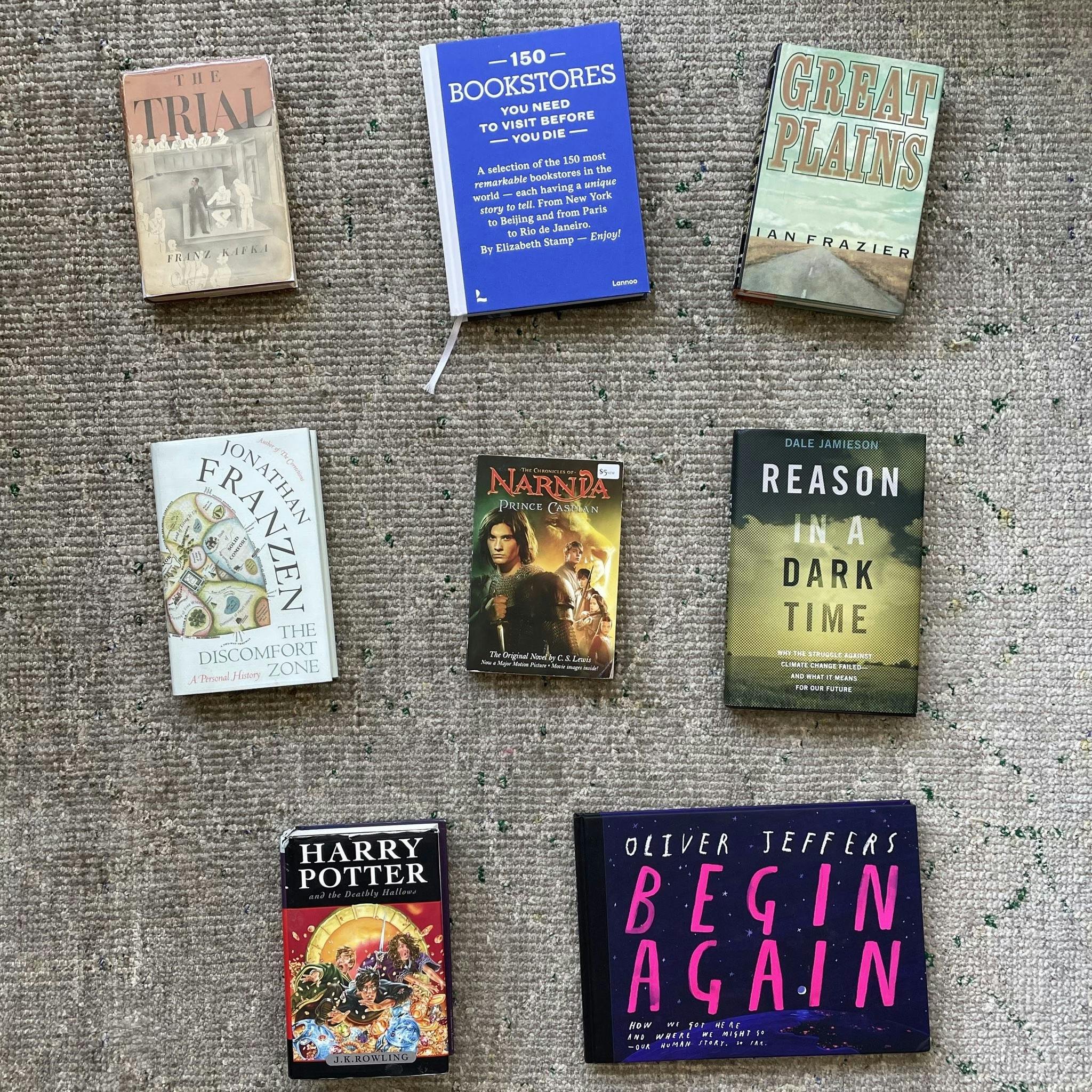
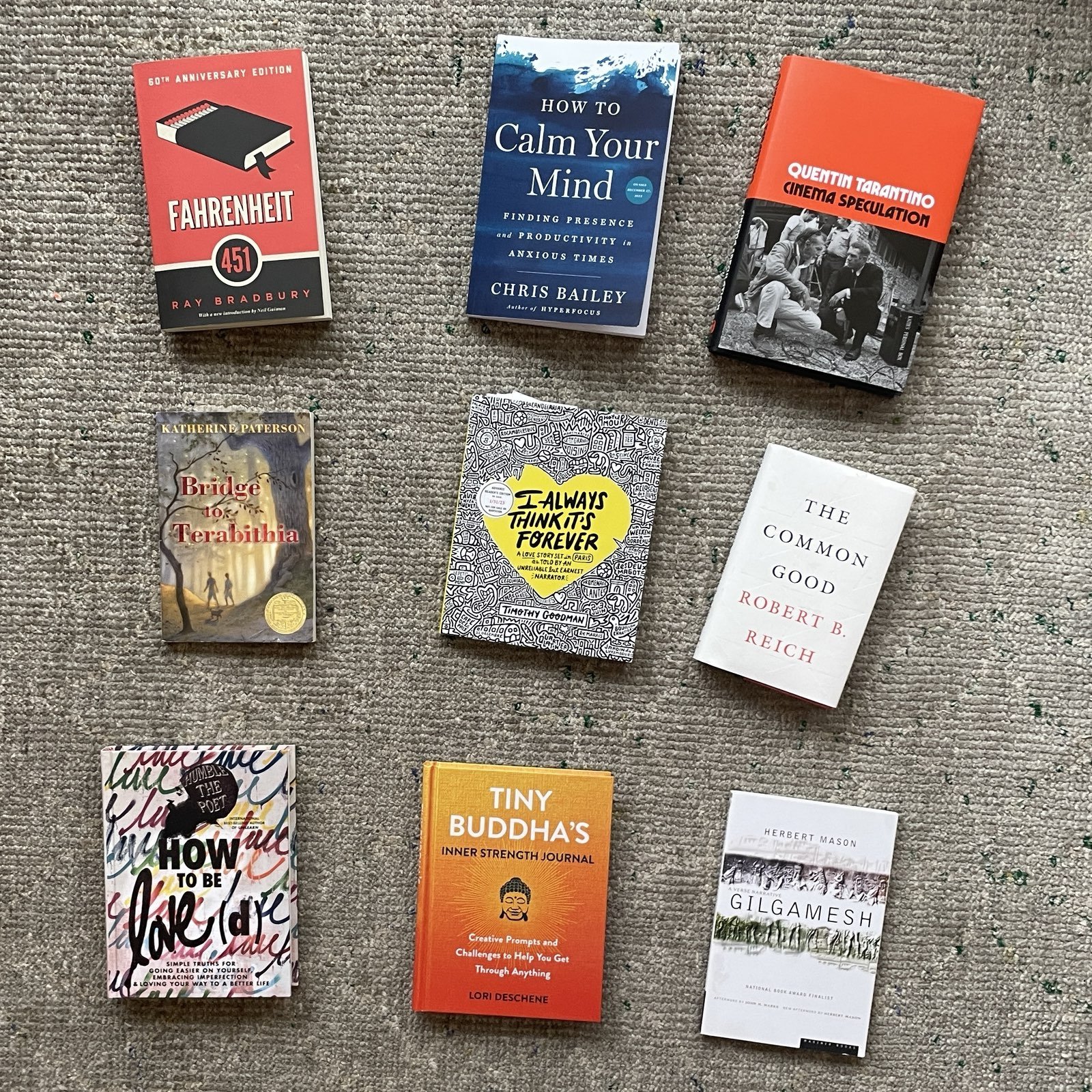
1. The Trial by Franz Kafka. “No one’s got Kafka these days,” Patrick told me recently, petting his cat behind the counter at the underground used bookstore mecca Seekers. “Can’t keep him in stock. Nobody can. Hits too close to home these days.” Could that be true? No used bookstore in all of Toronto has anything written by the 1883-born Franz Kafka? This is a guy who instructed his buddy Max to burn all his unpublished books after he died. Max, sharp dude, did the opposite. I went hunting in a few used bookstores – gotta buy Kafka used, I figured! – but eventually caved in and went online to AbeBooks to find the 1954 edition of the 1925 publication of the 1914 written book that sounds like a 100-year-in-the-future prophecy of our low-trust surveillance state. First sentence sets the scene: “Someone must have been telling lies about Joseph K. for without having done anything wrong he was arrested one fine morning.” Why? “We are not authorized to tell you that,” say the cops, who are mercilessly beaten in a closet later on. This is a slowly-closing-in-on-all-sides tale of foreboding. Can you imagine being arrested by a remote, inaccessible authority, without your crime being revealed to you? Maybe doesn't seem as farfetched as it should! There's a reason kafkaesque became a word, after all. Max stitched the chapters together from Franz’s handwritten scraps so chapters do feel occasionally ... stitched together. But it does all add up to a highly engrossing, wonderfully paced, increasingly bleak book that gave me skin-crawling anxiety. Yet there is art in the bleakness! Reflection and thundering thematic resonance across space and time. Highly recommended.
2. 150 Bookstores You Need to Visit Before You Die by Elizabeth Stamp. Lots to like about this book! Lots to not like, too. But let’s start with the positive: It's a beautiful, colorful collection of some of the world’s most stunning bookstores, paired with a 200-ish word writeup mentioning what makes each unique – from the “Winnie Mandela mural” (Cheche Books, Nairobi, Kenya), Pacific Northwest section (Arundel Books, Seattle, Washington), or unique, store-made stationary (Podpisnie Izdaniya, St. Petersburg, Russia). Cliffside bookstores! Main Street Mississippi bookstores! Glass boxes in the middle of Chinese jungle bookstores! Everything’s here! Or: so it seems. Then you look closer. And realize it's not. So that’s my quibble. The book just isn’t in any way … authoritative. Like here in Toronto, for instance. We’ve got one bookstore featured from the city. Great! But, no offense to Queen Books, they picked the wrong one. Type Books, which Queen Books is clearly based on, is not featured – but Type is superior. More history, more events, more weird genres (“Plotless Fiction” becoming so culty they’ve stamped it on T-shirts now.) Or what about the four-story baby-blue behemoth BMV? Way more of a standout on the Toronto bookstore scene, with its entirely-graphic-novel attic, basement full of vintage 70s pinup mags, and lock-and-key rare book glass shelves featuring $700 dictionaries. And no Monkey’s Paw? Come on. There’s a reason Monkey’s Paw is featured in Atlas Obscura. The place sells “Old and Unusual Printed Matter” and has the world’s only Biblio-Mat – an incredible book vending machine! How do you skip any of those for newbie Queen Books? Or Parnassus Books in Nashville, or The Painted Porch in Bastrop, or Nowhere Bookshop in San Antonio? How do you miss them? By… uh, not visiting. Yes, upon closer inspection, the book is written by Elizabeth Stamp, about whom we get 0 biographical info. Is she a bookseller? Book tourist? Book anything? Where does ... she live? Nobody knows! (I googled her and the answer is none of the above.) Stamp just picked, according to the intro, “bookstores I’d want to visit.” Ohhhhh. Want to visit. That’s why the Photo Credits at the back have a slew of iStockPhotos. Booooooooo! I give credit to Belgium-based Lannoo Publishing. They’ve figured something out. I know this book will look pretty on coffee tables but we need someone to fly around the world for a few years to put together something better. Who’s up for the job?
3. Great Plains by Ian Frazier. On the inside flap of this journalistic masterpiece are two faded-orange maps. The one on the left shows the “Great Plains c. 1850” with Coronado’s 1541 trail, Lewis and Clark’s 1804-1806 trail, and Parkman’s 1846 trail curling through Blackfeet, Sioux, Cheyenne, and Comanche country. The one on the right shows the “Great Plains Today”, with the same geography now labeled top-to-bottom with Montana, the Dakotas, Wyoming, Nebraska, Colorado, Kansas, New Mexico, Oklahoma, and Texas. And, instead of Lewis and Clark, we get “Frazier’s Route”, with the New Yorker humorist’s black-lined 25,000-mile routemap circling these states top to bottom, around and through, as he drove through them in the 80s. Booktuber Ariel Bissett once told us that books are places – taking you somewhere you’ve never been and leaving you with a satisfying sense of visiting afterwards. In this book, a local helps you through barbed wire fences, a radio announcer comes on and says “… if there’s anything you don’t want blown away, you better tie it down”, laundromat signs scream “Do Not Wash Rig Clothes Here”, and “a spider as big as a hand crosses the pavement.” Part travelogue, part David Sedaris diary (3/2022), this is a wondrous, mind-everywhere book that feels like a long road trip. You’ll feel the sun, you’ll feel the wind, and you’ll never want to run out of gas. Highly recommended.
4. The Discomfort Zone: A Personal History by Jonathan Franzen. Between his monumental 2001 National Book Award-winning 'The Corrections' and his monumental 2010 Oprah-and-Obama-praising 'Freedom', Jonathan Franzen quietly released a slim sub-200-page memoir told in six essays. I recommend this for anybody who’s gorged on Franzen’s fiction and wonders about the inner life that’s conjuring up his magic shows. Ultimately, the life story is kind of, you know, normal. Geeky kid grows up in St. Louis suburbs, with a couple older brothers, plays pranks in school with his buddies, falls in love with birds. But the magic here is in his frankness, bluntness, honesty, and poetic, dark asides, like this paragraph about the rich getting richer and the poor getting poorer: “Fabulous to be a defense contractor, shitty to be a reservist, excellent to have tenure at Princeton, grueling to be an adjunct at Queens College; outstanding to manage a pension fund, lousy to rely on one; better than ever to be bestselling, harder than ever to be mid-list; phenomenal to win a Texas Hold ‘Em tournament, a drag to be a video-poker addict.” Franzen’s keen eye turned inwards for the superfans.
5. Prince Caspian by C.S. Lewis. According to the Chronicles of Narnia 'Reading Order’, this is the second book to read in the 7-book Narnia series. Start with ‘The Lion, The Witch, and the Wardrobe’! (3/2018) First one, big one! That book came out in 1950, takes place in 1940 (Earth time), and 1000 (Narnia time). This book, ‘Prince Caspian’, came out in 1951, takes place in 1941 (Earth time), and 2303 (Narnia time). Bit of a bummer for the four Pevensie siblings to discover when they get back to Narnia the kingdom they once ruled (after defeating the White Witch in book one) has fallen into disarray. Animals hiding! Land dark! But, luckily, Prince Caspian escapes his evil stepfather, finds the talking animals, and then they all team up with the Pevensies to stage an epic battle to rule the kingdom. Not as good as the first book, I have to say. Maybe it only felt paint-by-numbers to me because it was the paint for so many fantasy series to follow. But I came away missing the rolling, swelling, poetic writing in ‘The Hobbit’, and ultimately this book helped me steel myself to finally tackle ‘The Lord of the Rings.’ Are you on Team CS or Team JRR? Kevin the Bookseller sold us hard on Lord of the Rings in that wild bouncing-around-a-bookstore chat we had back in Chapter 44. I do feel my allegiances growing to Team JRR. One series to rule them all, one series to find them...
6. Reason in a Dark Time: Why the Struggle Against Climate Change Failed – and What It Means for Our Future by Dale Jamieson. You got a great brain. Me too, if I do say so myself. We all own one of these extremely handy objects that are good at so many things! Unfortunately, solving climate change just isn’t one of them. “Evolution built us to respond to rapid movements of middle-sized objects,” writes Dale Jamieson, “not to the slow buildup of insensible gasses in the atmosphere.” Indeed. Climate change was international news 75 years ago! There was momentum. Summits! Pledges! Signatures from heads of state saying yes, yes, yes, we’ll reduce our greenhouse gas emissions. What’s happened since? The … exact opposite. The earth is heating up fast. Rising sea levels are soaking coastal cities. Climate migration is spiking. Weather patterns are in disarray. We didn’t even get snow this winter in Toronto! Why? Well, “climate change poses the world’s largest collective action problem. Each of us acting on our own desires contributes to an outcome we neither desire nor intend.” This is a necessary, detailed, devastating story of our increased awareness of human-created climate change, our failed attempts to do anything about it, and what happens next. It’s not simple! After opening with “The Nature of the Problem” and “Obstacles to Action” (which are worth the buy alone, just for the clear history presented that these days gets washed away in the slipstream of screaming on socials) the book gets into headier topics of morality and philosophy that try and pull apart the problem in the many ways we think about it. One memorable section shows the increasing abstraction that climate change plays on our minds from, you know, Jack stealing Jill’s bicycle is wrong, all the way up to “Acting independently, Jack and a large number of unacquainted people set in motion a chain of events that causes a large number of future people who will live in another part of the world from ever having bicycles.” Which is sort of what’s happening. Over 80% of global carbon emissions come from 10 countries. Who is it? That would be … us. Or people who, you know, drive, fly, buy stuff that comes from the other side of the world. Complexities of global economics and neverending disagreements on how to measure these things prevent the plastic bouncy ball bought from the dollar store and tossed in the birthday party loot bag from coming anywhere close to being properly priced. So what do we do? Jamieson closes with seven priorities: “integrate adaptation with development” (tie together the math on climate change with our goals on reducing poverty), “protect, encourage, and increase terrestrial carbon sinks” (stop cutting down rainforests and plant new ones), “full-cost energy accounting” (bouncy balls at dollar stores costing more than a buck), “raising the price of emitting greenhouse gasses” (black billowing smoke into the sky isn’t free), “force technology adoption” (like ditching coal-burning plants in favor of newer tech), and then making “substantial increases in research”, and, finally, to “plan for the Anthropocene.” We’re there, he’s saying, so let’s work on that. This is the kind of book most people will run away from. Or think the understandable “I’m just one person and I can’t possibly change things.” But we can take small acts: biking instead of driving, avoiding disposable junk, carbon offsetting flights. And, you know, at minimum, for the future of our species, being informed about what’s happened, what’s happening, and what we can help happen. Jamieson spent 25 years on this book – “I began writing when I turned 40 and handed in the manuscript when I turned 65” – and the detail, of thoughts, ideas, and research shows. It’s not an easy read. I alternated chapters on audio. (David Sedaris gave us that tip for ‘hard books’ back in Chapter 18.) But it’s a necessary read. Sure, I feel depressed, but in a much stronger, much more aware place, to at least understand what’s happening, why it happened, and then guide myself, and ideally my politicians, to keep the pressure on making change and, finally, ultimately, adapting. Highly recommended.
7. Harry Potter and the Deathly Hallows (Book 7) by J. K. Rowling. Like Harry Potter and the Half-Blood Prince (Book 6) (8/2023), I read this right when it came out. Like ten minutes after it came out. I waited in line at Chapters Rideau in Ottawa, Canada for midnight copies and was lying in bed at age 31 till the wee hours excitedly thinking “I am one of the first people in the world to be here right now!” That was 2007. But my 17-years-later self kind of withered from the few hundred extra pages of aimless Horcrux hunting in this final installment. The deep, long, somewhat pointless sidebar into Dumbledore’s sister and mom. I don’t mean to be snide. I love Harry Potter! And, I should say, that’s not all that happens. There is also the senseless murder of a major character every 50 pages. Yes, we do get the epic 100-page fight scene of Harry and Lord V circling each other in the Hogwarts atrium dispensing plot reveals (“You touched the elder wand last!”, “No, you touched the elder wand last!”). And I will always love the book for what it is, what it was to me, what it will be to my kids I’m sure: A gateway drug to reading. A ticket to the world of “books as rock stars”. I mean, J. K. Rowling did a reading of Harry Potter in the Skydome. 20,264 people (seriously) listening to an author? That’s great! That’s gold. But ultimately, I’m just sort of torn up about the revisiting. No reader steps through the same river twice, I suppose. I did enjoy watching characters like Neville in their slow-building arc and, you know, I cried half a dozen times on the pillow next to my son. You know the scenes. But I have mixed emotions. Partly surfacing, maybe, from also just watching the first Harry Potter movie. Did we ever really feel sparks between Ron and Hermione? Did we really need that ‘19 Years Later’ chapter at the end? Ultimately, Book 7 wasn’t as good as Book 6, which wasn’t as good as Book 5, which wasn’t as good as Book 4, which wasn’t as good as Book 3. OK, it was better than the first couple. I’ll give it that. Azkaban, baby! Tentpole of the series! Thanks for the trip, J. K. It was a helluva ride and I’m sure I’ll be back with my next kid.
8. Begin Again: How We Got Here, and Where We Might Go – Our Human Story. So Far. by Oliver Jeffers. This isn’t a children’s book but a long visual essay that stirs a Sapiens-like species history into a disaffected artist’s worldview with a spirited hopefulness for the future. What’s Jeffers's recipe for our post-“cogs in the machine”, Total Entertainment Forever-type present? He says we get there “By slowing down. By creating better stories. Bigger ones where we all fit inside the same powerful plot. In which we think beyond our own lifetimes.” I’m not sure what children Harper Collins Children’s Books had in mind here with this massive, thick, thirty-dollar hardcover. Feels more geared to high school art students. It’s stunning to look at – evocative neon pinks and splashy purple watercolors with cavemen walking out of oceans and inventing rocket ships. But, ultimately, a one-and-done read that’s heavy on moralizing without adding much to the conversation. I’d skip this for Oliver’s earlier books like ‘How to Catch a Star’, ‘Lost and Found’, and ‘The Way Back Home’ and even, in this newer, more zooming-up-and-out political spirit, his 2017 “Here We Are: Notes for Living on Planet Earth.”
9. There is no 9! You hit our regular loot bag of links. First up, I was stunned by this New York Times piece on "A Marketplace of Girl Influencers Managed by Moms and Stalked by Men." I was brainstorming a 'what if we got a million signatures on a petition to increase the social media age' ... but maybe that's not the right approach. What do you think? At least the UK is putting an end to phones in classrooms — Rishi Sunak nailed it with this launch video. Brené Brown shared a blog post with the first line 'My mom died on Christmas morning.' Jason Fried reminds us to 'never delegate your word'. In an era of bots, we trust brains! Have you forgotten how trippy 'Be Our Guest' is? Bryan Johnson was on the Rich Roll podcast and it kind of blew me away — here are my pop-out quotes to see if you're up for the 3-hour trip. Oh! And, for those who've read 'The Happiness Equation', I invented a follow-up to The Saturday Morning Test called The Sunday Night Suffix. Finally! Remember it's the full moon so Chapter 133 is live right ... now.
Interested in more of my reviews? Read my monthly book clubs or visit my Goodreads page.
Click here to join the Book Club email list.
Neil Pasricha's Monthly Book Club - January 2024
Neil's Monthly Book Club is my oldest and most popular email newsletter. Click here to subscribe.
Hey everyone,
How was your January?
We’ve been desperate for snow in Toronto. Everything is gray, slushy, twig-silhouettey.
So much in the air these days – love, fear, connection, disconnection. And I feel this growing sense of loneliness. Research says 1 in 2 American adults feel “lonely” now – which is worse for our health than smoking 15 cigarettes a day. I know the feeling! Felt it for years. In and out of relationships. Many / most of us have!
Wondering about loneliness, and eager to learn more about what creates healthy connection and community, made me reach out to 76-year-old Oxford Professor Robin Dunbar, most famous for coining ‘Dunbar’s Number.’
I had my mind blown by the gleeful, quick-of-tongue, anthropologist-evolutionary-psychologist who offered so much context, history, and advice on how we live rich, full, connected lives. I just dropped the chat as my first-ever video podcast.
Also, I’ve been working with a few folks at the Toronto District School Board to think about how to ban cell phones from classrooms. After I spoke to principals a sixth-grade teacher told me “Phones ring all through class. They know there’s no ban. And, trust me, it’s always the parents calling.” Does your school board ban cell phones – or have some policy? (Let me know what’s working!) Btw: I think the best researcher on this topic today is NYU professor Jonathan Haidt who is publishing wonderful work and whose new book "The Anxious Generation: How the Great Rewiring of Childhood is Causing an Epidemic of Mental Ilness" drops March 26, 2024. (I pre-ordered my copy from my local indie but I see Jon just tweeted it's on sale at Barnes&Noble)
Anyway! What do we do when things feel like a lot?
READ! MORE! BOOKS!
Scroll down for reviews of the books I read this month...
Neil
PS. Oh, and every January I remind you this Book Club is one of four email lists I have. You can also get my midnight awesome thing, bi-weekly blog post, and/or full-moon podcasts. Adjust your dosage right here.
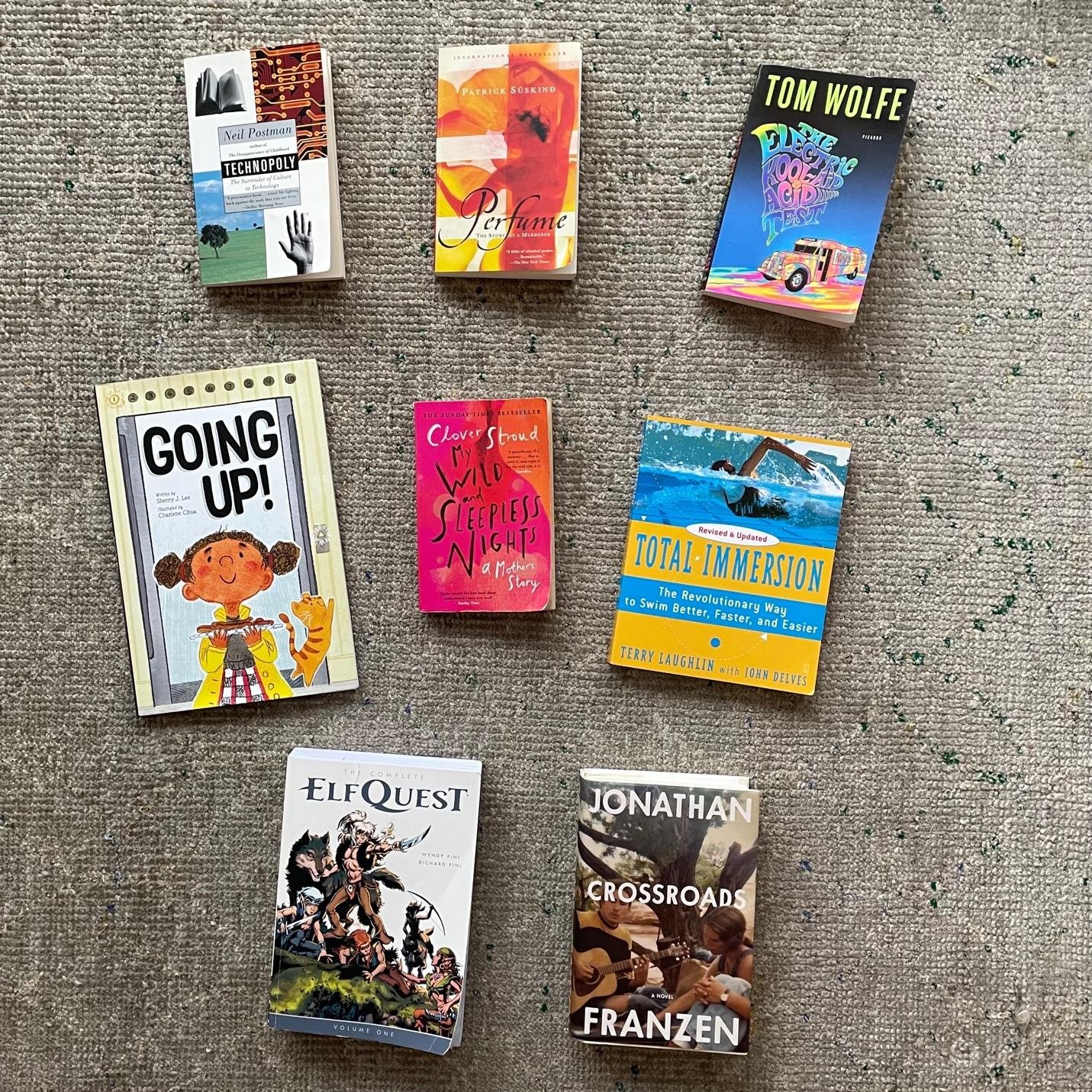
1. Technopoly: The Surrender of Culture to Technology by Neil Postman. A prophetic 30-year-old manifesto about the dangers of pervasive technology by NYU professor Neil Postman, who died in 2003 at age 72. A book that illuminates the algorithm and AI conversations we’re having today. I first heard of this book while reading “It’s Time to Dismantle the Technopoly” in The New Yorker by Cal Newport (excited for his, too!) where he calls this book Postman’s “masterwork”. It’s not nearly as famous as "Amusing Ourselves to Death" (picked by Mitchell Kaplan in Chapter 16!) but it sure is a sloshy bucket of ice-water to the face. The book opens by saying, yes, of course, technology gives us great riches, unfathomable riches, but that it also takes something away. (He excerpts a fascinating couple of 95-year-old paragraphs from Freud.) Postman then says “once a technology is admitted, it plays out its hand; it does what it is designed to do. Our task is to understand what that design is – that is to say, when we admit a new technology to the culture, we must do it with eyes wide open.” Yes! I think of the mere 5000 days we've had with social media and the seeming eye-opening we're going through now. There's so much Technology Archaeology here with Postman endlessly pulling out sandy shards from 500, 1000, or 2000 years ago. The book was written in 1992 (I love 1992!) but honestly feels like it was written tomorrow. Casts that wide a timescale. Sample sentence from Page 10: “In introducing the personal computer to the classroom, we shall be breaking a four-hundred-year-old truce between the gregariousness and openness fostered by orality and the introspection and isolation fostered by the printed word.” Everything is backed up with a fat Notes, Bibliography, and Index, making this book much shorter than it seems when you pick it up (199 pages!). And Postman's an artist, too. I love when he references fiction like: “As described by Farley Mowat in "The People of the Deer", the replacement of bows and arrows with rifles is one of the most chilling tales on record of a technological attack on a tool-using culture. The result in this case was not the modification of a culture but its eradication.” He quotes poetry, he quotes the Bible, he quotes C.S. Lewis. It's a spellbinding magic trick of an enormous mind. And the result is a bubbling manifesto cautioning us against the “technopoly”. Which is? “… a state of culture [and] a state of mind. It consists in the deification of technology, which means that the culture seeks its authorization in technology, finds its satisfactions in technology, and takes its orders from technology.” Hmmm, OK. And what permitted this so-called “technopoly” to flourish in America first? Many things! Including “American distrust of constraints”, “the genius and audacity of early American capitalists”, and “the success of twentieth-century technology in providing Americans with convenience, comfort, speed, hygiene, and abundance so obvious and promising that there seemed no reason to look for any other sources of fulfillment or creativity or purpose.” If this sounds meaty, we’re only on Chapter 4, and get ready because Nietzsche, Darwin, Marx, Freud, Watson, and Einstein are all quoted in the next paragraph. Meaty, my friends. Probably need to read it five times to understand it. And I disagree with some, for sure. But that’s what makes it great. Illuminating, relevant, flying-through-time-portrait of our historical relationship with technology and potential implications for our cultures, communities, and relationships as we alllll fly together right now in warp speed. Highly recommended.
2. Perfume: The Story of a Murderer by Patrick Süskind. Oscar nominations just came out! I was thrilled to see ‘Past Lives’ nominated for Best Picture. Leslie and I loved it so much we went back to theaters to see it again. And then I reached out to Celine Song, writer, director, genius (debut!) filmmaker, and she kindly agreed to chat about her 3 most formative books. And, of course, as is the case with almost every book to almost every person, I hadn’t heard of any of them. Her first two formative books, Bohumil Hrabal’s "Too Loud a Solitude" (11/2023) and Stefan Zweig’s "Chess Story" (11/2023), were good. Not must-reads, but, you know, good, solid books. But this! Her third formative book is on another plane. Celine calls it “sumptuous.” Sumptuous, yeah. Rich. Decadent. Overwhelming, in some ways. For one thing, Süskind has the world’s greatest ability to create “smell-portraits”. On Page 1 he’s describing the stench of France in 1738: “The streets stank of manure, the courtyards of urine, the stairwells stank of moldering wood and rat droppings, the kitchens of spoiled cabbage and mutton fat; the unaired parlors stank of stale dust, the bedrooms of greasy sheets, damp featherbeds, and the pungently sweet aroma of chamber pots.” He does this over and over: olfactorily yanking us into a scene. “People stank of sweat and unwashed clothes; from their mouths came the stench of rotting teeth, from their bellies that of onions, and from their bodies, if they were no longer very young, came the stench of rancid cheese and sour milk and tumorous disease.” Yet, somehow, it’s a speedy plot, too. The book tells the life story of poverty-stricken, nasally-gifted, slumdog-orphan Jean-Baptiste Grenouille from his birth in the “most putrid spot in the whole kingdom” on July 17, 1738 through his zero-to-hero-to-zero-to-I-won't-ruin-the-ending arc as a perfumer to a “hot day, the hottest of the year” in Paris on June 25, 1766. This 28-year span is told with a scene-creating vividness that reminds me of David Mitchell ("Cloud Atlas" [06/2019], "Black Swan Green" [11/2016]). I found myself amazed, disturbed, and awed by this book. It had a tug. A pulling. It did that thing novels do, which is to offer a range of emotions unlike almost anything else. Books rattle from the inside. This book is a rattler. Read the Plot Summary if you want. Written in 1985 in German (as ‘Das Parfum’) it has been on Der Spiegel's bestseller list for decades and sold over 20 million (!) copies. Yet: The author, now-76-year-old Patrick Süskind, is a ... recluse. No one knows where he lives. No one knows what he looks like. Heard of him? I hadn’t! And yet: 20 million copies make it one of the top-selling books of the past century. Mysterious! Adding this to my TBRA as it surely deserves To Be Read Again. Next time I may try audio. If you want to go audio, try Libro or Libby. Highly recommended.
3. The Electric Kool-Aid Acid Test by Tom Wolfe. This is the 1966 back-of-the-bus New Journalism view of one of the birthplaces of the hippie movement. What birthplace? The one where "One Flew Over the Cuckoo’s Nest" author Ken Kesey races headfirst into the not-yet-illegal world of LSD with his revolving band of 10-14 friends (aka the “Merry Pranksters”, who included Neal Cassady and future members of The Grateful Dead) as they drain six figures of Kesey’s book royalty payments to fund a just-purchased-just-spraypainted school bus drive across America to share their newfound light-bright awareness with the world. Uh, seems to have worked!? From Steve Jobs to Elon Musk to Tim Ferriss, it feels like LSD has penetrated the culture. It’s extremely wild to hear, really hear, what’s coming out of the mouths of people trying it over 50 years ago. Now, I found the first 100 pages of this book the best 100. That’s the bus trip coming together and the actual drive. Rest is what happens after. But the trip! Geez, what a trip. You’ll feel like you’re right there …. right there getting into an argument with a Texan gas station attendant when a dozen of your unwashed stoned friends suddenly line up outside the gas station bathroom … right there in the humbling cold-shower moment your wild rambunctiousness hits the ceremonial seriousness of “the-other-LSDers”, Timothy Leary and Richard Alpert (pre-Ram Dass) … right there setting up banners and painted road signs to invite the Hell’s Angels to your house to introduce them to LSD. This book is a vibe and most of my life I would have chucked it before finishing the first fifty chaotic pages. But I loved, loved, loved "The Bonfire of the Vanities" (08/2018) and "A Man in Full" (04/2019) and felt I owed it to Tom Wolfe to keep going. And then at some point, I finally realized: Ohhhhh. This is ... how it was. He’s writing it this way to make you feel ... like it felt. What a magic trick! (I later found an Author’s Note on Page 415 where Wolfe writes: “I have tried not only to tell what the Pranksters did but to recreate the mental atmosphere or subjective reality of it.”) No kidding, Tommy! Maybe tell us before next time. Anyway, the net result is an unbelievably-inside inside view of the culturally shifting mid-60s where you get to play Ken Kesey or, more realistically, the only sober one at Ken Kesey’s house. Non-fiction journalism fused with avante-garde poetry. And the whole time, I cannot say this enough, you feel right there … right there with friends getting insomnia saying insane things … right there with friends stripping down and jumping in ponds … right there careening down steep mountains hills on the roof – the roof! – of the bus. Cop teasing! DMT experiments! It’s all here! And it comes wrapped in the general late-night party feel of both excitement … and exhaustion. A helluva book.
4. Going Up! by Sherry J. Lee. Illustrated by Charlene Chua. You are a happy, smiling young Black girl in a gray sweater and checkerboard plaid skirt baking cookies with your dad before heading up to the 10th-floor Party Room for a birthday party in your downtown apartment building. Going up! Next floor pop in happy, smiling Santucci brothers – white redhead bikers in shredded skull tank tops and arms full of tattoos. Going up! Next floor pop in a happy, smiling, birthday-balloon-toting lesbian mixed-race couple with their giant sweatered dog. Going up! Next floor pop in happy, smiling Mr. and Mrs. Habib, in a sari and kurta pyjama with happy, smiling grandkids Yasmin and Jamal holding a bowl of gulab jamun. And the book keeps going up! Lots more floors after that. A raucous celebration of community, diversity, and apartment-building love. I adored this book. Get it read aloud to you on YouTube right here.
5. My Wild and Sleepless Nights: A Mother’s Story by Clover Stroud. We haven’t done a Leslie’s Pick in a few months! Time to bring it back. Enter Leslie: “My dear friend Kelly sent me this book in a package from London with a handwritten card that said ‘You have to read this. When you’re done, pass it on to Heather.’ Unfortunately, I couldn’t pass it on to Heather, because I folded down too many pages, underlined too many sections, and already can’t wait to read it again. (I did send her a fresh copy!) Clover attempts to answer the question, ‘What does motherhood feel like?’ I have never read such a poignant, detailed, accurate, beautiful, staggering, vulnerable account of motherhood (the only other book that does this, about the first year of motherhood, is 'Brave New Mama' by Vicki Rivard). She talks about the pain of breastfeeding, sex as a mom, the judgment she feels over having a fifth child, how she craves giving birth as a way to touch where life and death collide, how messy her house really gets, and the grief she experiences as her eldest becomes a teen. This book took my breath away and made me feel connected to mothers around the world and through time. I kept on turning to Neil saying, ‘Please, can I read you another paragraph? Just one more!’ because Clover put into words experiences and feelings I haven’t been able to articulate. An absolute must-read for anyone who knows, deep in their heart, what motherhood feels like but can’t quite put it into words, and for anyone who is curious about the deep emotional soul of motherhood.”
6. Total Immersion: The Revolutionary Way to Swim Better, Faster, and Easier by Terry Laughlin with John Delves. I learned how to swim in my 30s. Bit late to the game! A childhood full of ear infections and tubes left me starting swimming lessons when I was a decade older than all the other kids in the three-foot pool. I sputtered, sank, and swerved my life the other way. Now in my 40s, after a few "Adult Learn To Swim" classes, in a story I sometimes share in keynote speeches, I can stay afloat and do the front crawl ... but not much more. Enter this book! My friend Frank Warren sent it to me and it’s like having a swimming coach in your pocket. Simple things, like “reshaping the vessel”, help teach swimming with less effort. How? By consciously pushing your airbaggy chest down so your legs come up – helping to avoid the log-floating-in-a-pond posture I typically use! What else? Learning that “what you do between strokes is more important than how you take the stroke.” Uh, what you do between strokes? Right! Lengthen your body! Less drag. And it goes on and on. I actually took this book with me to the public pool a few times, got my courage going by reading a few pages or a chapter, and then jumped in to try. Did the book turn me into an Olympian? No. It did not. But it gives me new things to try and I can feel my Swimming Confidence nudging up and up.
7. The Complete Elfquest by Wendy Pini and Richard Pini. At the end of Chapter 35 of 3 Books with Jen Agg, I played a 1-833-READ-A-LOT voicemail from 3 Booker Gavin from Longmont, Colorado who shared how Elfquest, a comic that ran over 40 years starting in the 70s, was formative to him. He then recently wrote me, four years later, to see if I ever read it. Well, I hadn’t, but I thought 'This sounds like a great gift' and bought it for my oldest son. He opened it Christmas morning and … we didn’t see him much over the next few days. He fell into the transportive, visually dense 720-page (!) odyssey of Elfquest. I just asked him what he thought and he says: “It’s good, dad. Really good. So basically, it’s about these elves, who live in a forest, and there are humans they fight against, and one day the humans use fire to burn down the woods, and then the elves go down to the troll caves to survive, but then the trolls betray them and lead them to a desert, and they can barely survive there, and then they meet another tribe of elves, and first they fight with them, but then they start working together, and then the leader of the elf tribe who lived in the woods leaves to look for more elves, and they find the high ones, which are their leaders.” For fans of adventures and quests. Think Percy Jackson! Big thanks to Gavin for the tip-off. (If you have a formative book you’d be willing to suggest or share with me, just give me a ring at 1-833-READ-A-LOT. It’s a real phone number! I listen to every message and for six years I’ve played a voicemail at the end of every Chapter of 3 Books. If I play yours I will sign and personalize and mail you a book – anywhere in the world. I love analog, phone call, crinkly envelope communities.)
8. Crossroads by Jonathan Franzen. There is nothing like a Jonathan Franzen novel. Nothing like it! Pulsing, messy, scabrous, erotic, reflective, breath-holdy, shocking, punchy, illuminating. Plot twists! Pitch-perfect dialogue! ‘Okay, okay, but what are they even about?’ Leslie asked me as, once again, we found ourselves struggling to zip a suitcase with a 600-page hardcover on top. ‘A family drama, basically,’ I said, ‘With the first 400-ish pages in this book taking place over literally one day, on December 23, 1971. Then the final 200-ish pages are the following few months.’ And what a family drama! We follow the Hildebrandts – father Russ, mother Marion, and four kids ranging from college-age Clem to high school social queen Becky to drug-dealing tenth grader Perry to little, almost invisible Judson – as they navigate complex inner-outer lives around their church in the fictional small town New Prospect, Illinois. Every chapter gives each character’s unique perspective and backstory – alternating in that ‘Babysitter’s Club Super Special’-style – until the slow-pounding 200-page fireworks display at the end. Every private, embarrassing, scandalous thought – it’s there. The characters might be dark – but there’s a humanity, a beauty, an inner-inner life, that Franzen exposes like almost nobody else writing today. Perry resolves to quit smoking weed! Clem feels morally compelled to sign up for Vietnam! Becky sets her sights on the churchgoing folk singer! Secretly-psychiatric-seeking Marion struggles to make sense of her past in a remarkably lifelike appointment with her therapist aka “the fat dumpling.” And Russ! I don’t know where to begin. He’s churchy, nerdy, horny, and has an almost “violent pacifism.” This book is a trip. You’ll walk across “unrecent tire tracks”, feel the stare of “that glower of his”, and watch “resinous knots of juniper explode in orange sparks.” 10/10 on character, 10/10 on plot, this is a twisting acrobatic plunge into the deep pool of literature. I might suggest starting with "The Corrections" and then "Freedom", but if you’ve read those, and even if you haven’t, "Crossroads" will take you far, far away. A book to help us stare slack-jawed at something in ourselves while adding some taffy and fillings to the human experience. Let it plug in a few holes, and chip a few others away, while we collectively race across this endlessly fleeting blur called existence. Highly recommended.
9. There is no 9! Just our usual jumble of lootbag links. Let's start with a string of wonderful quotes from Robin Dunbar. Oh, and I just challenged myself to list my Top 25 Movies Of All-Time. I was super-thrilled after interviewing Susan Orlean but my kids were not impressed. I like this personal lunar calendar app. A short article by Derek Sivers about a "walk and talk" – a great way of getting together with people you admire. "The proliferation of smartphones and social media mean that young men and women now increasingly inhabit separate spaces and experience separate cultures." My 7-year-old's zen koan jokes. Super Bowl quarterback Kurt Warner reminds us about context. I just learned 'fishes' is a real word! (Now can we go back to octopi?) Brad Stulberg reminds us we are mirrors. Why we should get offline and talk to strangers IRL more. And the movie Leslie and I saw on our last date night! Thanks for reading all the way to the very end. 3521 words later and you made it!
Interested in more of my reviews? Read my monthly book clubs or visit my Goodreads page.
Click here to join the Book Club email list.
Neil Pasricha's Monthly Book Club - November 2023
Neil's Monthly Book Club is my oldest and most popular email newsletter. Click here to subscribe.
Hey everyone,
How you holding up?
Our place has been full of midnight fevers, junkyard dog coughs, and screams from the basement. "More tissues! More tissues!" Poor Leslie has gone down with the ship. Been the ship, really. She was, however, in top form on her first-ever feature podcast. We just dropped it as a Bookmark called "Tips to Be a More Peaceful Parent."
I also released a longform "live from New York" conversation with human rocket ship Sahil Bloom. And on the next full moon (Monday!) I'll be dropping a chat with Ralph Nader. Still fiery! Btw: If you're new to the pod start with David Sedaris, Brené Brown, or Quentin Tarantino.
Last thing! Our Book Of Awesome – the first awesome book in a decade, written collectively with all of you! – drops in paperback on Tuesday. It's got a new HOT PINK cover and I put a review in below. Grab a copy for you or someone you love right here.
The world does not want us to read books! Every screen seduces us farther away from the deeper, richer world of compressed wisdom waiting for us in the pages. I love our reading rebellion. If you know someone who'd like to join us send them here.
Here are my book recommendations this month!
Neil
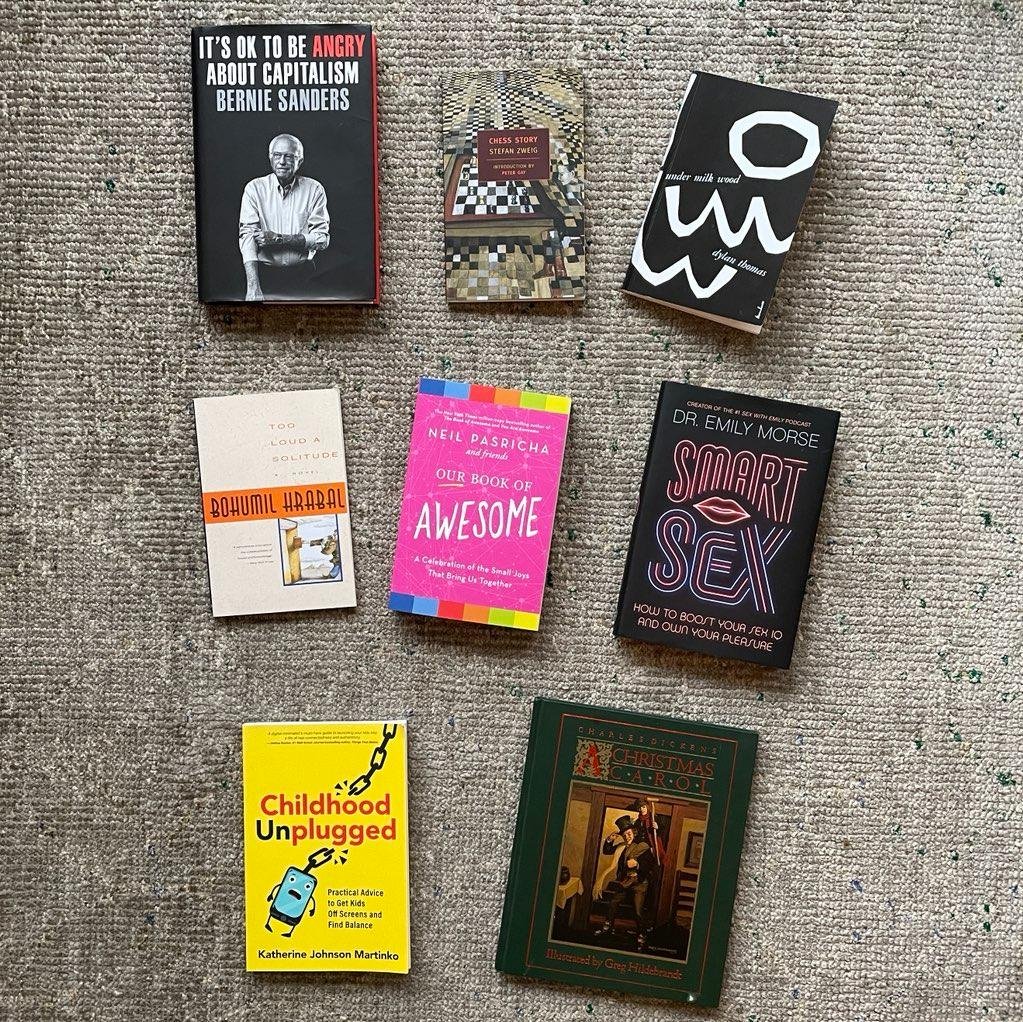
1. It's OK To Be Angry About Capitalism by Bernie Sanders. I remember reading a New York Times Op-Ed by Bernie Sanders a few years ago called "The Foundations of American Society Are Failing Us" and being struck by the clarity, concision, and power. Apex communicator! (He just wrote another Op-Ed four days ago called "Justice for the Palestinians and Security for Israel.") Do you see what I mean? The world is just so messy, blurry, and overwhelming and we need penetrating voices – master distillers! – to offer us clear views. Bernie is one 82-year-old elder doing just that. This book contains ten passionate, rallying-cry chapters that smartly fold together stories, research, and reminders about big laws that were headline news for a few weeks a few decades ago but have disappeared as news. The result is some kind of slow, almost grotesque, pan shot of the state of the US. Chapter sub-heads include phrases like "Health care is a human right, not a privilege", "Children should be taught to think – not educated to be cogs in the machine", and "Political reform requires alternatives to a for-profit media system that dumbs down and diminishes debate in America." Each chapter is its own manifesto and I found my heart beating faster and faster while reading. "If someone were to offer a senator $100 to vote for or against a piece of legislation," he writes on Page 116, "it would, by any court of law, be considered a 'bribe.' Taking that bribe could land that person offering it – and the senator taking it – in jail. If that same person were to put $100 million into a super-PAC for that senator, their spending would be considered perfectly legal. It would also, if successful, win the donor a very close and grateful relationship with a very powerful elected official." We know truths like this, but Bernie has a way of spelling them out in arresting ways. "Made you look", he always seems to be saying. "Our struggle is against a system where the top twenty-five hedge fund managers in the United States pocket more money than 350,000 kindergarten teachers." Exactly. Or how about on Page 124 when he shows how the US spends more than double, per capita, on health care than the UK, Canada, France, or Germany, and yet ranks at the bottom on longevity, accessibility, and coverage. "In other words, we are getting a terrible return on our huge expenditure on health care." You can skip around the book. I flipped past some rehashes of election campaigns or specific bills but loved the more elevated macro-level ideas he borrows from countries around the world such as the zoom-in on learning from Finland's education system. (Spoiler alert: elevate teaching standards through pay and trust, reject standardized testing, ban for-profit private schools, etc.) The book shares how the US got where it is – and what can be done to unwind a lot of the damage. Do I agree with everything? Of course not. Books aren't brains – they're views. But there aren't many views more pointed, sharp, and passionate than this one. Highly recommended.
2. Chess Story by Stefan Zweig. A hundred years ago Stefan Zweig was one of the highest selling and most translated writers in the world. This is the first book I've read by him and I can safely add: For good reason! He had a tumultuous life. In 1934 he fled Austria for England as Hitler was gaining power but then, years later, ended up listed in the 'Black Book', which convinced him to flee further to Brazil. I imagine him writing this tight, gripping 84-page "one long boat trip across the Atlantic" novella on his … long boat trip across the Atlantic. It tells the story of a group of people who encounter the chess world champion on their boat! They challenge him to a game! He soundly defeats them! But then … another challenger emerges with a haunting past and the story swerves wildly. A short book to help you get back on the reading train. Vivid, welcoming, and a pace that accelerates as the story goes on. This is Zweig's last book and was submitted to his publisher just two days before he and his wife died by suicide in Rio.
3. Under Milk Wood by Dylan Thomas. Do you know the poem "Do Not Go Gentle Into That Good Night" by Dylan Thomas? I thought I did! But I think I really just knew that one line – "Rage, rage, against the dying of the light" – from like a dozen different movies. I never ingested it, you know? Fanned it in slowly like perfume. Because that's what it deserves. It's a stunning bit of writing. I suggest reading it here and then listening to Dylan Thomas reciting it here. If you feel something there I think you'll love the high-flying literary acrobatics in this much longer 1954 BBC radio play transcript that Dylan wrote just before his death at age 39. This is truly one of the most wild things I've ever read. I found it hard to take in more than a fraction of what was going on -- but the words, you'll see, they just keep pulling. Under Milk Wood is a 95-page fast-paced "day in the inner lives" of a small Welsh town. That's it! But the wordplay, the twisting – it's got a vibe like Lincoln in the Bardo (04/2018). Here, take a look, this is two pages near the beginning, featuring an inner conversation between Mrs. Ogmore-Pritchard and her two dead (though still alive in her mind!) husbands, Mr. Ogmore and Mr. Pritchard:
Mr Ogmore: I must blow my nose.
Mrs Ogmore-Pritchard: In a piece of tissue-paper which I afterwards burn.
Mr Pritchard: I must take my salts which are nature's friend.
Mr Ogmore: I must boil the drinking water because of germs.
Mr Pritchard: I must take my herb tea which is free from tannin.
Mr Ogmore: And have a charcoal biscuit which is good for me.
Mr Pritchard: I may smoke one pipe of asthma mixture.
Mrs Ogmore-Pritchard: In the woodshed, if you please.
Mr Pritchard: And dust the parlour and spray the canary.
Mr Ogmore: I must put on rubber gloves and search the peke for fleas.
Mr Pritchard: I must dust the blinds and then I must raise them.
Mrs Ogmore-Pritchard: And before you let the sun in, mind it wipes its shoes.