Neil Pasricha's Monthly Book Club - November 2025

Neil's Monthly Book Club is my oldest and most popular email newsletter. Click here to subscribe.

Hey everyone,

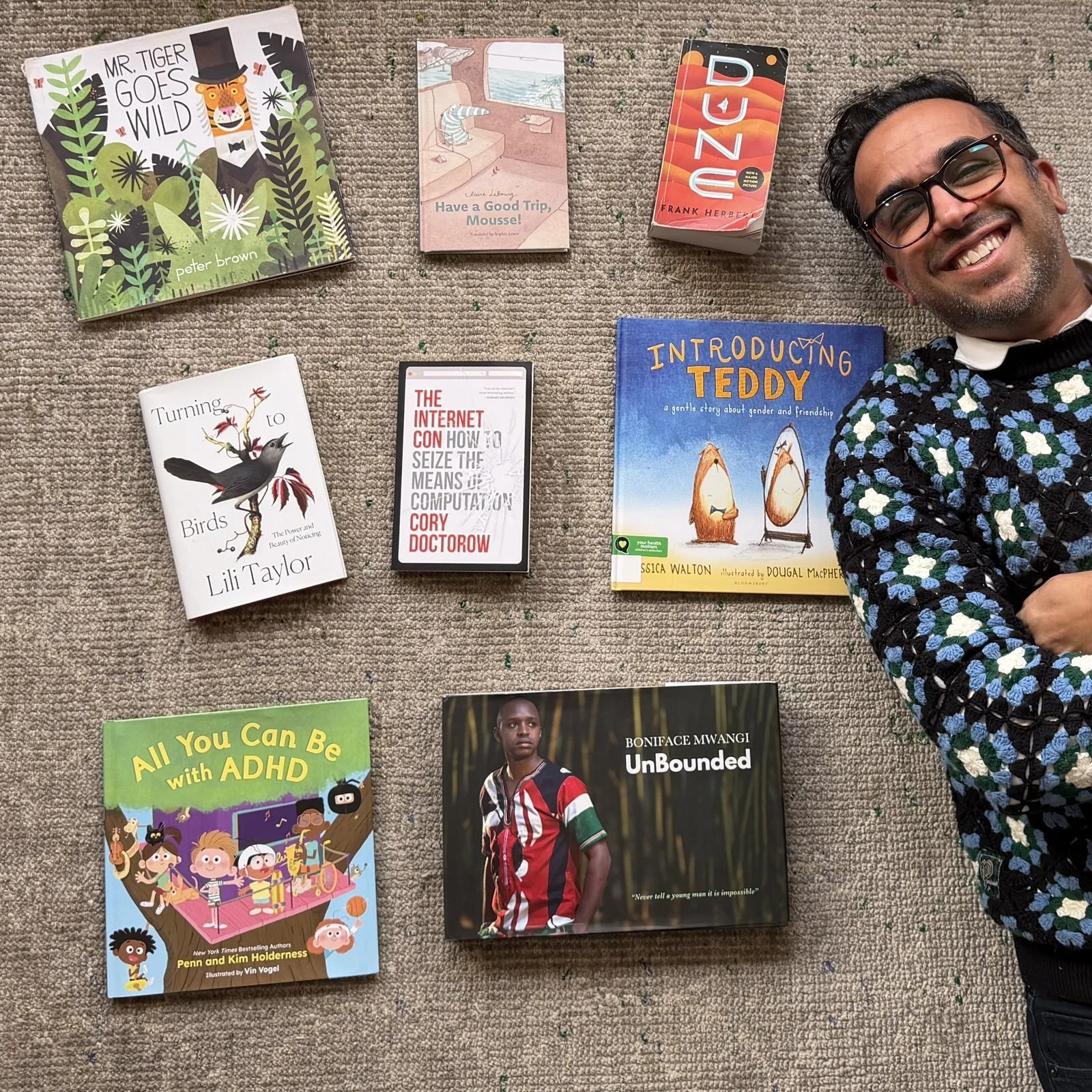
Scroll down to the picture for the book recos!

Or hang up here and let's open some letters from your fellow readers in our spirit of connection and community.

As always, to send me a letter just hit reply!

Okay, let’s do it:

Hey Neil, I am looking for book recommendations for a 10 year old for an upcoming birthday for my nieces and nephew. I would like to make it special and something they can take as a life lesson.

Jay

Hey Jay! I suggest ‘​Hatchet​’ (​02/19​), ‘​Alice in Wonderland​’ (​04/19​), ‘​From the Mixed-Up Files of Mrs. Basil E. Frankweiler​’ (​02/21​), and any ‘​Calvin&Hobbes​’ (​04/22​) … what else?

Hi Neil,

Thank you for your ​daily awesome​ emails. I can’t believe you hit #1 again. I have given members of my family blank journals and told them to put 1 awesome thing on each page. Because I think it’s important to look for the positive I encourage them to complete the journals by giving them $1000 when it’s finished. My daughter‘s family is working on their second one. There’s a place for bribery. My dad finished his and donated the thousand dollars to his favourite charity. And I really enjoy reading their journals.

Lynn

Whoa! What an idea, Lynn. I have to say … I kind of love it. ​Intrinsic motivation beats extrinsic​, of course, but extrinsic beats ... none! LOL. For the room: What gratitude practices do you use in your family? Any fun or new ideas you’re trying? Please reply and share. (As a sidenote I love the ​little gratitude zines Austin Kleon makes​!)

What else?

Hi Neil,

My name is Dan, and you are a genius in what you do. In the same way that The Beatles made complicated chords turn into memorable catchy tunes, and in the style that Buffet and Munger (and ok Housel) simplified and taught investing for us mortals, you do the same by taking the broad topic of literature and with humility and patience and dedication, simplify and communicate in a style that makes us all better for it.

Too kind, Dan, thank you. To borrow a question from my friend ​Michael Bungay-Stanier​ may I ask ... what is your world?

I am 66 years old and still practice family medicine, and my wife is a teacher-librarian in an elementary school. We live in British Columbia. We were at the game when ​Joe hit the home run​. We didn’t get home until daylight the next morning and I lost my voice for a week! I digress. I’ve been meaning to write you for quite a few years. I love books. —Dan O.

Me too. I love book love. I love book people! I like to highlight my favourite quotes and scrawl little questions in the margins when I read them. Sometimes I even email the author! Sometimes they reply. Sometimes they don’t. I’ve always wanted to be a writer who replies.

What else?

Hi Neil,

I'm currently reading ‘​The Happiness Equation​’ and thought you might be mildly interested in my reaction to your ​"never retire"​ section. I'm 41, left the military after 18 years, and now work in mining (potash). I'm happily married with no kids. My wife works in healthcare. For me work is a duty and a service more than passion. I get satisfaction out of my small part of helping to feed the world and I enjoy the people I work with. But at a certain point my watch will end and someone else will take my place. Based on my wife's family medical history, she is unlikely to be around much past her 70s. Any of us could die tomorrow, but how am I going to feel if I work until the day one of us dies, knowing we could have afforded to spend every day together for years and decided not to just so I would have an alarm clock and could feel I earned my time sitting exhausted on the couch? (My alarm clock starts at 3:45 a.m. and I get home around 6:30 p.m.) I can see you're not specifically talking to us who are bluer in the collar (the meatpacking plant line) though I am curious what meatpacker-types like me are really meant to take from the whole thing, then. For me, when I leave my job it will be to take my wife on adventures around the world. To spend time with my parents and friends. To work on old cars with my dad. I do all of this now, but I would do it all a lot more if I were working less. Pleasant conversations with co-workers and alarm clocks are fine and all. But I'm getting more mental stimulation from figuring out how to get a Nissan Leaf EV drivetrain to run a 1950 Dodge pickup truck than I do at my job. And my relationship with my wife and family is deeper than with the friendly co-workers. I am curious how your never retire message is typically received. Do people become grumpy as I did?

Kalin B

Ha! I love your letter, Kalin. It’s not grumpy! Believe me, if you think that’s grumpy don’t read ​my YouTube comments​! But yeah, looking back, the chapter title “Never Retire” in ‘​The Happiness Equation​’ was probably more provocative than I'd use today. I think the more nuanced thought is that you always need to be doing SOMETHING (fixing cars) with PEOPLE (your wife, friends) so you have PURPOSE (​ikigai​, a reason to get out of bed) ... which … definitely sounds like you have. For some I know retirement has led to the loss of social connection ... structure in their lives ... stimulation and learning ... or, really, any story or purpose ... and I’ve seen that really hurt mental health. That’s where I was writing from. But your plan sounds wonderful and I appreciate your thoughtful reply. Maybe the revised chapter title should be NEVER RETIRE UNLESS YOU FOR SURE ARE GETTING THE 4 S'S ELSEWHERE. (​More on my 4 S’s here.​)

What else?

Neil,

Yesterday we were out for breakfast with a dear friend. I cannot recall how but the Awesome books found their way into our conversation. I mentioned I have them but that I had misplaced ‘​The Book of Awesome​’. Perhaps I lent it or gave it to someone. Anyway, he said he would be right back and … he left the restaurant! He came back with ‘The Book of Awesome’ in his hand. When he sees books he thinks his friends would enjoy, he picks one up. He keeps the books in his car so he has them at hand when he wants to give one away. So, due to his act of kindness, my collection is complete once more. —Elizabeth P

Wow! I love your friend, Elizabeth. What a story! ‘The Book of Awesome’ has had so many lives of its own. From letters like ​the one on this post​ or the ​creation of this song​ or ​people making ice-cream cakes out of it​ to trick-or-treaters telling me at my house this year “We’re doing your book at school!” it’s just … had a life of its own.

Very grateful and thank you for sharing.

Hit reply anytime to send me your letter! Or, if you feel like calling me, just dial up ​1-833-READ-A-LOT​ and leave me a message. (Yes, this is a real phone number.)

And, as I've done for many years, if I use your letter here or on the podcast just email me your address so I can send you ​any book you want signed to anyone you like sent anywhere in the world​ … my pleasure!

Okay!

And now...

Let's get to the books!

Neil

1. Mr. Tiger Goes Wild by Peter Brown (b.1979). Four years before he wrote 2017’s breakout hit ‘​The Wild Robot​’, Peter Brown wrote and illustrated a wonderful 40-page picture book about a tiger who rejects stiff and uppity society life and suddenly begins walking on all fours, stripping off his tux in the town water fountain, and running through the streets naked. “Peculiar.”, “Wow.”, “Unacceptable!” Mr. Tiger retreats to the forest! But misses his friends. So he throws on a Hawaiian shirt and returns to a town that’s taken inspiration from him and loosened up its prudish ways. The book closes with Mr. Tiger being himself … dressed in his old tux on certain days and streaking through the forest with his friends on others. This is a 5-minute picture book our family has loved for years.

2. Have A Good Trip, Mousse! by Claire Lebourg (b.1985). Translated from the French by Sophie Lewis. I love this book so much. And it’s a genre I don’t really know? A colorful 60-page book with a couple paragraphs of accessible but longform, literary prose per page telling a short but detailed story with emotional heft. Wow. Genius. Leave it to ​the French​! Mousse is a creature who wants to have a summer vacay at the beach and then goes, gets frustrated, invites a friend (Barnacle, who calls him “Moo-shee”), the friend meets a friend (Felix, someone else at the resort), Mousse gets jealous, Mousse gets to know Felix, and then … they all become friends. A simple tale you can read to kids as young as 3 or 4 but upon a second read offers thoughtful commentary on everything from gender, class, beauty, gratitude, awe, jealousy, mental health, friendship, and happiness … woven in like wind through palms on a sunny day. A delightful 15-minute read for all ages.

3. Dune by Frank Herbert (1920—1986). Monstrous, mind-expanding, faraway fantasy novel from 1965 told in a series of tight sequences that are simultaneously fast and slow, sharp and soft, detailed and abstract. This book devoured me. Confused me. Captivated me! I’d always heard ‘Dune’ described as a book for kids. Uh … what kind of kids? I’m 46 and found myself scrolling the ​Wikipedia Plot Summary​ a few times to properly piece this puzzle together. But, oh, what a puzzle to piece! The plot isn’t complex but it’s vast and written with a scale that will have your mind stretching far left to far right. This book has everything: cutting dialogue, twisting turns, visceral characters, bloody action, seismic myth. Reading it now and knowing Star Wars came out a decade later the influence is obvious: Arrakis to Tatooine, Paul Atreides to Luke Skywalker, the Sisterhood to the Jedi and Sith. I mean, maybe ​Joseph Campbell​ underwrote both? Or ​Homer​? Or just human oral tradition for millions of years? Maybe. Either way this is a 794 page feast of a book. And that doesn't even include the 76 pages of Appendices (like “Appendix III: Report on The ​Bene Gesserit​ Motives and Purposes”), 30-page Glossary (titled, quite seriously, “Technology of the Imperium”), and even Cartographic Notes. Sorry, cart-o-graph-ic notes? Yeah, on the very last page we’re finally given a map of the place! LOL. This is the most fun I’ve had reading in a long time. And getting the mass-market paperback edition from my friend ​Doug Miller​ meant I could lug it around in a backpack pretty easily. The book is an endless conversation starter and acts like a kind of nerd magnet. Dune is, of course, the other name of the “desert planet Arrakis” where Duke Atreides, head of one of the four Great Houses, has just been sent (rewarded with or banished to, he wondered) to take over from fearsome Harkonnen House. Duke Atreides is not alone! He brings his military, his advisors, his weapons, his government, his giant bull’s head, his medic, his mentat (some kind of human AI-like helper created after all technology was banned thousands of years ago), and, yes, of course, … cue music slowdown … his family. What family? Two people! His Bene Gesserit wife Jessica (“a witch of the weirding way”) and 15-year-old son Paul, our hero. Who sent the Duke? The Emperor! There has to be an Emperor, of course. Dude isn’t around much but of course I couldn’t help picture Christopher Walken lurking above everything:

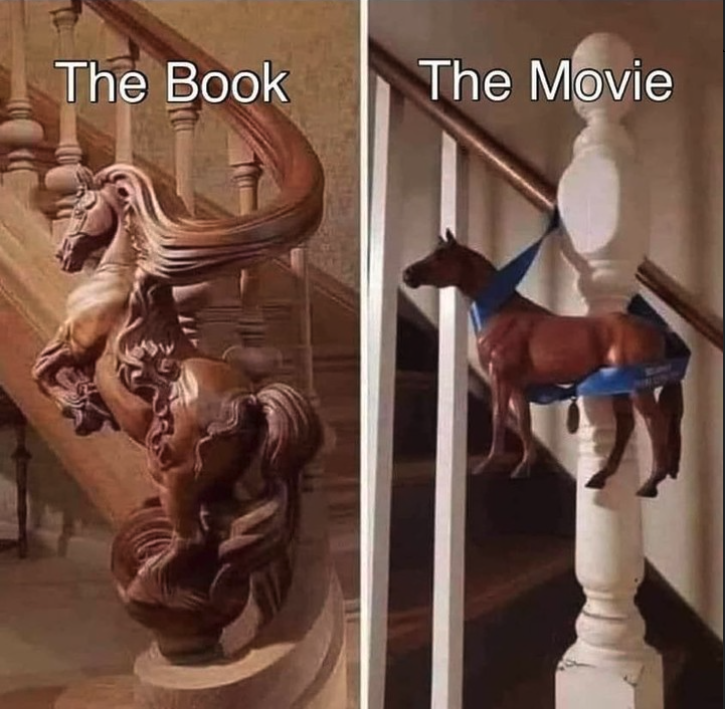
That is one problem with reading the book after seeing the movie, of course. Jack Torrance in The Shining suddenly is Jack Nicholson, Harry Potter suddenly is Daniel Radcliffe, and we get those flattened mutations like Harry Potter’s famously green Lily Potter-inherited eyes turning blue because Radcliffe was allergic to green contact lenses (​seriously!​). I mean, is it a problem? Are we turning our blurry and unique mental images into a flat and homogenous bright-pixeled same? This meme memed for a reason:

Funny! But true? I admit I tell my kids they can't watch Harry Potter movies till they’re done the books. But, then again, I’m starting to see it the other way, too. Maybe the film is a doorway into a broader world that perhaps the book continues to help blossom and expand. Like a duet! Anyway, that’s what reading ‘Dune’ felt like to me! I’d already seen the movie Dune and Dune 2 and now after finishing this delectable brick I find myself itching to watch them again after, of course, ​combing reddit threads about what’s actually different​. The book can be read as a simple action story but it's really a window into duality, ecology, philosophy, morality, and so much more. From the Reverend Mother (the lady who makes Paul stick his hand into the ​gom jabbar​ in the movie’s opening scene) on Page 48: “A world is supported by four things … the learning of the wise, the justice of the great, the prayers of the righteous and the valor of the brave.” Or this from Page 104: “Jessica spoke, shattering the moment. ‘Besides, Wellington, the Duke is really two men. One of them I love very much. He’s charming, witty, considerate … tender—everything a woman could desire. But the other man is … cold, callous, demanding, selfish—as harsh and cruel as a winter wind.’” Part of the magic of the book are the endless … chapter epigraphs. Is that what they’re called? Every chapter opens with a thoughtful snippet of lore, gospel, a sentence, sometimes a page long, quoted and cited from … other made-up books … all written by Princess Irulan … a character we have never met … from some undetermined future. It’s a trippy and stunning effect. Reminded me of how Shoshana Zuboff so masterfully weaves an epic W.H. Auden poem through every chunk of ‘​The Age of Surveillance Capitalism​’ (​05/23​). Basically, Frank Herbert is saying: “Not only did I ignore my own life to write about another in great detail … I also wrote a whole bunch of other lives I’m not even going to tell you about except to drop a few crumbs from them to help illuminate this one.” I could understand how his son Brian Herbert writes in the Afterword on Page 869 that “the characters he created in Dune … competed with me for his affections.” Ouch! But, um, yeah. This isn't just another family, it’s another universe. So literary and poetic, too, like on Page 433 when Paul inhales and “sensed the softly cutting contralto smell of sage” and then we follow him seeing a large bird who brings “stillness to the basin so unuttered that the blue-milk moonlight could almost be heard flowing across sentinel saguaro and spiked paintbrush.” Or when Paul receives the ritual coffee service for Jamis, the Freman who he killed, on Page 698, and it’s served in “fluted alloy of silver and jasmium.” Unless you include YA (i.e., ‘​The Hunger Games​’), ‘Dune’ is the ​single best selling science fiction book of all-time​ with over 20 million copies sold. There’s a reason! A timeless epic serving as a mirror to reflect in and upon our big, small, complex, simple, chaotic, predictable world.

4. Turning To Birds: The Power and Beauty of Noticing by Lili Taylor (b.1967). A meditation in the form of a book this is actress ​Lili Taylor​’s story of falling into birding. The chapters are simple, slow-paced, and earnest, and I found the result to be a soothing bedtime read. Easy to read and largely written for the non-birder except for the later chapters which wade a little deeper into a few species. Pairs well with my recent essay ‘​8 reasons why it’s time to become a birdwatcher.​

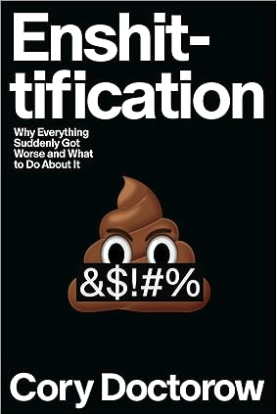
5. The Internet Con: How To Seize The Means of Computation by Cory Doctorow (b.1971). If you were online back in the 90s you probably read the writing of Internet pioneer and former BoingBoing co-editor ​Cory Doctorow​. The guy has one of those early blogger brains with the ability to combine a fierce genius together with a salty and accessible tone. Like some kind of grandfather of ​Mark Manson​. He’s passionate! And his fire singes your mind as you read. No wonder the cover blurb from ​Edward Snowden​ calls him “one of the internet’s most interesting writers.” Doctorow opens by pointing out something so obvious that most people miss it: forty years ago we pulled the teeth out of monopoly laws … and so forty years later, after a century of bashing monopolies back into competitive markets, we now have … monopolies again! A few rule a many because, as ​Peter Thiel​ says, “Competition is for losers.” So now a very tiny few exist and rule across “pharmaceuticals, health insurers, appliances, athletic shoes, defense contractors, book publishing, booze, drug stores, office supplies, eyeglasses, LCD glass, glass bottles, vitamin C, car parts, bottle caps, airlines, railroads, mattresses, Lasik lasers, cowboy boots, and candy.” Any issue with that? Yes! Tons! It creates “autocrats of trade, unelected princelings whose unaccountable whims dictate how we live, work, learn, and play. Apple’s moderators decide which apps you can use, and if they decline to list an educational game about sweatshop labor or an app that notifies you when a US drone kills a civilian overseas, well, that’s that.” ​Prophetic​! ​Apropos​! Doctorow grew up on the Internet’s Inside so he’s not just shouting from a soapbox—he's using specific and cited examples tearing the Apples, Googles, and Amazons to shreds. He’s had it with the bigs as much ​Chris Smalls​ but approaches things from a totally different angle. Doctorow coins the next corporate phase “enshittification”—a viral word he invented in a ​2022 blog post​, expanded in a ​2023 Wired feature​, before it became a ​Word of the Year​, and now the subject of a 2025 Goodreads Choice Nominated book for “Best Nonfiction”, along with the requisite cussing poop emoji on the cover:

Tell us, Cory! What is enshittification? What do the big corporates do? “First, they are good to their users; then they abuse their users to make things better for their business customers; finally, they abuse those business customers to claw back all the value for themselves. Then, they die.” Soooo … will all of Big Tech just eventually die? Well, yes, that is likely. Eventually. But what about all our stuff? Doctorow explains that switching costs prevent us from actually leaving (say) Instagram even if it’s endless new beeps, bells, alarming notifications, and spammy DMs (say) are making the platform increasingly … enshitty. (Or enpoopy, as he calls it in the polite press.) We still go because all our friends are there! And that’s where the Really Big Idea of the book is presented. Because, lo: There is a solution! And the solution in one single word is: interoperability. Imagine being able to plug and play all the different pieces and parts you actually want to use from Big Tech, in the ways you actually want to use them. This is a tight, fire-breathing screed that, if you can hang on, teaches us “what interoperability is, how interoperability works, how we can get interoperability, and how we can mitigate interoperability’s problems.” I was desperate for both a little less and a little more in this book. The book assumes you have a mind as large and fast as Doctorow’s and I wanted him to slow down and simplify for me. Me slow. But I was also itching for more … Notes, Appendices, a meatier Index, as I kept trying to patch things together my own way. This is the first Cory Doctorow book I’ve read but it doesn’t feel anywhere close to the last. ​Seth Godin told us back in Chapter 3​ that he’s a huge Cory fan. (Check out this ​old post​ on ​Seths.blog​ about sitting next to Cory at a conference!) The voice in this book is irresistible. I went back online and found so many endless gems in his blog like when ​he wrote after moving out of England in 2015​ after living there for years: “London is a city whose two priorities are being a playground for corrupt global elites who turn neighbourhoods into soulless collections of empty safe-deposit boxes in the sky, and encouraging the feckless criminality of the finance industry. These two facts are not unrelated.” LOL. Such an entrancing voice. If you liked books like ‘​Team Human​’ by Douglas Rushkoff (​05/24​), ‘​The Age of Surveillance Capitalism​’ by Shoshana Zuboff (​05/23​), ‘​The Chaos Machine​’ by Max Fisher or ‘​The Attention Merchants​’ by Tim Wu, you will love this book.

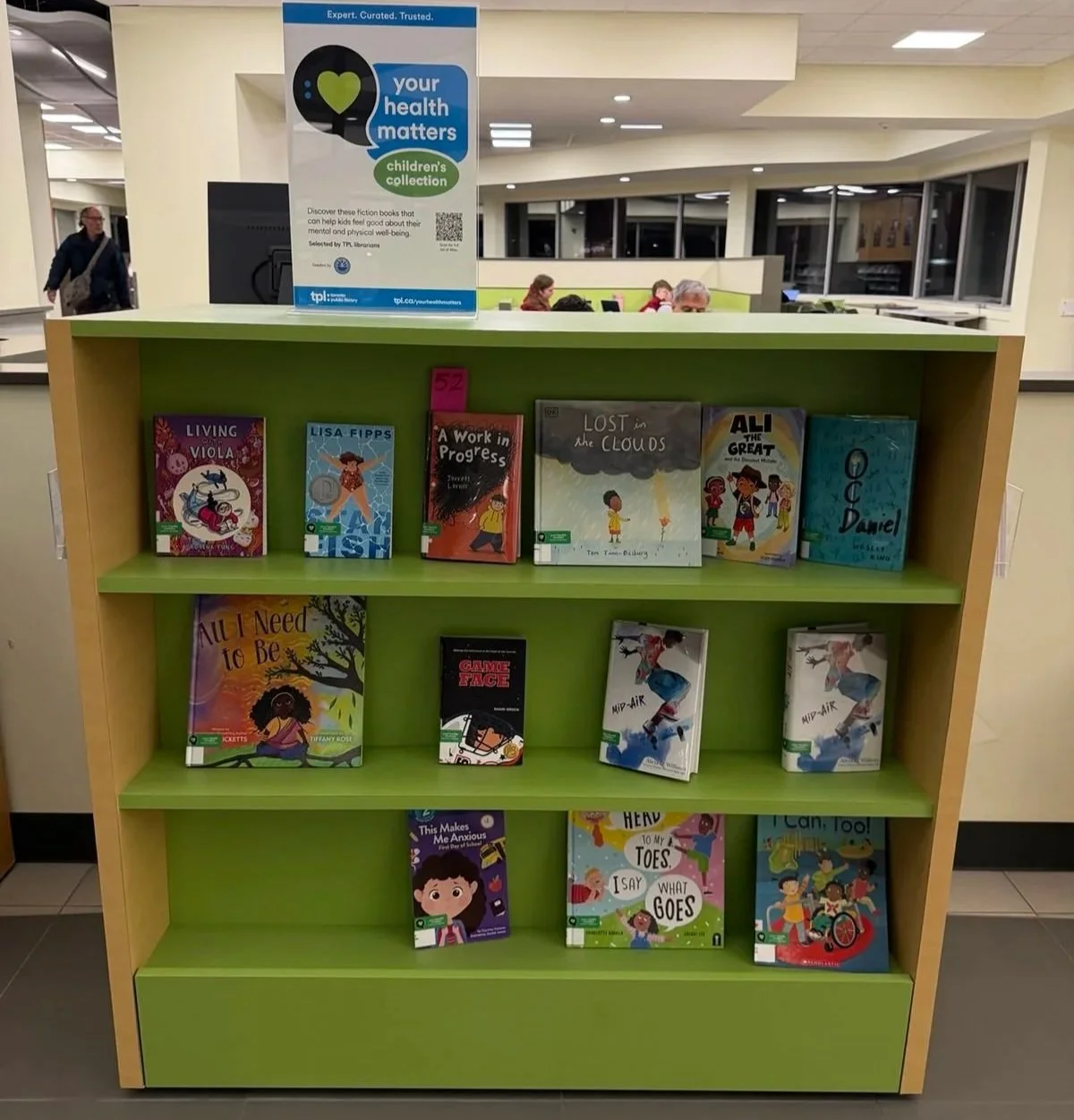
6. Introducing Teddy: A gentle story about gender and friendship by Jessica Walton. Illustrated by Dougal MacPherson. The largest library system in the whole world is the ​Library of Congress​ with over 178 million items. But! The largest public library system in the world, like one you can actually walk into and get something, is the ​Toronto Public Library​. It has over 100 branches and two bookmobiles! I pop into a TPL branch a couple times a month and noticed they have new displays focused on mental health for children and adults:

I found this book there and started flipping. Thomas the Teddy Bear is Errol’s best friend. They play together every day! They “ride their bikes in the backyard … plant vegetables in the garden … have sandwiches for lunch in the treehouse … and have tea parties inside when it’s raining.” But Thomas seems glum. "Why?", asks Errol? “If I tell you you might not be my friend anymore.” Yikes! What is it? Well: “In my heart I’ve always known that I’m a girl teddy, not a boy teddy. I wish my name was Tilly, not Thomas.” This simple tense scene a third of the way through the book leads to Errol ... continuing to love teddy (“What matters is that you are my friend.”), teddy moving his bowtie to a hair clip (check the cover photo!), and Errol's friend Ava coming over and feeling comfortable enough on the swings to let her own hair down. And what are they doing together at the end? Of course they “ride their bikes in the backyard … plant vegetables in the garden … have sandwiches for lunch in the treehouse … and have tea parties inside when it’s raining.” A joyful celebration of acceptance, non-judgment, and inclusion told in a gentle and openhearted way without any finger-wagging.

7. All You Can Be With ADHD by Penn and Kim Holderness (aka The Holderness Family). Illustrated by Vin Vogel. One of the world’s all-time greatest rhymers has to be Penn Holderness, one half of the Holderness Family, ​who joined us on 3 Books earlier this year​. I absolutely loved Penn and Kim’s book ‘​ADHD Is Awesome​’ (​11/24​) and put it in ​The Very Best Books I Read in 2024​. Now comes the picture book follow-up distilling core messages down to a two-minute read. Now, I admit part of me wishes we’d move past the horribly outdated term “ADHD". We have more and more books saying ADHD is this and ADHD is that but we know that neither D in that acronym is correct! It’s not attention deficit (Penn is one of the best hyperfocusers I know … one of his 3 formative books is ‘Dune’!) and it’s not hyperactivity disorder. Awful name. The better name is VAST or Variable Attention Stimulus Trait. Start using that! The name came from ​Edward Hallowell​ and ​John Ratey​ who wrote the OG book on the condition in ‘​Driven to Distraction​’ back in 1992. Yes, it’s Variable Attention (as in it can go up or down) and it’s a Stimulus Trait (like VASTers need more lemon juice to get the taste of lemon or have a high need for stimulation). But, alas, if the ancient and outdated ADHD flag must fly forward, this is a fine book to fly it. “If your brain’s like ours, then you may be different, you may be fantastic, you may be vociferant”, it invites. “Yes, it can be lonely—I’ve said to myself, ‘Why can’t I be normal like everyone else?’ Sometimes we are squirmy, sometimes forgetful—we interrupt friends, that makes us regretful.” And it’s ultimately affirming: “Your brain is a source of great innovation, you have an amazing imagination. Your brain can be super spontaneous plus! No one’s more creative or funny than us.” Thanks, Penn and Kim, for yet another gift to the increasing numbers of VASTers among us.

8. UnBounded by Boniface Mwangi (b.1983). This is a powerful and haunting book of photos. I met ​Boniface (“Bonnie”) Mwangi on Twitter​ years ago. He’s got over 2 million followers there and when I walked around Nairobi with him last month it was clear … everybody knows him. Not a single person passed by us without a fist bump, a nod, a smile, or a hug. He is, most definitely, “of the people.” A courageous activist who has been ​jailed for his protests​. And now he has announced that he is running for ​President of Kenya in 2027​ under the slogan “Love and Courage”! In his ​2014 TED Global talk called “The Day I Stood Alone”​ he talks about putting himself out there to rid Kenya of corruption and injustice. This book carries on his photojournalistic work over many years and is a vivid portrait of the humanity and inhumanity in our species today. I got the book personally from Bonnie in Nairobi at ​Nuria Books​ (run by Bulle—pronounced ‘Boo-lay’—the bookseller). Over the past few months Bonnie introduced me to ​Peter Kimani​, the award-winning Kenyan novelist who just joined us on 3 Books (​YT​, ​Apple​, ​Spotify​), and a few others who will be on the show very soon. A graphic, haunting, and eye-opening book which you can pair with my ​2022 longform chat with Bonnie​.

9. There is no nine! Just our regular loot bag of links! I've put ​every awesome thing​ (minus the ones from page-a-day calendars) on one page. May be the longest online page ever! Tomas Pueyo explores the question ​When will we make God​? Bryan Johnson does ​mushrooms​. Authors! Did AI models illegally steal all your books to train their machines? The answer is probably yes. You can get around $3000 per book back via the ​Anthropic copyright settlement​. (Thank you ​Sofi Papamarko​ and ​Tim Kreider​ for sending this to me.) Lindyman argues that ​talent follows incentives​. My friend Ago sent me this great ​Paris Review essay "My Truck Desk"​. Academics agree: ​TikTok is breaking our brains​! Only in Canada: ​A bicycle kick in a blizzard​. Great ​NFL hallway sign at Lambeau​. And, yes, my friends, ​that pan’s clean​!


Interested in more of my reviews? Read my monthly book clubs or visit my Goodreads page.

Click here to join the Book Club email list.