
Chapter 1 from 'You Are Awesome: How to Navigate Change, Wrestle with Failure, and Live an Intentional Life'
Hey everyone,
How’s your April going?
Feels like every day there’s a new challenge out there.
I’m getting notes from you telling me about feeling overwhelmed by the news, relationship frictions, battling addictions, and feeling generally overwhelmed.
I hear you!
I feel it, too.
I’m right there with you.
A couple weeks ago I wrote a letter to the Prime Minister protesting our Premier’s autocratic takeover of our lake, posted it on Twitter (lots of hate!), posted it on Instagram (mostly love!), and then turned it into a Change.org petition (please sign!).
Of course, then people started saying it needs to be a ‘federal petition’ and that I should to have got MP support first, etc, etc.
Argh!
Sometimes when we work so hard ... we just hit new walls.
But what do we do then?
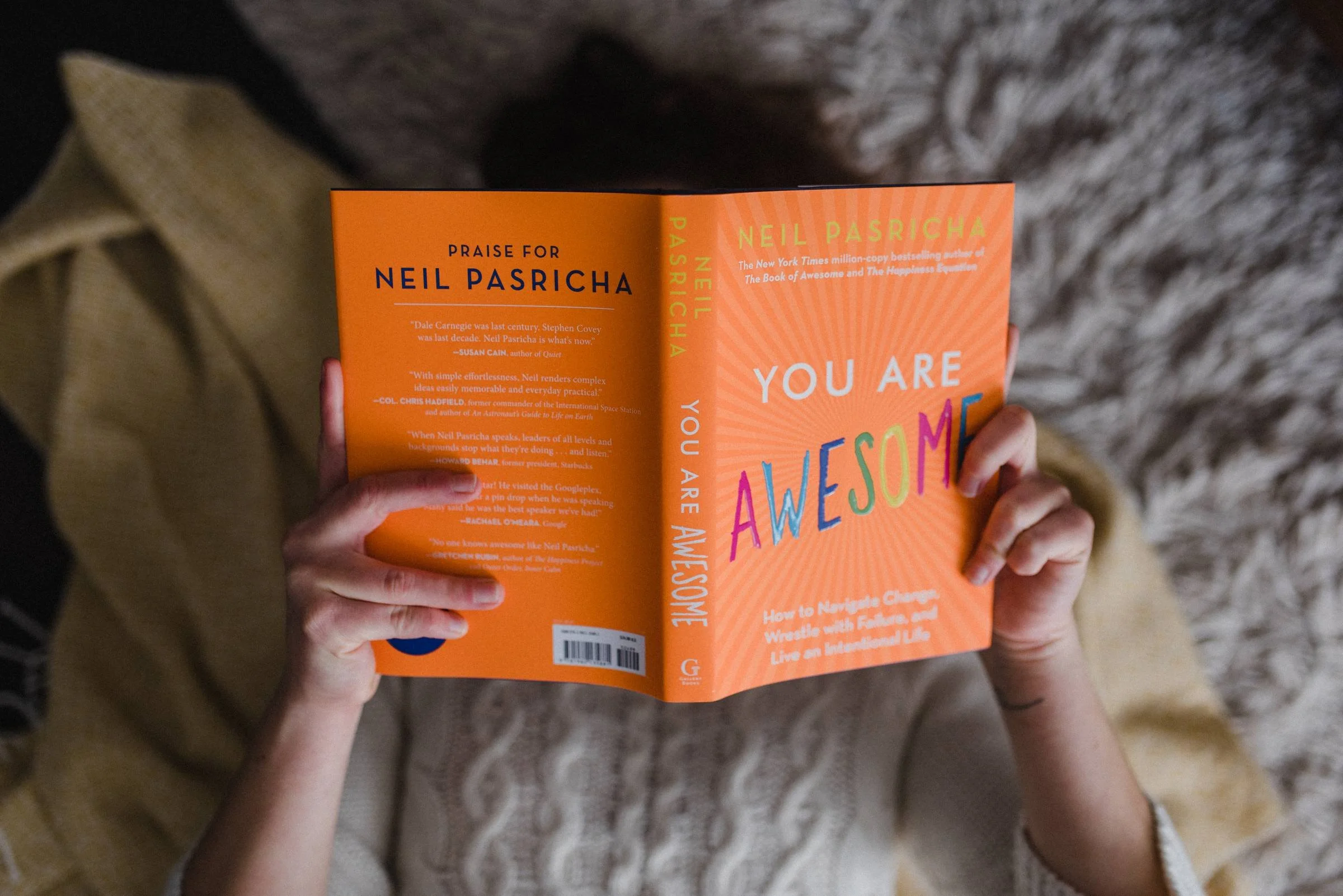
Well, that’s why I thought I’d share a chapter from my book on resilience today. It’s the story of my mum along with a few mental models I’ve learned from her. When life tries to give you a period ... add a dot-dot-dot. When you catch yourself saying you can’t do something add a ... yet.
Forward this email to a friend who’s going through a tough time.
Remind them they aren’t alone!
And neither are you.
As always, you can invite others to join our tribe right here.
Neil
Chapter 1 from 'You Are Awesome: How to Navigate Change, Wrestle with Failure, and Live an Intentional Life'
Add A Dot-Dot-Dot
My mum was born in Nairobi, Kenya in 1950.
Growing up the youngest of eight kids in a small house off the downtown core, she was quiet, shy, and always the baby.
Back when my mum was born, Kenya had a black majority, a brown minority, and a white cream on top. Kenyan natives, the East Indian class imported to get the economy chugging, and the British colonialists who ran the whole show.
That East Indian class included my mum’s dad who moved from Lahore, India, to Nairobi in the 1930s to help build the railroad.
The Brits took over Kenya in the late 1800s and the country didn’t gain independence until the mid-1960s so it was very much a British-ruled country when my mum was born. White people running the show. White people running the government. White people running the best schools.
My mum wasn’t born a white person.
So she wasn’t born the right person.
And she wasn’t born the right gender, either.
What do I mean?
I mean my grandparents had seven kids before my mum was born. Four girls and three boys. As my mum and her sisters tell it, my grandparents were desperately hoping for a final boy to even their numbers out and give them a solid four-four split.
Boys were the prized possession in the culture. All everybody wanted.
For generations there was more money for male education and training, which meant men were financially self-sufficient. Women, on the other hand, were dependent on husbands opening wallets every Sunday to dole out shillings to buy groceries and clothes for the family. Women also traditionally “married out” and joined their husbands’ families, taking care of their in-laws instead of their own parents. So having a son provided a cultural pension long before real pensions existed. No old-age checks once a month! Just your daughter-in-law cooking you curried lentils and serving you chai.
Even worse, the culture compensated men further by providing a dowry. What’s a dowry? I didn’t understand it growing up but a dowry is an ancient and archaic gift given by the bride’s parents to the groom’s parents as if to say “Thank you for taking our daughter off our hands.”
By the way, I really do mean ancient. Even one of the world’s oldest texts, the Code of Hammurabi, dating from almost four thousand years ago, discusses dowries in this way, as gifts for the groom’s family. And I do mean gift. A dowry often includes jewelry, property, and big piles of cash, resulting in a massive financial burden for anyone with a daughter to marry off.
When my grandparents had my mum, all those additional costs and burdens sank in. It breaks my heart to think about my mum opening her newborn eyes, slowly soaking in the sea of faces in front of her, and what was the first thing she probably saw?
Everyone’s disappointment.
How was that family burden, that sense of not being wanted, communicated to my mother? The way deep cultural norms are often communicated—like a heavy, invisible blanket pushing down on her, a force she couldn’t see but felt in her bones.
When a boy was born, friends and neighbors would say “Badhaee ho!” It meant “Wonderful, great, congratulations!” And when a girl was born? “Chalo koi nahi.” What’s the translation? “Keep going. Soldier on. Oh well—you have to keep moving.”
As my mum described it, there was a fatalist feeling of closure and finality over everything. “My life was set out,” she told me. “It was decided.” Gender, culture, and traditions all pointed to a well-worn finish line she could see in her future. Her life seemed like a sentence. Something preordained and punishing.
No sense of possibility, no options . . . no dot-dot-dot.
Just the end. A full stop.
As she got older, my mum watched her older sisters finishing the same sentence ahead of her, plucked from the family home one by one, married off to a man chosen by her parents, to provide him with children and home cooking while taking care of him and his parents. In the face of a life sentence ending in a full stop, my mum had a choice to make: Would she ever see past the period?
What about you?
Do you ever feel like you don’t have options?
Do you ever feel like you don’t have a choice?
Do you ever see the period at the end of your sentence?
We all have this feeling sometimes.
We all sometimes feel a fatalist feeling of closure and finality in the sentence of our lives. Maybe it’s growing up in a male-dominated culture without any visible options. Maybe it’s taking care of a sick family member and always putting yourself last. Maybe it’s feeling trapped in your job after twenty years of education and a suffocating pile of debt. Maybe your family is living in a country where your visa application to join them keeps getting rejected. Maybe they won’t promote you. Maybe they won’t release you.
What do you do when you can see the future on the path you’re walking on but you don’t like where it’s leading?
Well, there’s a crucial mindset to adopt. It’s not about giving up. And it’s not about turning around and running away. Because we both know life isn’t that simple. Commencement speech advice doesn’t always work. Follow your heart! Do what you love!
“My heart said follow him. And he dumped me.”
“I want to do what I love. But I have bills, responsibilities, and other people.”
Sometimes the hardest thing to do is simply making the decision to keep going.
Sometimes the hardest thing to do is simply making the decision to continue to breathe, continue to move, continue to function, continue to operate.
A period means giving in to life’s circumstances, relenting in the face of things that look immovable, things that look impossible, things that look too painful.
A period is giving in.
What we need to hold on to in our hearts is the quiet courage to change the punctuation. What we need to hold on to is the idea that resilience means seeing the free will that exists just past the period.
We need to hold on to a desire to see past that full stop.
To see past the period.
And add a dot-dot-dot.
A 500-year-old invention we can use today
In grammatical terms, that dot-dot-dot is called an ellipsis.
Dr. Anne Toner is a Cambridge University academic who spent years studying the history of the ellipsis. No, I’m not joking. But there is good news. She found it! Yes, the first time the famous dot-dot-dot appears is in the 1588 English translation of Roman dramatist Terence’s play Andria.
Let’s pause for a moment to stare at a bit of blurry calligraphy from half a millennium ago. The first-ever ellipsis. Fellow history and trivia nerds, let’s all pause to look in wonder upon this amber-encapsulated marvel ...

Look like small potatoes? Well, let’s see if we can come up with a new punctuation mark the whole world will use in five hundred years. It’s not easy. But there was help. Ben Jonson began using it in his plays soon after and then that old bard Bill Shakespeare joined in the fray. Boom! That was the Middle Ages equivalent of getting retweeted by Oprah. The ellipsis then moved from there all the way up to Virginia Woolf and Joseph Conrad. Today, even Adele uses the dot-dot-dot when teasing the first few chords of her new album in TV ads.
No joke, Dr. Toner even wrote a whole book about the ellipsis called Ellipsis in English Literature: Signs of Omission and in it she wrote that the ellipsis was “a brilliant innovation. There is no play printed before . . . that marks unfinished sentences this way.”
Unfinished sentences?
What else is an unfinished sentence?
The answer is everything.
Everything you do, every path you take, every diagnosis you get, every wall you hit, every setback, every failure, every rejection. All of these experiences are part of the unfinished sentence of your life story.
Sometimes the best thing you can do is learn to add that dot-dot-dot . . . and keep going.
What happens when you see past the period?
Let’s get back to Kenya.
In my mum’s case, there were massive political, cultural, and family pressures all around her, so she kept her mouth shut and her head down rather than rail against cultural norms. She added a dot-dot-dot by finding a way to keep going. She didn’t shave her head and start smoking by the train tracks. No, while her three older brothers received the bulk of the family’s praise, attention, and money for education, she joined her sisters sweeping floors, working the stove, and scrubbing the work clothes clean.
To keep her mind challenged, she sat on her front porch and memorized the license plates of cars driving by. She was craving a mental challenge. So she found a safe space where she could satisfy it silently.
Why license plates? “There was nothing else to memorize,” she told me later. “It was a game for myself. Just to see if I could do it.” She’d see a familiar car and guess the numbers from a distance, quietly congratulating herself when she got one right. At night, in the corner of the clattery kitchen, she’d study math under dim lights and curious gazes. None of her sisters worked so hard on schoolwork. Who needed to study so much just to cook curried lentils and serve chai?
Given she had seven older siblings all growing up and out of the house, the majority of her education was self-taught. Her parents didn’t have time for picture books before bed or late nights patching together a volcano for the school science fair. That would have been laughable. No, it was pile of textbooks, pile of paper, pile of pencils. Fend for yourself. Rinse and repeat.
All of her studying came to a head in 1963 when she took the government’s standard National Exam with every other thirteen-year-old in the country.
And what happened?
She got the highest mark.
In the country!
Suddenly a fat scholarship dropped into her lap and she was whisked away from her family home to a preppy English boarding school in the countryside with all the white British kids of the colonialists. She was the youngest of eight kids and the first one to leave home for boarding school. Nevermind on a scholarship.
She added a dot-dot-dot to her story throughout her upbringing. Memorizing license plates. Extra homework. Always after cooking and cleaning.
And then?
She got past the period. Her story continued . . .
But there are always more periods up ahead.
There always are.
“I couldn’t believe it,” my mum told me. “The school was a heaven on Earth. The grounds were so beautiful. We knew there were schools just for white people. For the rulers. But when I got there, everybody was so rich, coming in the best cars with chauffeurs. I was overwhelmed. I was scared. I never imagined I would be allowed to go in. I didn’t feel like I was equal to the other students. I just wanted to go home.”
How many times have you gotten past a period and then just wanted to go home?
“I never imagined I would be allowed to go in. I didn’t feel like I was equal to the other students.”
How many times have you felt this way? I feel this way all the time. Finally get the promotion? Now it’s new job, new boss, new way of doing things—and here comes that feeling of wanting to run for the hills. Sick family member gets better? Now you really have to confront the future you said you didn’t have time for. Visa gets approved? Great! Now how do you really feel about leaving your culture and aging parents behind to start all over again?
When we get past the period, the struggle starts all over again. You may dream of tapping out, stopping before you start, sticking a big period on the end of the new sentence so you don’t have to keep moving, fighting, working, trying. But it’s back to doing the same thing we’re talking about here.
What if you add a dot-dot-dot and keep your options open instead?
There is power in moving slowly through the motions.
There is power in letting the story continue.
“I don’t waltz . . . yet”
For the next few years, my mum’s life was full of reciting the Lord’s Prayer, memorizing Shakespeare passages, and eating soft-boiled eggs in the corner of the school cafeteria. After hitting the books away from friends and family, she graduated at seventeen and started to feel like her life was back on the rails, like she had made it, like everything was slowly coming together.
And then the phone rang.
And it was her father.
And he asked her to come home right away.
“I’m dying,” he told her. “Go make something of yourself.”
He passed away within days, just as violence and political instability were growing in East Africa. The dictator Idi Amin was ordering all East Asians out of neighboring Uganda and fears were growing that Kenya would be next.
My mum had added the dot-dot-dot as a kid but was now given new tests as a teen: her father suddenly dying, her home country unsafe, and those same heavy cultural pressures now falling onto my grandmother to scrape together a dowry and find her a husband.
“It’s great you managed to get an education . . . but now we really need to marry you off.”
So my mum fled to England with her mother and lived with her in London as her older siblings scattered and settled into their own married lives. And then my dad visited from Canada on summer vacation, the families introduced them, they had one date (one!) and then an arranged marriage a couple weeks (weeks!) later. Then? He moved my mum back to his home in a small, dusty suburb an hour east of Toronto, Canada.
And it suddenly felt like another period.
My mum’s global migration happened so quickly. She landed with a thud in that dusty suburb, with no Indian people around, suddenly married to a guy she’d met twice—including at their wedding—with her parents, siblings, and friends all an ocean away.
I can’t imagine how scary that must have been.
Another challenge, another wrench, another kink in the garden hose, another place where it felt like the end of a sentence.
But she kept moving, kept going, kept adding a dot-dot-dot.
When she came to Canada my mum had eaten meat only a handful of times. My dad was a teacher and started bringing her to after-school barbecues and roast beef dinners at the Rotary Club, where they’d hang out with a couple dozen white people.
Indian food wasn’t widely available so it was meat, meat, and more meat. And this was the suburbs in the 70s. Saying you were a vegetarian meant picking bacon bits off your Caesar salad and going home hungry. What did my mum do? She went along with the crowd.
When she came to Canada, my mum had never been ballroom dancing in her life. She’d never heard of ballroom dancing. But my dad’s idea of fun was going to Club Loreley, the local German club, and waltzing her around the room. So she let herself be waltzed. I remember hearing this story growing up and jumping in.
“But you don’t waltz!” I said.
And she said, “I didn’t do anything Dad did. But what was I supposed to do? Sit at home? I just told myself I don’t waltz . . . yet.”
I would ask her how she had navigated so many hairpin turns: new country, new husband, new job, new friends, new foods, new pastimes. She always seemed to keep moving. But how could she change everything so quickly?
Was it survival?
She told me she was just keeping her options open. Adding a dot-dot-dot to the end of the sentence. Letting things happen so she could navigate forward from a position of strength rather than feeling like all her doors had closed.
Keep your options infinite
An MIT study confirmed the value of adding a dot-dot-dot.
Researchers Dan Ariely and Jiwoong Shin showed that the mere possibility of losing an option in the future increases its attractiveness to the point that people will invest money to maintain that option. As they put it in their study: “The threat of unavailability does make the heart grow fonder.”
What’s the point?
The point is that although it may be hard to admit it and hard to see it and certainly hard to do it, we really do subconsciously crave adding that dot-dot-dot.
Life is a journey from infinite possibilities when you’re born—you can be anything, do anything, go anywhere—to zero possibilities when you die. So I’m proposing that the real game is trying to keep those options open as long as you can.
Like the farmer, we need to add a “We’ll see” when life blasts us into the stratosphere or sends us screeching wildly into the ravine beside an icy road.
We need to remember and constantly work on developing the muscle of continuing to move forward and always adding a dot-dot-dot . . .
The single word that makes it happen
Add a dot-dot-dot.
Sounds snappy.
But how? How can we really do that? Right as we’re falling, as we’re feeling it, as we’re looking up at the light disappearing above us, how? What is the tool we can use to try to put this theory into practice?
Well, it comes down to adding one word to our vocabularies.
It’s the word I heard my mum use over and over growing up.
And the word is “yet.”
“Yet” is the magic word to add to any sentence that we begin with “I can’t,” “I’m not,” or “I don’t.”
Wait! Yuck! Who talks like this? Who is that negative? Well, we all do this. We do! We declare things about ourselves to ourselves. We issue proclamations!
Pitch gets rejected? “I’m not creative.”
Cut from the team? “I’m not good at sports.”
Bad blood test from the lab? “I don’t take care of myself.”
And it’s not only when we’re falling, either.
Our negative talk is even more insidious when we’re just moving through the motions. Just walking down the path. Painting in the paint-by-numbers. Hopscotching the chalky boxes.
Why get married if you’re not in love?
“I can’t meet new people.”
Why put yourself last as you take care of someone you love?
“I don’t have any better options.”
Why go to law school if you don’t want to?
“I’m no good at anything else.”
We talk like this. And every time we do, we’re inserting periods at the ends of sentences that we might have kept going.
I use my mum’s story to show how easy it would have been for her to just stop and give up, to shut off the taps. It’s much harder to keep the taps on. It’s harder to add a “yet” to the end of a self-judgment.
How does the magic word look in practice?
“I can’t meet new people . . . yet.”
“I don’t have any better options . . . yet.”
“I’m not good at anything else . . . yet.”
“I don’t waltz . . . yet.”
When we gain the courage to add a “yet” to statements about ourselves, we leave our options open. Adding the word “yet” is empowering. It wedges a little question mark into the negative certainty we hold on to so fiercely in our minds. It lets us hold both ideas. The idea that we can’t. And! The idea that we can.
It leaves the door open.
It adds a “To be continued . . .”
Growing up, my mum never let her story finish.
And over the years ahead she continued to face many challenges. Sudden onset mental illness. The shocking death of her closest sister. Many moments where she could have closed things off with a period. But she always added a dot-dot-dot instead.
This is the first step to building resilience as you’re falling.
Resilience is being able to see that tiny little sliver of light between the door and the frame just after you hear the latch click.
Prom invite shot down? I haven’t got a date . . . yet.
Passed over for promotion? I’m not a manager . . . yet.
Cholesterol way out of whack? I don’t exercise . . . yet.
My mum never added a period in the brand new continent she found herself living in in her midtwenties.
“This doesn’t feel like home . . . yet.”
She never added a period in the arranged marriage her family ushered her into.
“I don’t know this man . . . yet.”
She never added a period at the boarding school where she was asked to pray to a new God in a new religion in a new language.
“I’m not confident at this school . . . yet.”
She never added a period when she was born the fifth girl in a family praying for a fourth boy.
“I don’t know what I’ll do . . . yet.”
Setbacks didn’t kill her spirit.
She just saw that sliver of light.
So when you feel like you’re falling, don’t just end the sentence.
Add a dot-dot-dot instead . . .
Thank you so much for reading. This was Chapter 1 from my book on resilience 'You Are Awesome: How to Navigate Change, Wrestle with Failure, and Live an Intentional Life'. I honestly think it’s the best book I’ve written! If you liked this chapter, check out the book.
Sign Up for a Dose of Inspiration:
Every other week, I send an email out with an article I’ve written, or one of my favorite speeches, essays or poems. No ads, no sponsors, no spam, and nothing for sale. Just a dose of inspiration or beauty!
Memories of a 94-year-old friend...
Hey everyone,
I grew up without grandparents.
3 of the 4 were dead before I was born and the remaining grandmother—Mata Ji—spoke a different language and lived an ocean away. She gave me my first "Om" necklace and squeezed my hands with loving, watery eyes the few times she visited but when she died in 1996 I felt like I barely knew her.
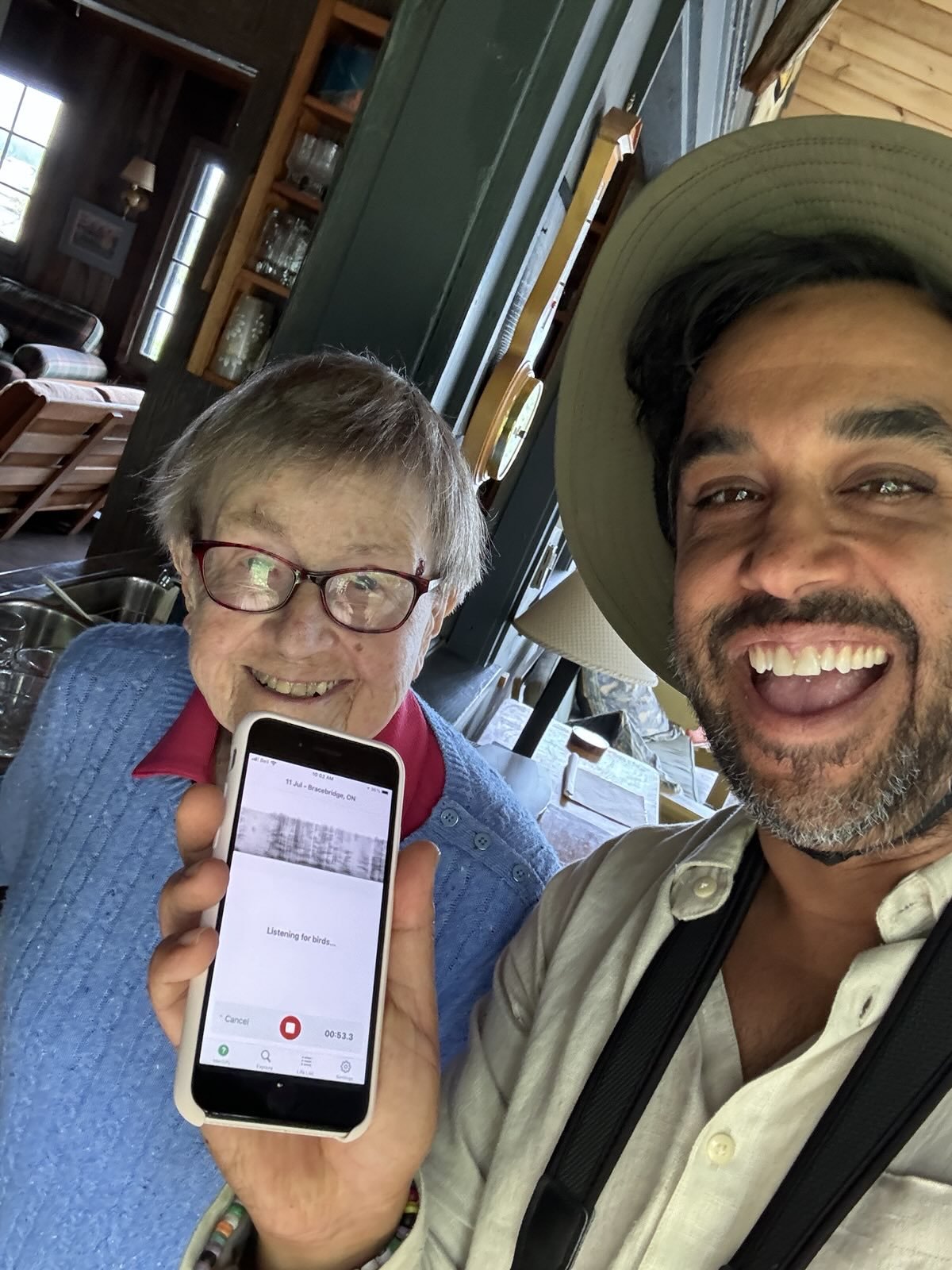
Maybe I've tried to fill that "grandparent hole" with other wise elders I've come across. Like "Aunt Jane" who was the 94-year-old up the hill from my mother-in-law's cottage. My wife Leslie had just told me she died before I got this text from her son the next morning:
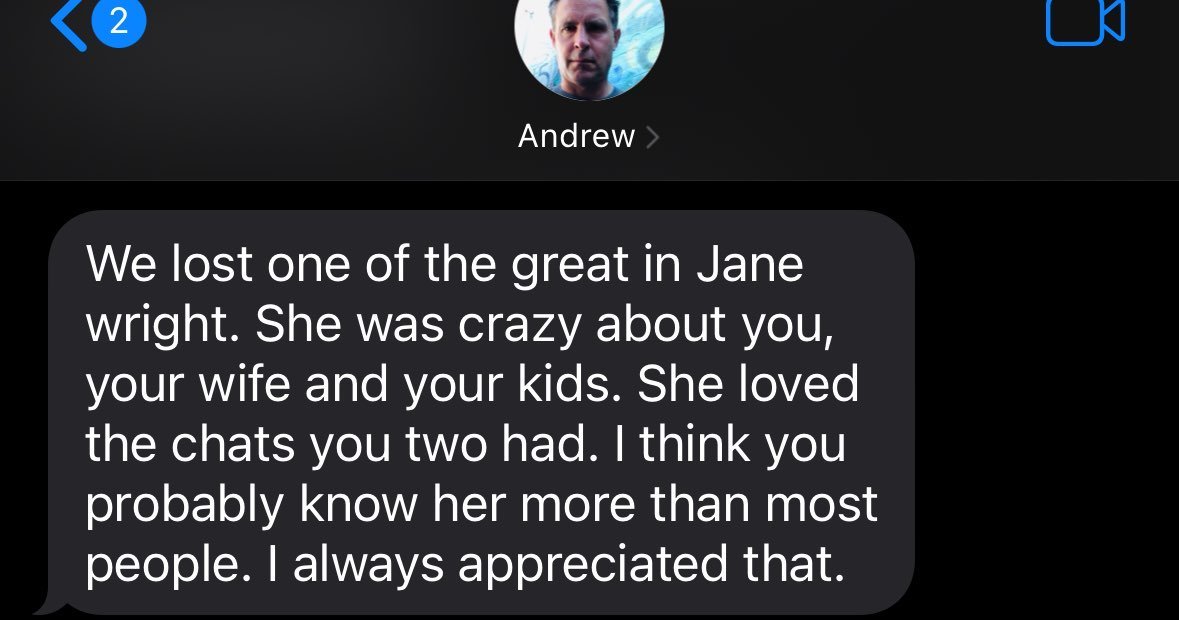
We just had a wonderful ceremony and funeral for her where somebody accidentally called me her son-in-law and I felt myself grow a couple inches. I mean: 94 years old—wow! I saw her hike and swim two times a day, every day, last summer. Heard she did the Wordle in 3 the day before. Housekeeper found her the next morning where she'd apparently died while changing her sweater. Lived alone till the end in the house she raised her five children. Husband of 62 years died a decade ago from cancer.
I replied to her son's text with a few memories below and I thought I'd share them with you, too.
Treasure the elders in your life.
We never know how much time is left.
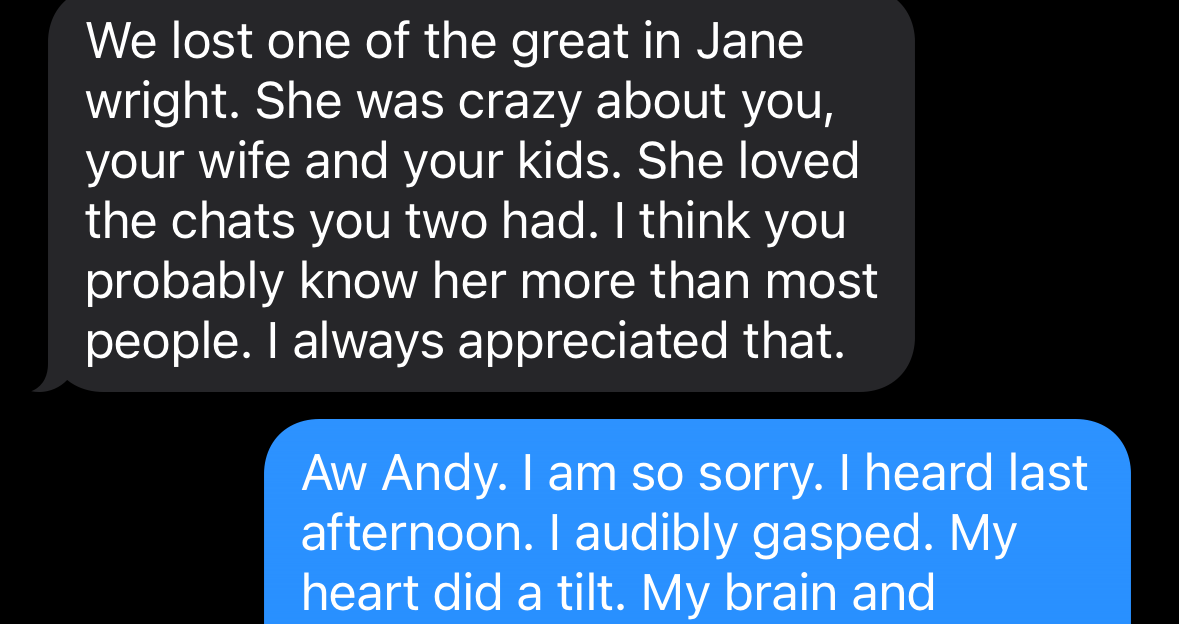
Aw Andy. I am so sorry. I heard last afternoon. I audibly gasped. My heart did a tilt. My brain and stomach felt momentarily, for a second, unconnected—in a way I've rarely, if ever, felt. She was such a wise woman. 94, right? Wow. And I somehow got so lucky to know her for a blissful 15 of those. To think she was a spritely 79 when we met—doing her backstrokes beside Don every day around the island. I have so many memories and they race across my mind like pictures. Sitting beside her telling her about the American Robin or White-crowned Sparrow I saw on the end of the island—or updating her about the Herring Gull or Turkey Vulture nests. Her holding a pencil and telling me how she counts the Common Loons for nationwide record-keeping purposes. Her flapping red and white flag. I loved her non-fiction in the morning, fiction at night tendencies. I loved that she always had a book. It was sad the day she switched to the e-reader and Libby app but that was also part of her ability to modernize, stay cutting edge, and confidently embrace the future. I loved her spartan wooden room full of sparkling lake waters and tall skinny pine trees with my kids jumping on the trampoline down below. Her white hydrangeas, orange lilies, purple wildflowers. All filtered through a thick screen haze. In the Don days, maybe there was opera playing. For sure the totem pole cast a glow. One day I asked her about the different sections and she said "Oh, just a minute!" and pulled open a drawer which held a piece of paper she kept specifically to answer that question. "Aunt Jane," as I hilariously knew her, was my wife's mother's father's brother's beautiful wife— wow. She was so deeply and truly awesome. Truly. What a woman. Full of light and a warm learned energy of understanding, respect, solitude. A generous ear. A kind hello. A daily traipse down the rocky slope to the dock. Later with a cane. Then with ski poles. Always in her black one piece swimsuit and, even later, after I almost hit her once in the boat, a bright white swimming cap, purchased within the hour by Mary. I asked her last summer, after she spent a minute climbing up the dock ladder, "How was the swim Aunt Jane?" and she replied right as I finished, right as she sat down in the Muskoka Chair, "Ohhhh, wonnnderful!" Jane seemed like a forest spirit to me. Tall. High up there. Windy, blowing. Full of life, full of energy. Often quiet but so many clever retorts—always wrapped in kindness. The way a forest reflects a deeper mood. In her I also I sensed a rugged individualism. A steadfastness. An always. An every. A reach back to that deeper wisdom. To me, in one spot in my bird-loving heart, she was my favourite bird: an owl. Great Horned or Great Gray, maybe? Big eyes, full of wisdom—with her beautiful salty-black bowl cut and big round glasses magnifying her eyes. Humans have been here 3 million years. Owls? 60 million. They are apex predators. The only birds with feathered talons for silent travel and forward-facing eyes that penetrate deeply—which goes well with 270-degree neck swivelling and the ability to see behind, and around, corners. Jane. I love you. I miss you. I feel you. I'm near you. Thank you for so many years full of wisdom. I saw you as a distant soul that somehow felt so close. A wonderful nest maker to five inspiring, smart, and exceptionally kind children. To Aunt Jane. With love.


More reflections on death?
When Leslie's grandmother died I wrote this.
When my friend Chris died I wrote this.
Sign Up for a Dose of Inspiration:
Every other week, I send an email out with an article I’ve written, or one of my favorite speeches, essays or poems. No ads, no sponsors, no spam, and nothing for sale. Just a dose of inspiration or beauty!
Joy in Dark Times
Hey everyone,
I hope you and your loved ones are healthy these days. Grief comes up in so many ways—so many places. Love and energy to those of you in California. For Leslie and I, we've had a couple friends and family members get challenging diagnoses recently. Grief does seem to help pull what's important to the surface.
Our friend Clare shared she's been finding solace in a book called 'Wild Hope: Healing Words To Find Light On Dark Days' by Donna Ashworth (@donnaashworthwords). Leslie bought the book and we loved the first poem Clare texted us which is called 'Joy Chose You.'
I hope it resonates with you too,
Neil
Joy Chose You
Written by Donna Ashworth


Joy does not arrive with a fanfare
on a red carpet strewn
with the flowers of a perfect life
joy sneaks in
as you pour a cup of coffee
watching the sun
hit your favourite tree
just right
and you usher joy away
because you are not ready for her
your house is not as it should be
for such a distinguished guest
but joy, you see
cares nothing for your messy home
or your bank balance
or your waistline
joy is supposed to slither through
the cracks of your imperfect life
that’s how joy works
you cannot truly invite her
you can only be ready
when she appears
and hug her with meaning
because in this very moment
joy chose you.
Here's another poem that helps me focus on what's most important.
One of the best ways to be ready for joy? Practicing gratitude.
Sign Up for a Dose of Inspiration:
Every other week, I send an email out with an article I’ve written, or one of my favorite speeches, essays or poems. No ads, no sponsors, no spam, and nothing for sale. Just a dose of inspiration or beauty!
Why are we so bad at predicting the future?
Hey everyone,
Just a friendly reminder: None of us can see the future. When times are good that may not be so bad! We can't imagine something terrible happening. But when times are tough it's a problem because we also can't imagine things improving. Here's a piece I wrote that was posted on TED's blog and makes up a chapter in my 9-step book on resilience 'You Are Awesome: How to Navigate Change, Wrestle with Failure, and Live an Intentional Life.'
Hope you enjoy, Neil
P.S. Leslie and I released a new journal last week! 'Two Minute Evenings' is a simple system that will help you acknowledge the good and address the bad through the science-backed power of gratitude. Get your copy here.
Why are we so bad at predicting what will happen to us in the future?
Written by Neil Pasricha
The staircase represents your life so far. And you can’t see up the invisible staircase.
Look down behind you. That part is visible. You can see where you came from. All the steps you already walked up.
Look. There’s the time you moved in fifth grade and got bullied by that goon Adam every day after school.
Remember? That’s when you first picked up a basketball and started practicing with Coach Williams every night.
There’s Francesco, the tattooed chef who chewed you out every shift you showed up late to wash dishes at the seafood place as a teen. It was painful but you learned to be on time.
Prom—remember that disaster? I guess that night helped you realize you were gay.
So many steps up to today. Big steps. Hard steps. But steps all the same.
And what’s next on the staircase?
Well, that’s the problem.
No one knows.
It’s invisible. We can’t see the future. And maybe if that were the only problem, that would be okay. But it isn’t. It gets worse.
Why?
Because according to the research, we actually think we can see up that staircase.
Our brains think, “Oh yeah, sure, I know what’s next in my life.” In reality, we suck at it. Let me explain.
In 2013, Science published a fascinating study conducted by the researchers Jordi Quoidbach, Daniel T. Gilbert and Timothy D. Wilson. They teamed up to measure the personalities, values and preferences of more than 19,000 people ages 18 to 68. In a series of tests, they asked the subjects about two pretty simple things: how much they thought they had changed in the past decade and how much they would change in the next decade.
They used a lot of scientific methods to make sure the data were legit, then they published their results. Academic circles started buzzing. Media outlets clamored to share the results.
Why?
Because the results were mind-blowing.
It turned out that no matter how old the respondents were, they uniformly believed that they had changed a ton in the past but would change little in the future.
What?
Imagine a 30-year-old guy telling the tempestuous story of his last 10 years but figuring his next 10 years would be smooth sailing. Imagine a 50-year-old woman talking about how everything had flip-flopped after she turned 40 but then assuming that at 60, she’d be the same person she was now. That was the case for everybody regardless of age, gender or personality.
We all do it.
We all think that the way things are now is the way things will continue to be.
If you’re flying high, that’s maybe not a bad thing, but if you’re falling, if you’re busted, if you’re heartbroken, if you’re lonely, then this is a dangerous psychological tendency. And we all share it.
When we’re at rock bottom, we are certain that there’s no way up. We think we’ll never get out of our parents’ basement. We think our divorce means we’ll never meet someone new. If we’ve lost our jobs, we think we’ll be scrolling online postings forever.
The researchers called this the “end of history illusion.” We think everything will remain unchanged from here on out.
Why did those researchers study go to the effort of 19,000 people? Gilbert went on NPR’s Hidden Brain and explained, “You know, like everybody, I suffer the slings and arrows of outrageous fortune. You know, we have divorces. We have surgeries. We have breakups with women we love and friends we enjoy. So it was sort of ordinary events that befell me all in one year. And I realized that, had you asked me a year earlier how I would be faring, the answer would have been, ‘Oh, my gosh, I’ll be devastated.’ But I wasn’t devastated … And it made me wonder if I was the only person who was just too stupid to be able to look ahead into his future and figure out how he’d feel if really bad or maybe really good things happened.”
There it is. The invisible staircase.
Even Gilbert, the famed Harvard psychologist and professor, the author of bestselling books such as 'Stumbling on Happiness,' even he forgets that the rest of the staircase is invisible. He went through a flop or two and figured, “Well, darn, my life’s gonna suck forever.” But it didn’t.
Inevitably, everything we go through in life really is a step to help us get to a better place.
It’s hard to see it this way. But we have to, because this study helps us realize we’re prone to catastrophizing. That alone should be enough to zoom backward in your brain and go, “Wait a minute here. I’m tricking myself! Who’s to say I won’t get out of the basement? Meet someone new? Land a plum gig I love?”
See it as a step.
Gilbert ended up figuring out that when it comes to predicting the future, we’re all stupid. Each and every one of us.
Doesn’t that feel better?
This research reminded me of an HR job I had where I had to escort bosses into meeting rooms whenever they had to fire an employee. I was there for paperwork, for witnessing, for emotional support. I was in the room when dozens of people got fired, and it was awful. There were tears and wet tissues and many afternoons when I’d be consoling someone in a freezing parking lot as they loaded up their trunk with framed pictures from their desk saying “I thought I’d be here forever” and “What am I going to do now?” and “I’ll never find another job.”
Those scenes left me heartbroken. I lost a lot of sleep over them.
Sometimes I’d bump into the former employees years later. And what did they tell me? “Getting fired was the best thing that happened to me! If I hadn’t gotten that severance package, I never would have had those crucial six months to spend with my dad before he died.”
Or: “I traveled to Peru and became a nutritional supplement importer, and I love what I’m doing now!”
Or: “I’m working at a smaller company now, and I’ve gotten promoted twice in two years!”
Or: “I used my severance pay to take the time to be with my daughter and son-in-law in the months after her third miscarriage.”
Why did every fired employee tell me this? Why did they all react so positively after some time had passed? How can that happen?
Because we confuse the challenge of picturing change with the improbability of change itself.
We do.
We confuse the challenge of picturing change (“What am I going to do now?”) with the improbability of change (“I’ll never find anything!”).
In other words, you can’t picture yourself changing so you assume that you won’t.
Why?
Because your seeing skills are shit. And so are mine. So are everyone’s. You think because you can’t see up the staircase there aren’t any more steps. But there are more steps.
And change will come.
It always does.
That’s why it’s so hard to see change as a step. To see this failure, this flop, this difficult life experience as part of a process, as part of a greater whole. It’s hard to see it as a step because you can’t see the next step. And you sure can’t see 10 steps after that.
Why do we always think failure leads somewhere bad? It’s not true. It rarely is. Remember the end of history illusion. Our brains think this is the end. Remember all those people I met after they were fired saying how positive that left turn ended up being?
It’s me, too. How could I have known that failing at P&G would somehow lead us to having the conversation we’re having right now? I couldn’t have. Believe me, I far prefer having this conversation to doing price analysis on eye shadows and mascaras. But when I flamed out there, I pictured myself sleeping in a pile of club sandwich crusts in Cleveland.
So be kind to yourself.
When you’re there, when you’re stewing in the shock of failure and loss, when you’re convinced you’re stuck, when you’re convinced there’s no way forward, just remember: There’s a staircase you’re not seeing. Trust that it’s there, right in front of you, and that it leads to exciting new places. Have the courage to believe in this one thing that you can’t see.
There are so many steps ahead. So many steps. Don’t stop. Shift the spotlight, and keep moving.
It’s very possible and very likely that what you’re going through is a step toward a future you’ll be happy with. But you just can’t see it … yet.
Another potent gut-check on your present moment is to ponder the greatest regrets of the dying.
Need a stronger, more consistent dose? Check out the new journal Leslie and I released last week. 'Two Minute Evenings' will guide you through a science-backed gratitude practice designed to help you feel happier and healthier.
Sign Up for a Dose of Inspiration:
Every other week, I send an email out with an article I’ve written, or one of my favorite speeches, essays, or poems. No ads, no sponsors, no spam, and nothing for sale. Just a dose of inspiration or beauty!
Why we're so bad at predicting what will happen to us in the future

We all think the way things are now is the way things will continue to be. If you’re flying high, that’s not so bad, but if you’re falling, flailing or treading water like many of us right now, then this is a dangerous tendency.
Here’s how to counteract it.
See the failure you’re going through as a step up an invisible staircase toward a Future You in a Future Life you can’t even imagine yet.
The staircase represents your life so far. And you can’t see up the invisible staircase.
Look down behind you. That part is visible. You can see where you came from. All the steps you already walked up.
Look. There’s the time you moved in fifth grade and got bullied by that goon Adam every day after school.
Remember? That’s when you first picked up a basketball and started practicing with Coach Williams every night.
There’s Francesco, the tattooed chef who chewed you out every shift you showed up late to wash dishes at the seafood place as a teen. It was painful but you learned to be on time.
Prom — remember that disaster? I guess that night helped you realize you were gay.
So many steps up to today. Big steps. Hard steps. But steps all the same.
And what’s next on the staircase?
Well, that’s the problem.
No one knows.
It’s invisible. We can’t see the future. And maybe if that were the only problem, that would be okay. But it isn’t. It gets worse.
Why?
Because according to the research, we actually think we can see up that staircase.
Our brains think, “Oh yeah, sure, I know what’s next in my life.” In reality, we suck at it. Let me explain.
In 2013, Science published a fascinating study conducted by the researchers Jordi Quoidbach, Daniel T. Gilbert and Timothy D. Wilson. They teamed up to measure the personalities, values and preferences of more than 19,000 people ages 18 to 68. In a series of tests, they asked the subjects about two pretty simple things: how much they thought they had changed in the past decade and how much they would change in the next decade.
They used a lot of scientific methods to make sure the data were legit, then they published their results. Academic circles started buzzing. Media outlets clamored to share the results.
Why?
Because the results were mind-blowing.
It turned out that no matter how old the respondents were, they uniformly believed that they had changed a ton in the past but would change little in the future.
What?
Imagine a 30-year-old guy telling the tempestuous story of his last 10 years but figuring his next 10 years would be smooth sailing. Imagine a 50-year-old woman talking about how everything had flip-flopped after she turned 40 but then assuming that at 60, she’d be the same person she was now. That was the case for everybody regardless of age, gender or personality.
We all do it.
We all think that the way things are now is the way things will continue to be.
If you’re flying high, that’s maybe not a bad thing, but if you’re falling, if you’re busted, if you’re heartbroken, if you’re lonely, then this is a dangerous psychological tendency. And we all share it.
When we’re at rock bottom, we are certain that there’s no way up. We think we’ll never get out of our parents’ basement. We think our divorce means we’ll never meet someone new. If we’ve lost our jobs, we think we’ll be scrolling online postings forever.
The researchers called this the “end of history illusion.” We think everything will remain unchanged from here on out.
Why did those researchers study go to the effort of 19,000 people? Gilbert went on NPR’s Hidden Brain and explained, “You know, like everybody, I suffer the slings and arrows of outrageous fortune. You know, we have divorces. We have surgeries. We have breakups with women we love and friends we enjoy. So it was sort of ordinary events that befell me all in one year. And I realized that, had you asked me a year earlier how I would be faring, the answer would have been, ‘Oh, my gosh, I’ll be devastated.’ But I wasn’t devastated…. And it made me wonder if I was the only person who was just too stupid to be able to look ahead into his future and figure out how he’d feel if really bad or maybe really good things happened.”
There it is. The invisible staircase.
Even Gilbert, the famed Harvard psychologist and professor, the author of bestselling books such as Stumbling on Happiness, even he forgets that the rest of the staircase is invisible. He went through a flop or two and figured, “Well, darn, my life’s gonna suck forever.” But it didn’t.
Inevitably, everything we go through in life really is a step to help us get to a better place.
It’s hard to see it this way. But we have to, because this study helps us realize we’re prone to catastrophizing. That alone should be enough to zoom backward in your brain and go, “Wait a minute here. I’m tricking myself! Who’s to say I won’t get out of the basement? Meet someone new? Land a plum gig I love?”
See it as a step.
Gilbert ended up figuring out that when it comes to predicting the future, we’re all stupid. Each and every one of us.
Doesn’t that feel better?
This research reminded me of an HR job I had where I had to escort bosses into meeting rooms whenever they had to fire an employee. I was there for paperwork, for witnessing, for emotional support. I was in the room when dozens of people got fired, and it was awful. There were tears and wet tissues and many afternoons when I’d be consoling someone in a freezing parking lot as they loaded up their trunk with framed pictures from their desk saying “I thought I’d be here forever” and “What am I going to do now?” and “I’ll never find another job.”
Those scenes left me heartbroken. I lost a lot of sleep over them.
Sometimes I’d bump into the former employees years later. And what did they tell me? “Getting fired was the best thing that happened to me! If I hadn’t gotten that severance package, I never would have had those crucial six months to spend with my dad before he died.”
Or: “I traveled to Peru and became a nutritional supplement importer, and I love what I’m doing now!”
Or: “I’m working at a smaller company now, and I’ve gotten promoted twice in two years!”
Or: “I used my severance pay to take the time to be with my daughter and son-in-law in the months after her third miscarriage.”
Why did every fired employee tell me this? Why did they all react so positively after some time had passed? How can that happen?
Because we confuse the challenge of picturing change with the improbability of change itself.
We do.
We confuse the challenge of picturing change (“What am I going to do now?”) with the improbability of change (“I’ll never find anything!”).
In other words, you can’t picture yourself changing so you assume that you won’t.
Why?
Because your seeing skills are shit!
And so are mine. So are everyone’s. You think because you can’t see up the staircase there aren’t any more steps. But there are more steps.
And change will come.
It always does.
That’s why it’s so hard to see change as a step. To see this failure, this flop, this difficult life experience as part of a process, as part of a greater whole. It’s hard to see it as a step because you can’t see the next step. And you sure can’t see 10 steps after that.
Why do we always think failure leads somewhere bad? It’s not true. It rarely is. Remember the end of history illusion. Our brains think this is the end. Remember all those people I met after they were fired saying how positive that left turn ended up being?
It’s me, too. How could I have known that failing at P&G would somehow lead us to having the conversation we’re having right now? I couldn’t have. Believe me, I far prefer having this conversation to doing price analysis on eye shadows and mascaras. But when I flamed out there, I pictured myself sleeping in a pile of club sandwich crusts in Cleveland.
So be kind to yourself.
When you’re there, when you’re stewing in the shock of failure and loss, when you’re convinced you’re stuck, when you’re convinced there’s no way forward, just remember: There’s a staircase you’re not seeing. Trust that it’s there, right in front of you, and that it leads to exciting new places. Have the courage to believe in this one thing that you can’t see.
There are so many steps ahead. So many steps. Don’t stop. Shift the spotlight, and keep moving.
It’s very possible and very likely that what you’re going through is a step toward a future you’ll be happy with. But you just can’t see it … yet.
An earlier version of this article was published on TED.com