Neil Pasricha’s Unconventional Christmas Gift Guide
Christmas is messed up.
Most years lots are jammed, malls are rammed, and we race around in giant plastic cars to fill giant plastic bags with giant plastic toys to set under giant plastic trees. Can a pandemic slow us down? Of course not! Our clicker fingers get blisters as cardboard boxes pile up at the front door. What do we all want? More! More, more, more!
I’ve been talking to my wife Leslie about ways to pull back, pare back, and get intentional about what we’re giving. We are very, very, very far from perfect (I did write this, after all), but here is my best shot at nine unconventional gifts to dial down the insanity and dial up the intimacy:
9. Old jewelry. Most things in your grandma’s closet don’t age well. Pantyhose. Pink track pants. 20-Minute Workout VHS tapes. But jewelry is the exception. The story of a specific bracelet or pair of earrings only deepens, lengthens, and intensifies with time. “It’s the ring you grandfather bought me on our tenth anniversary” or “I bought these earrings for my prom back when I lived up north.” The story of old jewelry is the story of the milestones in your life. Also applies to hoodies, watches, or anything worn and loved which someone else could wear and love, too.
8. A birdfeeder and a bag of bird food. Who else has become crazy about birds during the pandemic? (I absolutely have!) Has your friend or loved one been going on and on about the Merlin ID app or asking if you want to traipse out to some forest at daybreak to spy on kinglets or owls? That person needs a bird feeder! And a bag of bird food! Bonus points if you include installation.
7. A batch of your homemade spaghetti sauce. Spend a day simmering a pot of the good stuff and pour it into jars for all your loved ones. Also works with salsa, jam, or granola. For bonus points cut out some little checkered cloths with pinking shears and wrap them around the lids with string. For double bonus points, cater to their unique allergy or dietary constraint. Nothing says love like keto carbonara.
6. A different version of their favorite book. When I interviewed my favorite bookseller on 3 Books she told me she had four copies of Are You There God? It’s Me Margaret by Judy Blume. Four? What? Why? Well, it’s her favorite book, they have different covers, one of them is signed, you get the idea. Why is this such a brilliant move? Because you already know they love it. Now they get an edition that’s different because of the cover or format or signature inside. You win points for fishing through used bookstore bins and if those are closed up try special autographed sites at Abe Books or Books-A-Million.
5. An outdoor hot chocolate carafe. Who else is doing a lot of cold weather distanced visits? If it’s freezing but you want some six foot love then get an outdoor carafe for coffee, tea, or hot chocolate and heat up everybody’s heart. (Here’s an example.)
4. A mix tape or personalized playlist with the track listing printed inside the card. Every single Christmas I eagerly look forward to my friend Mike’s “Best Of This Year” CD he painstakingly curates, produces, burns, and mails to me. Does anyone still have CD players? Yes, most of us do. In the basement! In the car! Somewhere! Mike loads the playlist onto Spotify too (here’s last years) so I can listen to it wherever. Music says what words can’t. And, in an era of infinite choice, the value of curation skyrockets. If you want to get hardcore you can record it on a cassette and pair it with an old Walkman to play it on. And, if not, then making a custom playlist and writing up a pretty track listing in the card also works wonders.
3. A gift certificate to your favorite independent bookstore. The pandemic has hurt independent bookstores badly. Many are shuttered and doing some crazy factory operations inside. But bookshops are one of the most vital members of our local cultural community and a gift certificate from a local shop is a stocking stuffer of love. Do you want more reasons? Here’s an article I wrote on why you should spend more time in bookstores. Do you want something to wrap with the gift certificate? Pick something from the 3 Books 1000 most formative books in the world.
2. A hand-written love letter. Sounds daunting! That’s why it sticks out. A few things up front: Paper doesn’t matter, pen doesn’t matter, crossing things off and rewriting them again and again doesn’t matter. No need for rhymes. No need for anything fancy. The goal is to remove all the hesitation between your heart and fingers and let it flow. What you remember about how we met, a few favorite memories from this year, and how you make me feel. That’s it! The letter is hardest before it’s written and easiest after you start. Leslie and I write one to each other every Christmas and it’s one of our fondest traditions. She even photographs them in case of tornado or typhoon. Again, length, style, format – none of it matters. According to a study published in the Journal of Psychological Science, when we express gratitude for others by writing them a handwritten letter, we underestimate how grateful recipients feel, overestimate how ‘awkward’ it is, and underestimate how positive they’ll feel. If you need a more detailed primer, here’s one to check out. But basically: Don’t think about it. Just go for it.
1. A homemade coupon booklet. I know you remember giving these to your mom when you were six and couldn’t afford to get her a sweater. “This coupon entitles the bearer to 1 free hug.” And those coupons were beautiful and sweet and I bet they made your mom cry and I bet she kept them. But then what happened? You started getting her can openers and blenders. Lame! Bring back the homemade coupon. But now, as an adult, you can make it a whole booklet. We know experiences make us happier than things and the homemade coupon brings experiences to life. Foot massages! Homemade lasagna! Watching the kids! Two weeks of laundry! Make out sessions! Wait, I’m talking about your partner not your mom now. I should clarify. (Hey, if you take the advice of bestselling author Kelly Oxford in GQ, then sexual favors in committed relationships are fair game, too.) Spicing up marriages, strengthening relationships, getting right to the nucleosis of generosity, and saving money. Is there anything homemade coupons can’t do?
Christmas, Christmas, long grown from its religious roots straight and into our increasingly secular world. But how do we escape our own itchy clicker fingers and the endless boxes piling up on the front porch?
We do it by preserving the magical reminder of generosity and togetherness by choosing gifts easy on the environment, easy on the wallet, and extra on the intimacy … whenever we can.
Happy holidays to you and yours!
3 Ways To Fight Cellphone Addiction In Schools
I was speaking at a principals’ conference recently. Want to take three guesses at what most of the questions were about? If you said “cellphones, cellphones, and more cellphones” you’re right.
“How do we pull students off devices?”
“How do we remove cellphones as a distraction and regain focus and attention in classrooms?”
“What can we do to cope with growing cellphone addiction and anxiety and other problems rising up?”
Well, first off, it is an addiction. We’ve talked before about how when everyone is addicted to something it looks like nobody is. It’s not the only thing! Caffeine, sugar, you guys know what I’m talking about. But, on phones, my old answer used to be to ban cellphones. Not allowed! Keep them away from classrooms, lunch rooms and hallways. But the tide has shifted. When I asked the room of 300 elementary and high school principals how many didn’t allow cellphones in classrooms … nobody put up their hand.
And then I stared a bit closer at all the conference tables around the room. What was sitting in front of everybody? Cellphones. Of course.
That’s when I realized.
Pandora’s Box is already opened.
You can’t stuff demons back in that easily.
It wasn’t even a few years ago I remember CEOs or conference MCs holding up cardboard boxes and asking everyone to toss their cellphone in before a big meeting began. But now all we do is tell people which hashtag to use.
Why are we so afraid to tell others to give up their phones? Because we don’t want to give them up ourselves.
And it’s not our fault as the devices are designed to be more and more irresistible and addictive and, since we are the most social species on the planet, our phones have become the primary connective tissue to our family, friends, coworkers, tribes, subreddits, fantasy football leagues, celebrity follows … all our social connections.
A 2017 study looked at how people with high and low nomophobic (no-more-phone-phobia) tendencies perceive and value their smartphones. The findings suggest that we see our phones as extensions of ourselves, which is what creates separation anxiety to our phones. That’s right — high cellphone users literally feel anxious when separated from their devices.
Clinical psychologist Brenda K. Wiederhold further elaborates on this subject: “Nomophobia, fear of missing out (FOMO), and fear of being offline (FOBO) — all anxieties born of our new high-tech lifestyles — may be treated similarly to other more traditional phobias. Exposure therapy, in this case turning off technology periodically, can teach individuals to reduce anxiety and become comfortable with periods of disconnectedness.”
But it ain’t that easy!
So what do we do?
Well, I have three suggestions.
1. Zones
After a moment one principal bravely put up her hand and said “You know, we’re trying something at our school. We have 25-minute nutrition breaks twice a day. And in those breaks we say cellphones aren’t allowed. The students sit at tables, face each other, and if we see a cellphone … we take it.”
“How’s it working?” I asked.
“Well, we end up taking a bunch of cellphones every day. It’s really hard for them. But most of them have figured out they can make it 25 minutes and be able to use their phones right afterwards.”
So if you can’t yank the drug, how about a cellphone free zone? It can be schedule-based or maybe location based. Like no cellphones in the library.
Alamo Drafthouse Cinema is an Austin, Texas-based movie theatre chain that is growing in leaps and bounds. While movie theatres nationally experienced a 3.4 per cent drop in box office sales in 2010, Alamo saw a 2.6 per cent rise in sales, and if you include food and drink revenue, that number is up to 4.8 per cent.
What differentiates the Alamo from the rest? Well, it has set in place policies to improve the customer’s overall experience … including one no other movie theatre has: if you use your cellphone a bouncer kicks you out.
Like I said, the chain is growing in leaps and bounds.
2. Modelling
Are you complaining about students using cellphones with your phone sitting on your desk?
Last month the New York Times released an article on why Silicon Valley parents are becoming increasingly obsessed with keeping their children away from phones … and why many are now asking their nannies to sign “no cellphone” contracts to help keep technology away from their kids.
One Silicon Valley nanny said: “Most parents come home, and they’re still glued to their phones, and they’re not listening to a word these kids are saying … Now I’m the nanny ripping out the cords from the PlayStations.”
Are children using their phones more because their peers are … or because their parents are?
This all reminds me of a New Yorker cartoon I saw recently. Two women are sitting beside each other on a park bench. Each has a young girl beside them, presumably their daughters. One mom is holding a phone. Her daughter is looking at a phone. The other mom is holding a book. Her daughter is reading a book. And the caption is phone-holding mom asking book-holding mom: “How do you get your kid to read?”
3. Fasting
How often do you say “Wow, I drank too much at that wedding. No drinks till next weekend.” Or “I gained five pounds over the holidays. I’ll walk to work this month.” These fasts are little mental systems put in place to prevent slipping again. Systems always beat goals.
So if you’re leading a group of people (in a school, sure, but it also applies elsewhere) you can apply the fasting principle to the group.
How? Start by saying you’re going on a fast.
A Facebook fast, an Instagram fast, a “no social media apps on my cellphone” fast. You pick the fast!
Then ask who else is in, draw up a leader board, and track who lasts the longest. Throw in a prize if it helps. Use a website like stickk.com or futureme.org if it’s helpful.
Declare cell free zones! Model the behaviour! Take a fast!
Yes, our tools may be dull and rusty.
But we can win this war yet.
A slightly modified version of this article originally appeared in the Toronto Star
Why You Should Spend More Time In Bookstores

Watch out, world.
Bookstores are making a comeback.
According to Harvard University, after Amazon launched in 1995, the number of independent bookstores in the United States plummeted by 43 per cent in only five years. But now, right alongside high-waisted jeans and record players, bookstores are making a comeback.
The American Booksellers Association reported a 35 per cent growth in the number of independent booksellers. Why? Well, according to Ryan Raffaelli, an assistant professor at Harvard Business School, the increase can be attributed to the ‘3 Cs’: convening, curation and community.
I was flipping through an issue of Monocle Magazine a few months back that ranked the world’s most livable cities. And what was one of its criteria? The number of independent bookstores.
I thought that was an ingenious little variable that does indeed make cities so much more livable. What else connects us so deeply with local business owners, fellow book lovers, and our incredible shared earthling history and culture?
Bookstores are a central public hub for events. Toronto’s oldest bookstore Glad Day bookshop hosts drag-themed brunches, Indigo offers talks and signings with authors including Jodi Picoult, James Frey and David Sedaris, and the Toronto Public Library often hosts author talks and Q&As with disreputable authors including myself. I’ve even hosted episodes of my podcast 3 Books in bookstores, including my conversations with Dave Barry at Books and Books in Coral Gables, Fla., and with Judy Blume in her own bookstore down in Key West.
And, nevermind events, they’re a central public hub for books. They are chock full of two-inch thick compressed volumes of the best thinking from the best brains in the history of the universe. All thoughtfully laid out on tables and shelves in front of you.
I love talking to the staff, who work until midnight every night of the week, at Seekers Books in the Annex; getting a book from the world’s first Biblio-Mat (book vending machine) from The Monkey’s Paw on Bloor St. W. in Dufferin Grove; and staring at the incredible graffiti wall upstairs at Mables Fables on Mount Pleasant Rd. where children’s book authors have drawn doodles and cartoons for more than 30 years. I get a sense of home, comfort and intimacy from bookstores that a computer will never replicate.
When I interviewed Chris Anderson of TED on my 3 Books podcast he explained that one of the goals of the TED conference is to provide a huge amount of incongruent ideas that stir together in your brain in unique ways so lightning bolt ideas flash and process. That’s what bookstores do too. You walk past Seneca’s letters on minimalism from 2,000 years ago before flipping through modern art books on forest therapy before getting sucked into a brand new novel by someone you’ve never heard of and would never have found any other way.
And, can I get something else off my chest?
I hate online recommendation engines.
There, I said it.
They just recommend the same 25 books to me over and over again.
What I want is someone who knows me, who has sold me books for years, who knows what I like, knows what I don’t, knows what I find too hard, and, maybe most importantly, knows what I’m going through right now. Sound impossible? It absolutely isn’t. I can spend hours getting suggestions from Sarah at Another Story Bookshop on Roncesvalles Ave., Lorna at Indigo Manulife Centre, or Kyle at Type Books on Queen St. W. In fact, on my nightstand right now I have Cherry by Nico Walker, The Wild Robot by Peter Brown, and The Secret Life of Cows by Rosamund Young. All recommendations from these three booksellers.
Let’s go back to Glad Day bookshop which I mentioned earlier. Not only is Glad Day Toronto’s oldest bookstore, but it’s also the oldest surviving LGBT bookstore in the world.Glad Day was founded in 1970 by Jearld Moldenhauer, who ran the bookstore out of his home in the Annex. Word spread that it was a safe space for members of the LGBTQ community to express their love of reading and purchase books and the store eventually moved to a house in Kensington Market, then to Yonge St., and eventually to 499 Church St.
Doesn’t that say something about what bookstores represent?
A place people come together, a place to share thoughts and ideas, and a safe escape from our sometimes overwhelming now into a different path, a different mind and a somewhat tangential narrative of life that we get to simply slip into for a while.
Who cares?
Well, books help us develop empathy, compassion and understanding for each other. Critical skills for any parent, teacher, or leader. The Annual Review of Psychology published a groundbreaking report in 2011 that stated books are medicine. Books are medicine! They create empathy and intimacy and happiness. Turns out our brain’s mirror neurons fire when we read about new experiences because we feel like we’re there.
It’s that line by George RR Martin: “A reader lives a thousand lives before he dies … the man who never reads lives only one.”
Books are my favourite vacations, book lovers are my favourite people, and bookstores are my favourite places.
Our city is full of so many incredible bookstores.
I hope to see you at one of them soon.
An earlier version of this article originally appeared in the Toronto Star.
The Power of 1000
I didn’t realize it at the time, but something special happened to me on June 20, 2008.
I was in a pretty depressive state with my marriage heading the wrong direction and my best friend suffering from severe mental illness. I needed an escape. An outlet. A place to go. A place to vent.
So, I typed “How to start a blog” into Google and pressed that “I’m feeling lucky” button, which no one ever presses. And 10 minutes later, I started up a tiny website called 1000 Awesome Things.
My idea was to write down 1000 awesome things for 1000 straight weekdays to cheer myself up.
Why 1000?
Well, 100 awesome things sounded too low. Too easy! I could whip that off in a few months and I’d be finished. I didn’t expect I’d have things figured out in my own head that quickly.
And one million awesome things sounded like too much. A million! How many years would that take? Oh, just a couple thousand. Since I’m not Gandalf, I knew I was aiming too high.
1000 became my baby bear bowl of porridge.
It sounded jussssssssst right.
For the next four years, for the next 1000 straight weekdays, I really did write 1000 awesome things on my blog. And while my marriage fell apart and my best friend sadly took his own life, that tiny blog became a salvation, a place to escape to, a place to disappear to.
On April 19, 2012, 1000 weekdays after I launched it, I announced the No. 1 awesome thing in a downtown bookstore beamed live to the CBC National News.
And then … that was it. I hit 1000. The project finished. The blog ended. And I moved on.
But something happened to me over the years.
And it’s something I never put a finger on until more recently.
The number 1000 kept popping up in my life.
I thought maybe it was just the famous Baader-Meinhof phenomenon. You know, when you keep seeing the same obscure word jump out at you after hearing about it for the first time. Does that happen to you, too? In 1994, a commenter on the St. Paul Pioneer Press’s online discussion board came up with that strange term after hearing the name of the ultra-left-wing German terrorist group twice in one day.
But the number 1000 felt deeper than that.
When researching The Happiness Equation,I looked at lifespans around the world. I was trying to understand why people in Okinawa, Japan, for example, live seven more years than North Americans and have no word for retiring.
So, guess what our average lifespan is? Here’s the interesting thing. It’s 1000 months. Or just over 83 years.
“There’s that number again,” I thought to myself.
A year later, I was working on my journal Two-Minute Mornings. I found I was stressed out so I came up with a routine to help me chill. Each morning, I would wake up and answer three research-backed prompts to both clear and focus my mind:
“I will let go of …”
“I am grateful for …”
“I will focus on …”
When part of your life is doing interviews with media, you get good insights from journalists. And that’s what happened. I was doing the TV, radio, and podcast circuit on this journal and a host said something that struck me. She said:
“Today, we welcome Neil Pasricha on the show. His challenge? You’re awake 1000 minutes every day. Could you take two of them to make the other 998 even better?”
Wait a minute.
You’re alive 1000 months.
You’re awake 1000 minutes a day.
What an incredibly helpful way to measure what you’re doing in life in the broadest possible sense.
Renovating your fixer-upper for three months? Feels awful. But maybe small potatoes in the grand scheme of things. After all, it’s only 3 of your 1000 months. Hate your 100-minute commute? That makes sense! You’re only awake 1000 minutes a day, so you’re burning 200 or 20% of them in the car.
What’s another reason 1000 is such a powerful number?
Because it’s a moon shot number that’s actually realistic.
When you’re only alive for 1000 months (or roughly 30000 days), then doing something for 1000 of them is a massive commitment … that you can actually do.
Can you do 1000 morning runs?
Can you cook 1000 homemade dinners?
Can you teach 1000 students?
Can you help 1000 people?
Yes, you can. It will take you a while.
But you can.
Why 1000?
Because it is clear and measurable and big and daunting … but reachable. I wanted to quit so many times while writing 1000 Awesome Things. But I had that number, that commitment, those three big zeros staring me in the face.
Once I’d spent a year writing a few hundred awesome things, could I look at myself in the mirror if I quit? I decided I couldn’t, which is where duds like, say, #806 Ducks came from on my blog.
How do I use it in my life today?
I decided I wanted to try and read the 1000 most formative books in the world before I die. Easy math. About a book a month. I realized there was no list of 1000 books I could trust and no algorithm that could feed me these 1000 important, life-changing books.
So, I made my own. I decided to interview 333 people who I find inspiring and ask each of them for the three books which most changed their lives. Who? Authors like Judy Blume, George Saunders, and David Sedaris. Artists like Sarah Andersen, Daniels, and Quentin Tarantino. And inspiring people I stumble upon like Vishwas Aggrawal, Rebecca S. Kaye, or Elder Cox and Elder Corona.
I record these conversations in a podcast called 3 Books with Neil Pasricha and I release one chapter on the exact minute of every full moon up to 2040.
2040? Yes! That’s the magic of 1000.
It’s a moon shot — I may never make it. I started the project at 38 years old and I’ll be 60 when it’s over. It's 1000 books so it will take a long time. But I now know, and I now believe, in the power of 1000 to lead me there.
As George R.R. Martin wrote: “A reader lives 1000 lives before he dies … the man who never reads lives only one.”
There it is again.
A one with three zeros.
What can you do a thousand times?
Just sign up for doing 1000 of something and then get ready to drop your jaw and stare back at yourself as you accomplish your massive goal.
Good luck!
A slightly modified version of this article originally appeared in the Toronto Star
7 Customer Service Lessons From The World’s Greatest Uber Driver
Do you Uber?
I’ve probably hailed an Uber two or three times a day for the past couple years and every time I do I scroll down to check the driver’s rating and number of rides. Do you do that? I’m always curious so I’ve sort of made a little mental map over time of what the ratings mean. 4.3? May drive on wrong side of the road. 4.5? Get ready for loud GPS directions. 4.7? Messy trunk with no suitcase room.
But something different happened the night I hailed an Uber driven by a guy named Vishwas Aggrawal, who goes by Vish for short. He had a staggering 4.99 rating. 4.99! I couldn’t believe it. I’d never seen a 4.99 before. I just figured he was just a brand new driver with a handful of rides until I scrolled down and saw that he’d given almost 5,000.

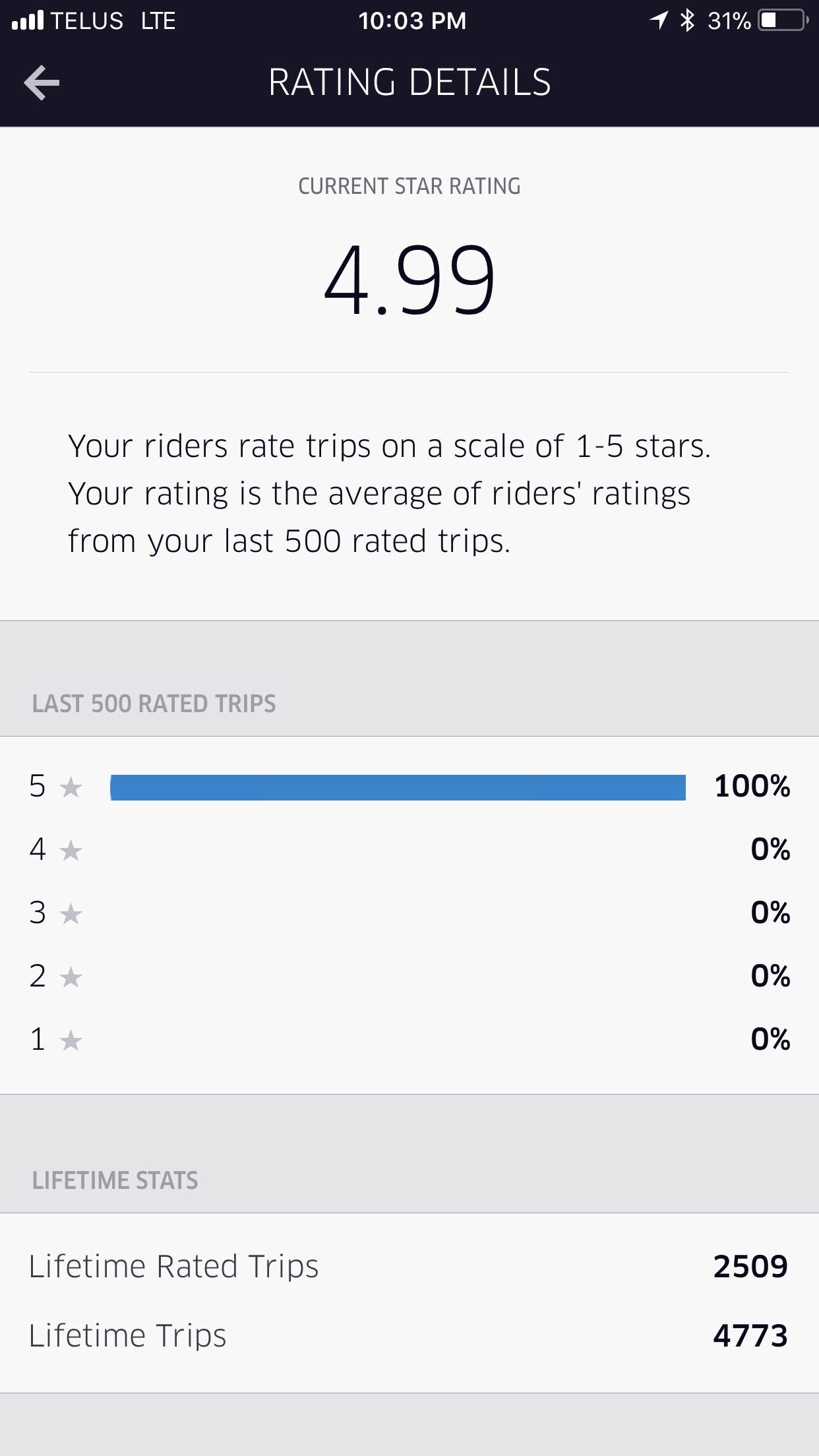
How was that possible?
Well, when I sat down in Vish’s car I realized how it was possible. The five-minute drive home blossomed into an interview I did with Vish the following week (in the back of his Uber, of course) for my podcast 3 Books with Neil Pasricha, where I discuss the three most formative books of inspiring people like Seth Godin, Judy Blume, and Gretchen Rubin. Vish was officially the first Uber driver on the show, and he shared with me why he cares so deeply about his service quality–even though Uber has no leaderboard, ranking, or major incentives tied to it–and what he does in order to keep that service so high.
1. MAKE A 10-SECOND OFFER, THEN CONFIRM THE DEAL
After Vish confirms his passenger’s name and destination, he always asks, “Do you have enough room back there?” while actually moving his seat up. So within 10 seconds he’s able to show — not tell — that he’s in the high-service game using a repeatable method to demonstrate this quickly.
After Vish moves his seat up, he says, “It will take 11 minutes to get to your destination. Does this sound good to you?” The purpose of the question is to establish the service being offered and find out if the passenger is in a rush. If they are, he’ll work hard to shave even a minute or two off the arrival time. If not, he knows the offering has been crystallized by both sides. The deal is confirmed.
2. YOU SET YOUR OWN STANDARDS EVERY DAY
Born and raised in Indore, a city in central India, Vish earned his MBA and held sales and marketing positions at Coca-Cola and New York Life, where he says, “I learned how to effectively deal with people” with tact and emotional intelligence. Eventually, Vish moved to Toronto and, like many immigrants, found it difficult to break into his adoptive country’s knowledge economy, despite his extensive corporate experience.
“Doing Uber was not my first choice,” he says, but he hasn’t lowered his work standards, even though the company doesn’t compensate him for it. “Why can’t you compare driving a car with flying an airplane? Like the pilot,” he points out. Both are fundamentally customer-service roles, requiring similar skill sets he developed earlier in his career. “One of my mantras,” Vish tells me, “is either I do the thing, or I don’t do the thing. But if I do the thing, I do it the best.”
3. IT’S ALWAYS THE CUSTOMER’S FIRST TIME

Despite the thousands of rides he’s given, Vish knows that “it’s always their first time with me.” He keeps wet wipes under his seat and cleans the floor mats between every ride. Why? “This car is my office. This is the only office I have in this business, so I’m supposed to keep it up, I’m supposed to maintain it, I’m supposed to clean it,” he explains. “Every day, even when I go home, I also take out the carpets, I clean them. If it is snowing or dirty, I wash them.”
As an Uber driver, Vish says, “I know I’m doing a service,” not just operating a vehicle. His passengers’ experience is really what they’re paying for, more than just getting safely from point A to B. Vish has his phone programmed to silent, and an auto-responder menu pops up on his screen to handle incoming texts and calls, allowing him to tap and send replies without losing focus on his passenger. The one I kept getting while trying to set up our interview said simply, “I am in a trip, please text me if needed” (followed by the smiley face and thumbs-up emojis).
4. GIVE THE TASK TO THE “YES” PART OF YOUR BRAIN
Vish says that the classic self-help book The Magic of Thinking Big by David J. Schwartz gave him “a formula in life always–the formula of ‘yes man’ and ‘no man’.” As Vish explains, Schwartz argues that “the human brain is like a factory with two foremen: one is a ‘no man’ and the other is a ‘yes man’ . . . If you give the job to the ‘no man,’ your own mind will start finding logic and reasons to prove how can’t you do this job.”
“You know debate competitions?” he asks me. The debater “who is speaking in favor looks quite right, and the person who’s speaking against also has valid logic, so at the time you feel both are correct.” In other words, we all have a choice as to which parts of our own brains we charge with executing certain tasks and tackling challenges. After reading Schwartz’s book, Vish says, “I started working on my ‘yes man.’ That’s what I do at Uber as well.”
Vish lets customers alter routes if they choose. He even calls passengers at home to tell them their UberPool-ing friend was dropped off safely, and tries to accommodate small requests along the way.
5. WE BUY WITH ALL SENSES
Vish only eats raw vegetables and salad in his car to avoid smells or odors. His car needs to be a blank slate that passengers can immediately feel ownership of, not like they’re suddenly in somebody else’s kitchen. He has the same theory about sounds, which is why his radio is never playing when a customer climbs in. If they want the radio on? That’s fine. But he turns it off for the next person. And if they’re eating a garlic stir-fry or smell like smoke? That’s fine, too. But he sprays a lemon air freshener and opens all the windows to start fresh the next time.
6. USE THEIR NAME
Vish says that Uber wants drivers to say “What is your name?” to customers before they get in the Uber. He ignores that. Instead, he greeted me with, “Is it Neil?” and a big smile. In fact, the excitement in his voice made it more of a statement than a question: “Is it Neil!” Real name, right off the bat, plus an immediate flash of intimacy.
“I try to break the ice by appreciating people,” Vish explains. “When you appreciate someone, you are not giving a discomfort to him or her.” Instead, he’s found that these simple moments of warmth he creates are almost always reciprocated. “They will surely come back with a positive remark or a positive affirmation, sentence, or a line or a word to you.” He adds, “If you start with a smile, 99% of people will smile back.”
7. KNOW YOUR CUSTOMER SPECTRUM (AND WHO FALLS OUTSIDE OF IT)
I asked Vish how he deals with drunk customers on busy Friday and Saturday nights. He surprised me by saying he doesn’t serve them. Drunk customers aren’t his target market. As soon as he lands one, he heads home. It’s a signal he’s serving folks outside of his customer spectrum and his day is done. (In fact, Vish also benches himself whenever he’s having an off day because he says driving is too risky–a judgment call that takes real self-awareness, especially in the gig economy, where there’s no direct boss to manage your performance.)
“The most important thing in your life is to enjoy what you’re doing,” Vish adds, and for him, it’s as simple as that. Driving an Uber wasn’t his first choice, and it isn’t what he intends to do indefinitely, but he’s doing more than just making the most of it.
He’s enjoying what he’s doing–and creating an unbelievably positive experience for everyone he interacts with in the process.
Can we all say the same?
An earlier version of this article appeared in Fast Company
Why You Need An Untouchable Day Every Week (And How To Get One)

I hate meetings. They sit subconsciously in my brain, taking up space. I prepare for them in my notebooks. I travel to them, and then back again, in the middle of my work days. And what do most meetings usually result in? You guessed it — more meetings.
When I worked as Director of Leadership Development at Walmart, my days were full of meetings. Everybody’s were! And when I quit a few years ago to strike out on my own, I thought my days full of meetings were behind me.
But I was wrong.
I now have research calls and phone interviews, lunches with literary agents and web developers, conference calls about book titles and publishing schedules, and radio interviews and media prep calls. And before every speech I give, there’s always a meeting with the client and meeting planner to clarify goals and logistics for the event.
Meetings never really go away.
But the problem is that I’m now measured almost solely on my creative output. And there’s no time for it! It’s not just me, either. As our world gets busier and our phones get beepier, the scarcest resource for all of us is becoming attention and creative output. And if you’re not taking time to put something new and beautiful out into the world, then your value is diminishing fast.
I used to be one of those “wake up at 4 a.m.” or “keep chugging till 4 a.m.” guys who grinds away for hours while everybody else sleeps. It’s how I wrote The Top 1000 page in a thousand days. But I now understand that you can only drive in the express lane for so long before the wheels come off.
I’m working hard to no longer be that guy. Now when I get home after work, I soak in time with my wife and little boys. Nothing is or will ever be as precious to me and I resist insight from anyone who isn’t making space for loved ones. I realized that what I needed was apracticalway to get more work done without taking more time. And, to be honest, I needed it fast. Why? Because in my first year as a full-time writer I actually started feeling my productivityslipping —even though I had quit my full-time job. It wasn’t just disheartening. It was embarrassing! “So how’s the new book coming?” “Oh, now that I quit my job? Terribly!”
I finally found a solution that I feel has saved my career, my time, and my sanity. If you’re with me right now, I bet you need this solution too: I call it “Untouchable Days”.
These are days when I am literally 100% unreachable in any way…by anyone.
Untouchable Days have become my secret weapon to getting back on track. They’re how I complete my most creative and rewarding work. To share a rough comparison, on a day when I write between meetings, I’ll produce maybe 500 words a day. On an Untouchable Day, it’s not unusual for me to write 5000 words. On these days, I’m 10 times more productive.
How do I carve out Untouchable Days?
I look at my calendar sixteen weeks ahead of time, and for each week, I block out an entire day as UNTOUCHABLE. I put it in all-caps just like that, too. UNTOUCHABLE. I don’t write in all-caps for anything else, but I allow UNTOUCHABLE days to just scream out to me.
Why sixteen weeks ahead? The number of weeks isn’t as important as the thinking behind it. For me, that’s after my speaking schedule is locked in — but, importantly, before anything else is. That’s a magic moment in my schedule. It’s the perfect time to plant the Untouchable Day flag before anything else can claim that spot.
On the actual Untouchable Day itself, I picture myself sitting in a bulletproof car surrounded by two-inches of thick impenetrable plastic on all sides. Nothing gets in. Nothing gets out. Meetings bounce off the windshield. Texts, alerts, and phone calls, too. My cell phone is in Airplane Mode. My laptop has Wi-Fi disabled. Not a single thing can bother me… and not a single thing does.
But, what about emergencies, you might be wondering?
The short answer is that there really never are any. The long answer is when my wife asked me about emergencies, she didn’t love my rant about how back in the day, nobody had cell phones, and we were all unreachable at times. As a compromise, I told her that when I started scheduling Untouchable Days, I’d open the door of my bulletproof car for an hour at lunchtime. When I did, I came face to face with the whizzing bullets of seventeen text messages, dozens of urgent-sounding emails, and endless robot-generated alerts and feeds — and precisely zero emergencies from my wife. So after a few months, we stopped doing that and instead I just started telling her where I’d be. That gave her peace of mind that if something horrible happened, she could call the place I was working or simply drive over and find me as a last resort.
I’ve now pulled off Untouchable Days for a few years. Nothing horrible has ever happened, and we’ve both grown more comfortable with zero contact throughout the day.
So what do Untouchable Days look like up close?
I think of them as having two components. There is the deep creative work. When you’re in the zone, you’re in a state of flow, and the big project you’re working on is getting accomplished step by step by step. And then there are the nitros — little blasts of fuel you can use to prime your own pump if you hit a wall. These unproductive moments of frustration happen to all of us, and it’s less important to avoid them than to simply have a mental toolkit you can whip out when they happen. What are my tools? Going for a workout. Grabbing a pack of almonds. Getting up and going birdwatching. Just getting outside! After all, Thoreau said “I believe that there is a subtle magnetism in Nature, which, if we unconsciously yield to it, will direct us aright.” What else? A short breathwork meditation. Moving workspaces. Or my wonder drug of precariously turning off Airplane Mode for ten minutes (while staying off of email and text) and leaving voicemails for my parents and close friends, telling them I love them. It works every time, and I get back to work quickly because, let’s be honest, nobody ever answers their phone.
So what happens if the bulletproof car really does get bumped? Say I get an incredible speaking invite or somebody much more important than me only has this one day to get together? Red alert: The Untouchable Day is under threat. What do I do?
I have a simple rule. Untouchable Days may never be deleted, but they can move between the bowling-lane bumpers of the weekends. They can’t jump weeks, though. They are more important than anything else I am doing, so if they need to move from a Wednesday to a Thursday or a Friday, that’s fine — even if I have to move four meetings to make room. The beauty of this approach is that when you plant the Untouchable Day flag on your calendar, it really does feel permanent in your mind. You start feeling the creative high you’ll get from such deep output as soon as you start booking them in.
Before I started using Untouchable Days, I treaded water — I wrote articles, gave speeches, but something was missing. When I implemented Untouchable Days? Magic happened. I wrote two new books, wrote and launched a new keynote speech, drafted book proposals for my next two books, and completely planned and began recording my new podcast — all while traveling and giving more speeches than I ever had before.
With a few years of Untouchable Days under my belt, do I still go through the exercise of scheduling one Untouchable Day every single week?
Well, the honest answer is no.
Now I schedule two.
A slightly modified version of this article originally appeared in Harvard Business Review