20. Stolen Focus: Why You Can’t Pay Attention – and How To Think Deeply Again by Johann Hari. (L/I/A) Like most of us, Johann (“Yo-han”) Hari noticed his attention fracturing but, unlike most of us, he decided to jettison to Provincetown, Massachusetts without his phone for six weeks to explore the issue. What emerges is a feast of a tale about many things happening at once: rises in speed and switching, increased algorithm manipulation, crippling flow states, and the death of free-range childhoods. The book offers optimism and specific practices we can do to win the vital battle for our attention.
3. Atlas of the Heart by Brené Brown. (L/I/A) I think this might be Brené Brown’s best book. I don’t say that lightly! It’s somehow rich as dense chocolate cake and light as the whipped cream on top. After a wonderful introduction the book opens up into essentially … a dictionary. Brené and her team catalogue 87 emotions you think you know … but would benefit from a little catchup on. On Anguish: “… powerlessness is what makes anguish traumatic. We are unable to change, reverse, or negotiate what has happened.” On Hope: "... We experience hope when we have the ability to set realistic goals ... we are able to figure out how to achieve those goals ... and we have agency..." Peppered with deep research, powerful quotes (“Boredom is your imagination calling to you.” Sherry Turkle) and Brené’s home-fried Texan wit, this atlas deserves a place on your shelf and in your, oh yes I’m going there, heart. (PS. Leslie and I sat down with Brené last year. Join us on the basement couch!)
Don't Hesitate by Mary Oliver
Written by Mary Oliver | Full poem here
Mary Oliver poems fill my heart with little doses of awe and appreciation. This one is no exception.
Poem:
If you suddenly and unexpectedly feel joy,
don’t hesitate. Give in to it. There are plenty
of lives and whole towns destroyed
or about to be. We are not wise, and not very often
kind. And much can never be redeemed.
Still, life has some possibility left. Perhaps this
is its way of fighting back, that sometimes
something happens better than all the riches
or power in the world. It could be anything,
but very likely you notice it in the instant
when love begins. Anyway, that’s often the
case. Anyway, whatever it is, don’t be afraid
of its plenty. Joy is not made to be a crumb.
Sign Up for a Dose of Inspiration:
Every other week, I send an email out with one of my favorite speeches, essays or poems. No ads, no sponsors, no spam, and nothing for sale. Just a dose of inspiration or beauty!
Click here to sign up.
43 Things I've (Almost) Learned As I Turn 43
I thought I’d celebrate my 43rd birthday by writing down 43 things I’ve (almost) learned. Lists like these are preachy by nature so, you know, just take what you like and leave the rest.
Here we go:
1. Life is too short for unsalted butter.
2. When arguing: Start sentences with ‘I’ not ‘You’.
3. Text friends, email coworkers.
4. Best gratitude game at dinner: Rose, Rose, Thorn, Bud.
5. Never start a speech by apologizing.
6. Clothing stores offer 2 of 3 of fashion, price, and quality. H&M? Fashion and price. Old Navy? Price and quality. Prada? Fashion and quality. Know what you’re buying, don’t expect what you’re not.
7. Five people who love you are worth a lot more than five million who like you.
8. Nothing is as expensive as a cheap pair of shoes.
9. You do make friends with salad. Master a great one.
10. Low opinion of others, low opinion of self? Cynical. High opinion of others, low opinion of self? Insecure. Low opinion of others, high opinion of self? Arrogant. High opinion of others, high opinion of self? Confidence. Aim for confidence.
11. To a large extent: If you can be happy with simple things it will be simple to be happy.
12. The three best home improvements are fresh paint, fresh flowers, and fresh air.
13. Never retire. Look for the 4 S’s instead: Social (friends), Structure (schedule), Stimulation (learning), and Story (purpose).
14. To be the favored client: Pay the bill as soon as you see it.
15. You’re the best judge of how good it is. You’re the worst judge of how well it will do.
16. Remember the 3 G’s in sex: Good, Giving, and Game.
17. Loosen the pickle jar lid but give it to a kid to pop.
18. To remember 2-digit numbers: Memorize 9 images and combine them. I use candle for 1, bicycle for 2, tripod for 3, table for 4, home plate for 5, soccer ball for 6, swan for 7, stop sign for 8, cat for 9, donut for 0. Friend’s birthday is 27th? Picture a swan on a bicycle. Movie comes out on the 16th? Picture a candle on soccer ball.
19. The best way to avoid a fight is to have a snack.
20. Before work trips: Hide a note under everyone’s pillow.
21. You always regret not doing more than you regret doing. Lean in.
22. Schedule one Untouchable Day each week.
23. The 7 for 7 Rule: 7 minutes of stretching for 7 hours better sleep.
24. If you have signed a contract with your work you need a signed contract with your family, too.
25. For perspective: Leave ten stones on your dresser, one for each decade of your life. Move one forward every ten years. Daily problems feel smaller with a zoom out.
26. It is easier to act yourself into a new way of thinking than to think yourself into a new way of acting. If in doubt? Start.
27. People remember who stayed till the end of the wedding. Stay till the end of the wedding.
28. Always cut grilled cheese into triangles.
29. For better skin: Bathe less.
30. Keep a lacrosse ball in your suitcase. Nothing improves a bad hotel room like a wall massage before bed.
31. You are not allowed to leave a bookstore without buying a book.
32. Practice 2 minute mornings: Before starting your day write and fill out: “I will let go of…”, “I am grateful for…”, “I will focus on…”
33. For better focus, attention, and privacy: Don’t take your phone.
34. 10 second mood lift: Hold the sides of your ribs and take a slow deep breath to inflate them outwards without raising your shoulders.
35. Put a gift note to yourself in the online order.
36. Woo the subconscious: Keep blank cue cards and a pen on your bedside table.
37. 3 best words for friends in tough times: “Tell me more…”
38. The only two ways to reply to any invite: No or Hell Yeah.
39. Swear words are the sharp knives in word kitchen. Teach kids how to use safely – not avoid.
40. Easiest way to love a park: Pick up one piece of trash every visit.
41. Leave the backup toilet paper where your guests can find it.
42. For assorted poisons you enjoy: Make it a treat.
43. Remember: If you have what you need it doesn’t matter what anyone else has.
I’m pretty sure I stole all of these but a few specific credits: Ryan Holiday (3), Mario Pilozzi (6), Kevin Kelly (7), Dan Savage (16), Derek Sivers (38), Sarah Silverman (42), and my dad (43).
Read more of my birthday advice:
45 Things I’ve (Almost) Learned As I Turn 45
44 Things I’ve (Almost) Learned As I Turn 44
Sign Up for a Dose of Inspiration:
Every other week, I send an email out with an article I’ve written, or one of my favorite speeches, essays or poems. No ads, no sponsors, no spam, and nothing for sale. Just a dose of inspiration or beauty!
Click here to sign up.
Dust If You Must by Rose Milligan
Hey everyone,
My kids finish school for the holidays in two days and everything's feeling busy. I stumbled across this old poem from Rose Milligan to help remind me what's important. Take a moment to let something fall off your holiday list today and instead just enjoy a moment of connection or love.
Neil
PS. If you insist on loading up for the holidays I recommend checking out my (pandemic written) Holiday Gift Guide. And, you know, nothing wrong with pulling off the spectacular Super Present Power Shop, either.
Dust If You Must by Rose Milligan
Dust if you must, but wouldn't it be better
To paint a picture, or write a letter,
Bake a cake, or plant a seed;
Ponder the difference between want and need?
Dust if you must, but there's not much time,
With rivers to swim, and mountains to climb;
Music to hear, and books to read;
Friends to cherish, and life to lead.
Dust if you must, but the world's out there
With the sun in your eyes, and the wind in your hair;
A flutter of snow, a shower of rain,
This day will not come around again.
Dust if you must, but bear in mind,
Old age will come and it's not kind.
And when you go (and go you must)
You, yourself, will make more dust.
Another way I keep focused on what matters is the Okinawan concept of ikigai.
Not sure how to get everything done so you can spend time with your family this holiday season? Check out my tips on how to cut meeting time (and any other to-do!) in half.
Sign Up for a Dose of Inspiration:
Every other week, I send an email out with one of my favorite speeches, essays or poems. No ads, no sponsors, no spam, and nothing for sale. Just a dose of inspiration or beauty!
Click here to sign up.
The Sun by Mary Oliver
Written by Mary Oliver | Full poem here
Mary Oliver poems fill my heart with little doses of awe and appreciation. This one is no exception.
Poem:
Have you ever seen
anything
in your life
more wonderful
than the way the sun,
every evening,
relaxed and easy,
floats toward the horizon
and into the clouds or the hills,
or the rumpled sea,
and is gone–
and how it slides again
out of the blackness,
every morning,
on the other side of the world,
like a red flower
streaming upward on its heavenly oils,
say, on a morning in early summer,
at its perfect imperial distance–
and have you ever felt for anything
such wild love–
do you think there is anywhere, in any language,
a word billowing enough
for the pleasure
that fills you,
as the sun
reaches out,
as it warms you
as you stand there,
empty-handed–
or have you too
turned from this world–
or have you too
gone crazy
for power,
for things?
Sign Up for a Dose of Inspiration:
Every other week, I send an email out with one of my favorite speeches, essays or poems. No ads, no sponsors, no spam, and nothing for sale. Just a dose of inspiration or beauty!
Click here to sign up.
What You Missed That Day You Were Absent From Fourth Grade by Brad Modlin
Written by Brad Modlin | Full poem here
Thank you to reader Christine O’Leary who pointed me to this little poem by Brad Modlin, Chair of Creative Writing at the University of Nebraska and author of the poetry collection Everyone At This Party Has Two Names. This is one of those “read it again right after you read it” poems for me. I found it helped zoom out and above a lot of the “have tos” and “should dos” in life and focus a little more on what really matters.
Poem:
Mrs. Nelson explained how to stand still and listen
to the wind, how to find meaning in pumping gas,
how peeling potatoes can be a form of prayer. She took
questions on how not to feel lost in the dark
After lunch she distributed worksheets
that covered ways to remember your grandfather’s
voice. Then the class discussed falling asleep
without feeling you had forgotten to do something else—
something important—and how to believe
the house you wake in is your home. This prompted
Mrs. Nelson to draw a chalkboard diagram detailing
how to chant the Psalms during cigarette breaks,
and how not to squirm for sound when your own thoughts
are all you hear; also, that you have enough.
The English lesson was that I am
is a complete sentence.
And just before the afternoon bell, she made the math equation
look easy. The one that proves that hundreds of questions,
and feeling cold, and all those nights spent looking
for whatever it was you lost, and one person
add up to something.
From Everyone at This Party Has Two Names - Southeast Missouri State University Press, 2016.
Sign Up for a Dose of Inspiration:
Every other week, I send an email out with one of my favorite speeches, essays or poems. No ads, no sponsors, no spam, and nothing for sale. Just a dose of inspiration or beauty!
Click here to sign up.
Dreamland by Mark Twain
Written by Mark Twain
Context:
Do you dream much? Not at all? My wife Leslie routinely wakes up vividly recounting her dreams. They're always intense and dramatic. Mine are more routine -- like I'm living another day at night sometimes. Since I was a kid I've been wondering what dreams are. About fifteen years ago I read a book on lucid dreaming and started up a Dream Diary to see if I could more frequently 'direct' my dreams from the inside. It worked a bit too well when I started mixing up daytime and nighttime realities, which felt dizzying, and so I stopped and the skill gradually fell away.
Most of us have some deep-seeded wonder or curiosity or beliefs about dreams. Maybe we use them to explore or investigate parts of ourselves, as conversations with other sides of our consciousness, as a memory-sorting device, or as a form of pleasure or escape. Mark Twain was no exception. A full 110 years ago he wrote this magical little essay in Harper's. I hope you like it as much as I did.
Article:
I once awoke from a dream while crossing Bond Street in New York with a friend, and it was snowing hard. We had been talking, and there had been no observable gaps in the conversation. I doubt if I had made any more than two steps while I was asleep. But I am satisfied that even the most elaborate and incident-crowded dream is seldom more than a few seconds in length. It is swifter than waking thought; for thought is not thought at all, but only a vague and formless fog until it is articulated into words.
The habit of writing down my dreams while they are fresh in my mind, and then studying them and rehearsing them and trying to find out what the source of dreams is, and which of the two or three separate persons inhabiting us is their architect, has given me a good dream-memory—a thing which is not usual, for few drill the dream-memory, and no memory can be kept strong without that.
In my waking hours, I cannot draw even the simplest picture with a pencil, nor do anything with a brush and colors; I cannot bring before my mind’s eye the detailed image of any building known to me except my own house; of St. Paul’s, St. Peter’s, the Eiffel Tower, the Taj, the Capitol at Washington, I can reproduce only portions, partial glimpses; the same with Niagara Falls, the Matterhorn, and other familiar things in nature. I cannot bring before my mind’s eye the face or figure of any human being known to me. I have seen my family at breakfast within the past two hours; I cannot bring their images before me, I do not know how they look.
Before me, as I write, I see a little grove of trees in the garden; high above them projects the slender lance of a young pine, beyond it is a glimpse of the upper half of a dull-white chimney covered by a little roof, and half a mile away is a hilltop densely wooded, and then a curved, wide vacancy, which is smooth and grass-clad. But I cannot shut my eyes and reproduce that picture at all, nor any single detail of it except the grassy curve, and that but vaguely and fleetingly.
My dream-artist can draw anything, and do it perfectly; he can paint with all the colors and all the shades, and do it with delicacy and truth. He can place before me vivid images of palaces, cities, hamlets, hovels, mountains, valleys, lakes, skies, glowing in sunlight or moonlight, or veiled in driving gusts of snow or rain, and he can set before me people who are intensely alive, and who feel, and express their feelings in their faces, and who also talk and laugh, sing and swear. And when I wake I can shut my eyes and bring back those people, and the scenery and the buildings; and not only in general view, but often in detail.
Everything in a dream is more deep and strong and sharp and real than is ever its pale imitation in the unreal life which is ours when we go about awake and clothed with our artificial selves in this vague and dull-tinted artificial world. When we die we shall slough off this cheap intellect, perhaps, and go abroad to Dreamland clothed in our real selves, and aggrandized and enriched by the command over the mysterious mental magician who is here only our guest.
In our dreams—I know it!—we do make the journeys we seem to make; we do see the things we seem to see; the people, the horses, the cats, the dogs, the birds, the whales, are real, not chimeras; they are living spirits, not shadows; and they are immortal and indestructible. They go whither they will; they visit all resorts, all points of interest, even the twinkling suns that wander in the wastes of space. That is where those strange mountains are which slide from under our feet while we walk, and where those vast caverns are whose bewildering avenues close behind us and in front when we are lost, and shut us in. We know this because there are no such things here, and they must be there, because there is no other place.
Originally appeared in the December 1912 issue of Harper’s Magazine.
Sign Up for a Dose of Inspiration:
Every other week, I send an email out with one of my favorite speeches, essays or poems. No ads, no sponsors, no spam, and nothing for sale. Just a dose of inspiration or beauty!
Click here to sign up.
Two powerful songs about fatherhood by Harry Chapin and John Lennon
Cat’s Cradle by Sandy Chapin & Harry Chapin | Source here
Watching the Wheels by John Lennon | Source here
Context:
I wanted to share two songs -- two poems -- about fatherhood.
After I wrote this journal entry last week I couldn't get the lyrics to “Cat's Cradle” by Harry Chapin out of my head. I realized I probably had the lyrics in my head since 1992 when Ugly Kid Joe covered the famous 1964 Harry Chapin single and introduced it to a new generation. For a suburban Toronto kid in the early 90s if a song was on the Top 6 at 6 with Tarzan Dan ... everybody knew it. A gripping poem peeling open father-son relationship tensions written, evidently, by Chapin's wife Sandy.
Years later I had kids and began listening to "Watching The Wheels" by John Lennon. It was the final single from John's 1980 "Double Fantasy" album and released a few months after his assassination. It's sort of a "mirror song" to Cat's Cradle because this poem talks about the cultural hits a man takes from others -- "People say I'm crazy ..." -- when he chooses to pause his career to take care of his children. At the time John living in New York with Yoko raising their son Sean and the video opens with John carrying Sean in a carrier through Central Park ... just steps from where he was shot.
I feel like these two songs -- two poems -- twist into something demonstrating the power of communicating such vast and complex emotions in such few words. And, as a father, I feel I always take something away from them both.
Song Lyrics:
CATS CRADLE
My child arrived just the other day
He came to the world in the usual way
But there were planes to catch, bills to pay
He learned to walk while I was away
And he was talking 'fore I knew it, and as he grew
He'd say "I'm gonna be like you, dad"
"You know I'm gonna be like you"
And the cat's in the cradle and the silver spoon
Little boy blue and the man in the moon
"When you coming home, dad?" "I don't know when"
"But we'll get together then"
"You know we'll have a good time then"
My son turned ten just the other day
He said, "Thanks for the ball, dad, come on let's play"
"Can you teach me to throw?", I said-a, "Not today"
"I got a lot to do" He said, "That's okay dad"
And he, he walked away, but his smile never dimmed
It said, I'm gonna be like him, yeah
You know I'm gonna be like him
And the cat's in the cradle and the silver spoon
Little boy blue and the man in the moon
"When you coming home, dad?" "I don't know when"
"But we'll get together then"
"You know we'll have a good time then"
Well, he came from college just the other day
So much like a man I just had to say
"Son, I'm proud of you, can you sit for a while?"
He shook his head, and then he said with a smile
"What I'd really like, dad, is to borrow the car keys
See you later, can I have them please?"
And the cat's in the cradle and the silver spoon
Little boy blue and the man in the moon
"When you coming home, son?" "I don't know when"
"But we'll get together then, dad"
"You know we'll have a good time then"
I've long since retired, my son's moved away
I called him up just the other day
I said, "I'd like to see you if you don't mind"
He said, "I'd love to, dad, if I can find the time
You see, my new job's a hassle, and the kids have the flu
But it's sure nice talking to you, dad
It's been sure nice talking to you"
And as I hung up the phone, it occurred to me
He'd grown up just like me
My boy was just like me
And the cat's in the cradle and the silver spoon
Little boy blue and the man in the moon
"When you coming home, son?" "I don't know when"
"But we'll get together then, dad"
"You know we'll have a good time then"
(Written by: Harry F. Chapin / Sandy Chapin, © Warner Chappell Music, Inc)
WATCHING THE WHEELS
People say I'm crazy
Doing what I'm doing
Well they give me all kinds of warnings
To save me from ruin
When I say that I'm okay, well they look at me kinda strange
"Surely you're not happy now, you no longer play the game"
People say I'm lazy
Dreaming my life away
Well they give me all kinds of advice
Designed to enlighten me
When I tell that I'm doing fine watching shadows on the wall
"Don't you miss the big time, boy, you're no longer on the ball?"
I'm just sitting here watching the wheels go round and round
I really love to watch them roll
No longer riding on the merry-go-round
I just had to let it go
Ah, people asking questions
Lost in confusion
Well, I tell them there's no problem
Only solutions
Well, they shake their heads and they look at me, as if I've lost my mind
I tell them there's no hurry, I'm just sitting here doing time
I'm just sitting here watching the wheels go round and round
I really love to watch them roll
No longer riding on the merry-go-round
I just had to let it go
I just had to let it go
I just had to let it go
(Written by: John Lennon, © Downtown Music Publishing)
Sign Up for a Dose of Inspiration:
Every other week, I send an email out with one of my favorite speeches, essays or poems. No ads, no sponsors, no spam, and nothing for sale. Just a dose of inspiration or beauty!
Click here to sign up.
Quotes On Reading by Marcel Proust
Written by Marcel Proust
Context:
Proust’s quotes on reading feel like poetry to me. If you’d like to hear me talk about Proust with Edward Packard, creator of Choose Your Own Adventure, just click here. (PS. If you’re looking for an accessible way into Proust I highly recommend Alain de Botton’s How Proust Can Change Your Life which wonderfully distills and sorts so much of his endless wisdom).
Quotes:
"Reading is that fruitful miracle of a communication in the midst of solitude."
"Reading is at the threshold of spiritual life; it can introduce us to it; it does not constitute it. There are, however, certain cases, certain pathological cases, so to speak, of spiritual depression in which reading can become a sort of curative discipline and assume the task, through repeated stimulation, of continuously reintroducing a lazy mind into the life of the spirit."
"There are perhaps no days of our childhood that we lived so fully as those we spent with a favourite book."
"That abominable and sensual act called reading the newspaper, thanks to which all the misfortunes and cataclysms in the universe over the last twenty-four hours, the battles which cost the lives of fifty-thousand men, the murders, the strikes, the bankruptcies, the fires, the poisonings, the suicides, the divorces, the cruel emotions of statesmen and actors, are transformed for us, who don't even care, into a morning treat, blending in wonderfully, in a particularly exciting and tonic way, with the recommended ingestion of a few sips of cafe au lait."
"In reality, every reader is, while reading, the reader of his own self."
"Theoretically, we know that the world turns, but in fact we do not notice it, the earth on which we walk does not seem to move and we live on in peace. This is how it is concerning Time in our lives. And to render its passing perceptible, novelists must... have their readers cross ten, twenty, thirty years in two minutes."
"A man of letters, merely by reading a phrase, can estimate exactly the literary merit of its author."
"The heart changes...but we learn of it only from reading or by imagination; for in reality its alteration, like that of certain natural phenomena, is so gradual that, even if we are able to distinguish, successively, each of its different states, we are still spared the actual sensation of change."
"After a certain age our memories are so intertwined with one another that what we are thinking of, the book we are reading, scarcely matters any more. We have put something of ourselves everywhere, everything is fertile, everything is dangerous, and we can make discoveries no less precious than in Pascal's Pensées in an advertisement for soap."
"In the sort of screen dappled with different states of mind which my consciousness would simultaneously unfold while I read, and which ranged from the aspirations hidden deepest within me to the completely exterior vision of the horizon which I had, at the bottom of the garden, before my eyes, what was first in me, innermost, the constantly moving handle that controlled the rest, was my belief in the philosophical richness and beauty of the book I was reading, and my desire to appropriate them for myself, whatever that book might be."
"Every reader finds himself. The writer's work is merely a kind of optical instrument that makes it possible for the reader to discern what, without this book, he would perhaps never have seen in himself."
Sign Up for a Dose of Inspiration:
Every other week, I send an email out with one of my favorite speeches, essays or poems. No ads, no sponsors, no spam, and nothing for sale. Just a dose of inspiration or beauty!
Click here to sign up.
"Be Drunk" by Charles Baudelaire
Written by Charles Baudelaire (link to original poem here)
Context:
James Frey, author of A Million Little Pieces, introduced me to this poem when he had me read the Charles Baudelaire poetry collection Paris Spleen before our chat on 3 Books. It stuck with me as a way to twist expectations -- maybe clickbait before clickbait -- and demonstrates so much power in such few words.
Poem:
You have to be always drunk. That's all there is to it—it's the only way. So as not to feel the horrible burden of time that breaks your back and bends you to the earth, you have to be continually drunk.
But on what? Wine, poetry or virtue, as you wish. But be drunk.
And if sometimes, on the steps of a palace or the green grass of a ditch, in the mournful solitude of your room, you wake again, drunkenness already diminishing or gone, ask the wind, the wave, the star, the bird, the clock, everything that is flying, everything that is groaning, everything that is rolling, everything that is singing, everything that is speaking. . .ask what time it is and wind, wave, star, bird, clock will answer you: "It is time to be drunk! So as not to be the martyred slaves of time, be drunk, be continually drunk! On wine, on poetry or on virtue as you wish."
Sign Up for a Dose of Inspiration:
Every other week, I send an email out with one of my favorite speeches, essays or poems. No ads, no sponsors, no spam, and nothing for sale. Just a dose of inspiration or beauty!
Click here to sign up.
By the Well of Living and Seeing, Part II, Section 28: “During the Second World War” by Charles Reznikoff
Written by Charles Reznikoff (link to original poem here)
Context:
I am in love when simplicity packs a punch. I find some speakers like Brené Brown pull this off in short personal stories. This poem struck me the same way. Thank you to George Saunders and Poetry Foundation.
Poem:
During the Second World War, I was going home one night
along a street I seldom used. All the stores were closed
except one—a small fruit store.
An old Italian was inside to wait on customers.
As I was paying him I saw that he was sad.
“You are sad,” I said. “What is troubling you?”
“Yes,” he said, “I am sad.” Then he added
in the same monotone, not looking at me:
“My son left for the front today and I’ll never see him again.”
“Don’t say that!” I said. “Of course, you will!”
“No,” he answered. “I’ll never see him again.”
Afterwards, when the war was over,
I found myself once more in that street
and again it was late at night, dark and lonely;
and again I saw the old man alone in the store.
I bought some apples and looked closely at him:
his thin wrinkled face was grim
but not particularly sad. “How about your son?” I said.
“Did he come back from the war?” “Yes,” he answered.
“He was not wounded?” “No. He is all right.”
“That’s fine,” I said. “Fine!”
He took the bag of apples from my hands and groping inside
took out one that had begun to rot
and put in a good one instead.
“He came back at Christmas,” he added.
“How wonderful! That was wonderful!”
“Yes,” he said gently, “it was wonderful.”
He took the bag of apples from my hands again
and took out one of the smaller apples and put in a large one.
Sign Up for a Dose of Inspiration:
Every other week, I send an email out with one of my favorite speeches, essays or poems. No ads, no sponsors, no spam, and nothing for sale. Just a dose of inspiration or beauty!
Click here to sign up.
'Maximus, to himself' by Charles Olson
Written by Charles Olson (link to original poem here)
Context:
I discovered this poem while preparing for my interview with the incredible Debbie Millman, the visionary artist and thinker who hosts Design Matters. It was hugely formative for her - in fact she chose a poetry anthology by Hayden Carrut in which it is published as one of her most formative books for 3 Books for that very reason - and does a beautiful reading of it for us during our conversation. I found this poem incredibly rich, layered, and deep. I'm sure I don't understand half of it but the bits I did manage to catch really lingered.
This poem was published as part of The Maximus Poems collection, written by Charles Olson in 1983 and published by the University of California Press.
Poem:
I have had to learn the simplest things
last. Which made for difficulties.
Even at sea I was slow, to get the hand out, or to cross
a wet deck.
The sea was not, finally, my trade.
But even my trade, at it, I stood estranged
from that which was most familiar. Was delayed,
and not content with the man’s argument
that such postponement
is now the nature of
obedience,
that we are all late
in a slow time,
that we grow up many
And the single
is not easily
known
It could be, though the sharpness (the achiote)
I note in others,
makes more sense
than my own distances. The agilities
they show daily
who do the world’s
businesses
And who do nature’s
as I have no sense
I have done either
I have made dialogues,
have discussed ancient texts,
have thrown what light I could, offered
what pleasures
doceat allows
But the known?
This, I have had to be given,
a life, love, and from one man
the world.
Tokens.
But sitting here
I look out as a wind
and water man, testing
And missing
some proof
I know the quarters
of the weather, where it comes from,
where it goes. But the stem of me,
this I took from their welcome,
or their rejection, of me
And my arrogance
was neither diminished
nor increased,
by the communication
2
It is undone business
I speak of, this morning,
with the sea
stretching out
from my feet
Sign Up for a Dose of Inspiration:
Every other week, I send an email out with one of my favorite speeches, essays or poems. No ads, no sponsors, no spam, and nothing for sale. Just a dose of inspiration or beauty!
Click here to sign up.
'You Learn' by Jorge Luis Borges
Written by Anonymous (link to original poem here)
Context:
The poem "Apriendendo" is believed to have been written in the 1940s in Spanish and later translated into English in the late 1960s. There is some controversy surrounding authorship. It has been most widely attributed to Jorge Luis Borges, but in the 1970s, others stepped up to claim it as theirs: Yamira Hernandez, Veronica Shoffstall and Judith Evans. It is also known with different titles: "Come the Dawn" and "After a While". Whoever the author is, the sentiments conveyed are beautiful and it is a potent reminder to make sure we continue to make time for what truly matters.
Poem:
After a while you learn the subtle difference between holding a hand and chaining a soul.
And you learn that love doesn’t mean leaning.
And company doesn’t mean security…
And you begin to learn that kisses aren’t contracts and presents aren’t promises, and you begin to accept your defeats with your head up and your eyes open with the grace of a woman, not the grief of a child. And you learn to build all your roads on today because tomorrow’s ground is too uncertain for plans and futures have a way of falling down in mid-flight.
After a while you learn that even sunshine burns if you get too much.
So you plant your garden and decorate your own soul instead of waiting for someone to bring you flowers.
And you learn that you really can endure, that you really are strong, and you really do have worth, and you learn and learn…with every good-bye you learn.
Sign Up for a Dose of Inspiration:
Every other week, I send an email out with one of my favorite speeches, essays or poems. No ads, no sponsors, no spam, and nothing for sale. Just a dose of inspiration or beauty!
Click here to sign up.
'Blessing for the New Year' by Kayleen Asbo
Written by Kayleen Asbo (link to poem here)
Context:
My wife Leslie forwarded this poem to me after she received it from Dr. Laura Markham. If you don't know Laura, her book Peaceful Parent, Happy Kids is one of our bibles. I also went down to Brooklyn to interview her on 3 Books. She's a treasure trove of wisdom! And this poem by Kayleen Asbo below is one perfect example.
Poem:
As the hours of darkness begin to slowly wane from the winter sky,
So too may the fearful places of your heart unclench their grasp on your life
As the presence of light begins to grow with greater sureness with each passing day
May your own courage blossom to open more brightly to truth and love.
Let this be the year that you turn off the television and silence the talk radio chatter
in order to pick up the writing pen, the paintbrush,
and watch the candle slowly burn.
May this be the year that you delight
in seeing how much joy you can extravagantly spread.
May you discover just how much beauty you can recklessly shower
upon this thirsty world.
May this be the year that you tune both the dusty piano in the corner
and the inner listening of your care-worn heart
So that both can play in harmony with the chorus of creation.
May you break the invisible yardstick of impossible expectations
and learn that just as you are,
you are enough.
May this be the year that you cease trying to march to an imagined ideal
and instead, wrap your arms around the messy wonder your life really is,
hold it close
and do the tango.
Let this be the year you befriend your soul in its radical particularity,
not forsaking it yet again for the bland demands and cravings of the masses.
Instead, may you elope with the wildness of your own true calling,
marry your soul to its deepest longings and invite the hungry world to the
wedding feast.
Sign Up for a Dose of Inspiration:
Every other week, I send an email out with one of my favorite speeches, essays or poems. No ads, no sponsors, no spam, and nothing for sale. Just a dose of inspiration or beauty!
Click here to sign up.
'To Laugh Much and Often' by Bessie Anderson Stanley
Written by Bessie Anderson Stanley (link to poem here)
Context:
A lovely little snippet of poetry from Bessie Anderson Stanley, often incorrectly attributed to Ralph Waldo Emerson. Thank you to my reader Laura Berenstain for sending it to me.
Poem:
To laugh often and much;
to win the respect of the intelligent people
and the affection of children;
to earn the appreciation of honest critics
and endure the betrayal of false friends;
to appreciate beauty;
to find the best in others;
to leave the world a bit better
whether by a healthy child, a garden patch,
or a redeemed social condition;
to know that one life has breathed easier
because you lived here.
This is to have succeeded.
Sign Up for a Dose of Inspiration:
Every other week, I send an email out with one of my favorite speeches, essays or poems. No ads, no sponsors, no spam, and nothing for sale. Just a dose of inspiration or beauty!
Click here to sign up.
The Very Best Books I Read in 2021
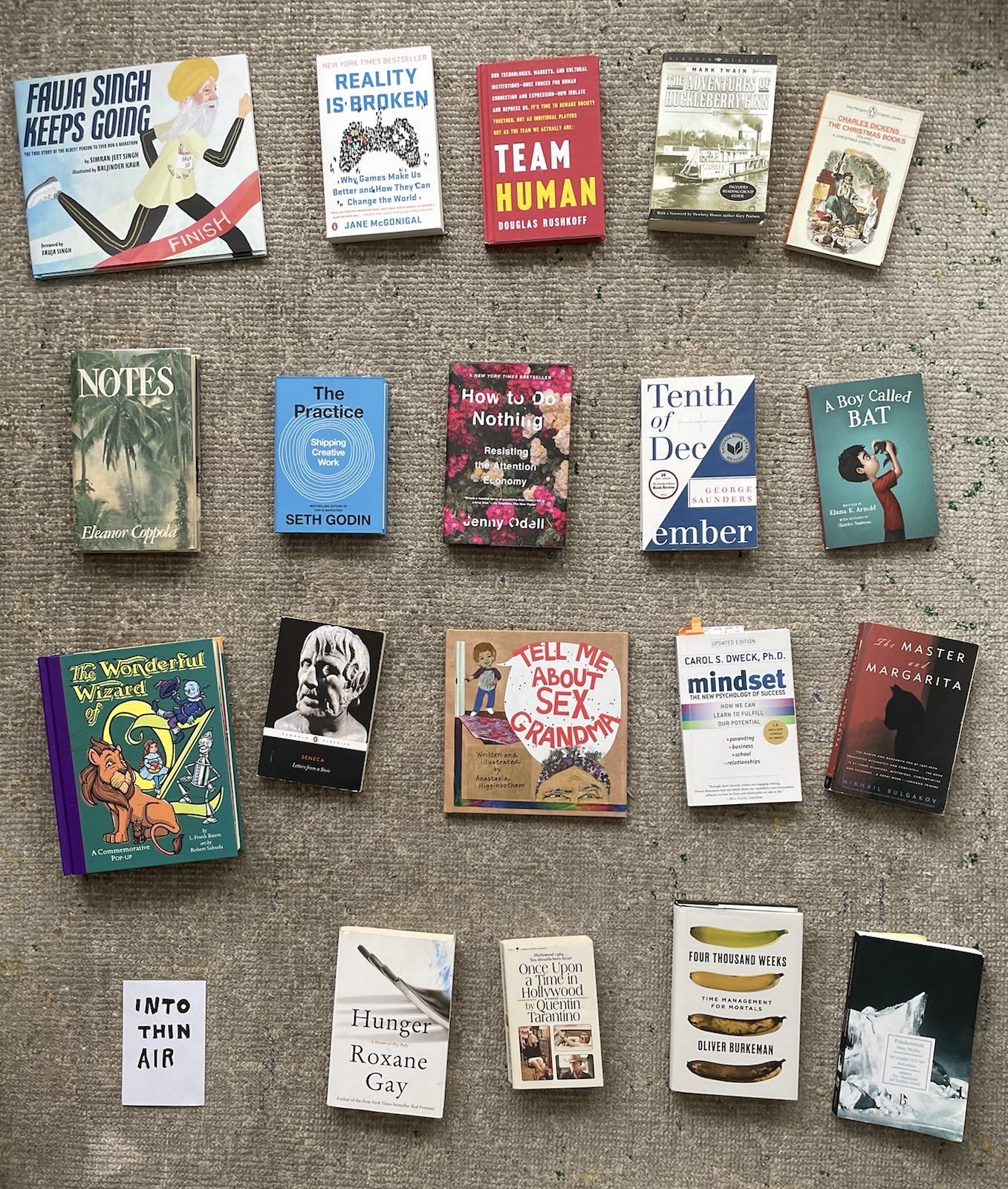
It’s that time of the year again!
Time to divvy up your holiday budget between books and everything else. What’s under the tree? Books! What’s in the Secret Santa pile? Books! What’s in the stockings? Books! And maybe an orange.
There are big piles of the newest, latest, and hottest at the front of the bookstores and top of the rankings but as always here we'll aim to discuss something a bit different. Some came out this year, some two hundred years ago, some two thousand years ago. Together here are The Very Best Books I Read In 2021.
Happy reading!
*. Fauja Singh Keeps Going: The True Story of the Oldest Person to Ever Run A Marathon by Simran Jeet Singh. (L/I/A) Let's start off with a picture book. I’ve always felt there was a weird gap somewhere between fiction and non-fiction picture books. On one hand: Fiction! So much fiction! Goodnight moon from the great green room and running with Thing One and Thing Two. But on the other hand? Non-fiction like The Milky Way or Ant or Mother Theresa or just blow-by-blow of how something works or a biography of someone famous. But where are the books about the everyperson – the Vishwas the Uber Drivers or Shirley the Nurses or Zafar the Hamburger Men of the world. Well, enter Fauja Singh to correct the balance! Fauja is alive and well today at 110 years old – 110 years old! -- and is the oldest person to ever run a marathon. Did he train all his life? No, he began running only a few decades ago ... in his 80s! A wonderful true story about a skinny boy growing up in Punjab with weak legs and a strong spirit. Doubles as a nice introduction to Sikhism which the book calls the fifth largest religion. (Wikipedia says ninth but who's counting?)
Perfect for: children looking for something beyond Dr. Seuss, anyone looking for a reminder it's never to late to start something new, folks looking to actively diversify their bookshelves...
*. Reality Is Broken: Why Games Make Us Better And How They Can Change the World by Jane McGonigal. (L/I/A) Before I read this book I was stuck thinking of gamers as slack-jawed teens sitting on stained couches in dark basements on piles of empty Cheetos bags. Play more video games? No! Get outside! Run around! That’s what I’m preaching. Well, this book gave me a splash of cold water and nudged my parenting philosophy from “No video games!” to “Let me help you pick a video game and play it with you!” Jane says some markers of healthy video game use include constantly picking new games (to invite challenge and the learned resilience involved in figuring it out), explaining how to play it to somebody else afterwards (to provoke learning and teaching and understanding), and, finally, inviting a discussion on what the game can help us do better in real life (to avoid replacing reality with games – but rather enhancing it). While I still think we all suffer from Nature Deficit Disorder, I felt my arguments against video games wilting in the face of this illuminating, well-researched tour-de-force. Jane sees games helping increase career satisfaction, helping elderly feel socially connected, and tackling global-scale problems like climate change and poverty. (Her TED Talk is a great overview.) She teaches us what a game is – they all have goals, rules, feedback systems, and voluntary participation – and then shares how they can lead to more satisfying lives.
Perfect for: Educators, parents of young children, anybody feeling guilty about playing too much fantasy football…
*. Team Human by Douglas Rushkoff. (L/I/A) Fiery, unblinking, culture-shifting manifesto imploring us – Team Human! – to come together in the face of autonomous technologies, runaway markets, and weaponized media. My mind was set ablaze reading this magnificent book organized into 100 short, powerful essays, each of which feels like it’s been simmered down into its most flavorful parts like a pot of all-day spaghetti sauce. Douglas Rushkoff is founder of the Laboratory for Digital Humanism at CUNY/Queens, where he is professor of media theory and digital economics and known for coining terms like ‘viral media’, ‘digital native’, and ‘social currency.’ I found it higher level, more informed, and a lot farther ahead on what’s happening than The Social Dilemma. All backed by well-sourced Notes that constantly sent me scurrying to look up some study or article. As the sub-headline says: “Our technologies, markets, and cultural institutions – once forces for human connection and expression – now isolate and repress us. It’s time to remake society together, not as individual players but as the team we actually are: TEAM HUMAN.”
Perfect for: people who watched The Social Dilemma, people who keep complaining about social media but also keep using social media, activists…
*. The Adventures of Huckleberry Finn by Mark Twain. (L/I/A) This year I travelled down the Mississippi River two hundred years ago in the wonderful company of thirteen year old Huck Finn. The antebellum time period feels grotesque in many ways but the vividness of this rousing coming-of-age adventure featuring endless popping characters sits on a high mantel all its own. Ernest Hemingway said "All modern literature stems from this one book."
Perfect for: anybody who wasn’t assigned this book in school (guessing most people outside the US?), advanced young readers, anybody looking for a great introduction to Mark Twain…
*. A Christmas Carol by Charles Dickens. (L/I/A) Okay, I guess I'm on a classics kick suddenly. But this really is a perfect book to read over the holidays. Do you know the story of A Christmas Carol? How did you learn it? Mickey Mouse on Disney? Alvin and the Chipmunks? I picked it up from a dozen cartoons as a kid and honestly, I wish I’d just read the original. It's so much better. There’s a reason this 178-year-old (and only 89 page!) story is so heavily mimicked, parodied, and referenced. It is gut-punchy, slapstick, and will leave you in tears. Opens with one of my favorite first sentences, too: “Marley was dead: to begin with.”
Perfect for: people who like short books, anyone need a reminder of the Christmas spirit, those looking to add more classics to their pile...
*. Notes by Eleanor Coppola. (L/I/A) Bit of an odd book to include but I really do feel like books are empathy training wheels. This book could be Exhibit A. A non-fiction book that reads like vivid fiction in its daily diary format. You are Eleanor, the artistic, wealthy, humble-yet-high-society wife of Francis Ford Coppola, as well as mother of three young children, and you are living for a few years in the jungles of the Philippines while your husband shoots a gigantic movie that is stressfully running over time and budget and which is both draining and growing your family in a thousand ways. What’s the movie? Apocalypse Now. A formative life experience with Eleanor’s diaries to read throughout. I loved this book. As a sidenote, this is one of Dave Eggers’ three most formative books.
Perfect for: anybody who wants to visit Southeast Asia, fans of Apocalypse Now or Francis Ford Coppola who want a behind-the-scenes look, busy moms of young children…
*. The Practice: Shipping Creative Work by Seth Godin. (L/I/A) Whether it’s through his popular altMBA, podcasting workshop, or daily emails, so many people receive counsel, guidance, and wisdom from Seth. (Here’s a big dollop of wisdom he gave me.) I have long made it a Life Rule to read any new Seth Godin book. The Practice is a wonderful contribution to his massive catalog. Read it if you need a little nudge, big nudge, or giant shove to do it. What it? Your it. That’s the deal: You choose your it and this book lights the path. It’s impossible to read The Practice and not shift your work into a higher gear.
Perfect for: anybody itching to start a business, people thinking about a career change, or anybody wondering if that hobby in the basement could really turn into something…
*. How To Do Nothing by Jenny Odell. (L/I/A) I would like to apologize to Jenny Odell for horribly judging her book by the cover. How to do nothing? On a pile of flowers? I thought the book would have the density of meringue. MY BAD! The book actually is the densest, richest dessert imaginable. “Nothing is harder to do these days than nothing,” it begins gently, before quickly pushing you down a steep mineshaft tunnel. You gain speed as you veer into dark, twisting arguments in favor of using your attention and, really, your entire personhood as a form of resistance against our fitter, happier, more productive society. A distant cousin to Trick Mirror by Jia Tolentino. Here’s a tiny (out of context) taste from Page 137: “When the language of advertising and personal branding enjoins you to ‘be yourself’, what it really means is ‘be more yourself,’ where ‘yourself’ is a consistent and recognizable pattern of habits, desires, and drives that can be more easily advertised to and appropriated, like units of capital. In fact, I don’t know what a personal brand is other than a reliable, unchanging pattern of snap judgements…” A ‘why’ book more than a ‘how’ book, I would put it in Cultural Studies over Self-Improvement.
Perfect for: birders, people who want to turn their ambition down a bit, anybody feeling exhausted by the attention economy and looking to understand how they navigate from here…
*. Tenth of December: Stories by George Saunders. (L/I/A) The opening story in this book is called Victory Lap. (Here it is.) It’s only 26 pages yet somehow builds from a disorienting opening into a final emotional wallop that might plaster your head back into your pillow while you stare at the ceiling for half an hour. What’s the good version of haunting? That’s what it did to my brain. I have so rarely been this affected by writing. I agree with Junot Diaz (“Few people cut as hard or deep as Saunders does”) and Mary Karr (“For more than a decade, George Saunders has been the best short story writer in English -- not "one of," not "arguably," but the Best.”) In 2013 when this book came out The New York Times Magazine declared that “George Saunders Has Written The Best Book You’ll Read This Year”. The paperback features a wonderful interview between Saunders and David Sedaris which is a must read for all writers. Gorgeous, illuminating, emotionally shaking. And here is Chapter 75 of 3 Books with George.
Perfect for: aspiring writers, New Yorker subscribers, people who want to read more literary fiction but need something shorter and more accessible...
*. A Boy Called Bat by Elana K. Arnold. (L/I/A) This middle grade story about Bixby Alexander Tam (BAT) is an adult education in autism and neurodiversity, too. BAT lives with his sister and his mom and stays with his dad every other weekend. He doesn’t like to eat leftovers, sliced cheese, and most yogurt flavors. He has oversensitive hearing, flaps his hands, only takes things literally, and wants to call the police when his mom’s a few minutes late from her work as a veterinarian. One night she brings home a newborn skunk orphan. And so the rest of the book tells the story of BAT’s quest to raise, nurture, and keep the skunk against all odds. Short and simple on the surface but a lot floats below.
Perfect for: teachers, middle-grade readers from 10 and up, anyone looking to learn more about autism (while of course still remembering the adage that 'if you know one child with autism you know one child with autism') …
*. The Wonderful Wizard of Oz: A Commemorative Pop-Up Book by L. Frank Baum and Robert Sabuda. (L/I/A) Hands down the best pop-up book I have ever seen. Whoever you get this book for will kiss you when they open it. Robert Sabuda is an ‘artist and paper engineer’ who created this absolutely stunning pop-up book of The Wizard Of Oz to commemorate the 100th anniversary. A deeply absorbing piece of art using text from the original book and all kinds of surprises including spinning cyclones and gigantic hot air balloons. Check out this YouTube video for the full effects. A pricey, special purchase for somebody who (ideally) won't tear it to shreds...
Perfect for: people who loved the movie The Wizard of Oz, anybody who needs more pop-up books on their shelf (who doesn't?) …
*. Letters from a Stoic by Seneca. (L/I/A) The fact that this book is still in print and Seneca lived two thousand years ago should give some indication to the quality. To give a little aperitif, here are three quotes I just pulled out from the first couple pages: 1) “Nothing, to my way of thinking, is a better proof of a well-ordered mind than a man’s ability to stop just where he is and pass some time in his own company.”, 2) “It is not the man who has too little who is poor, but the one who hankers after more.” and 3) “Similarly, people who never relax and people who are invariably in a relaxed state merit your disapproval – the former as much as the latter. For a delight in bustling about is not industry – it is only the restless energy of a hunted mind. And the state of mind that looks on all activity as tiresome is not true repose, but a spineless inertia … A balanced combination of the two attitudes is what we want; the active man should be able to take things easily, while the man who is inclined towards repose should be capable of action. Ask nature: she will tell you that she made both day and night.” Not bad, right?
Perfect for: anybody curious about Stoicism, anxious people looking for a nice zoom out, philosophical teens…
*. Tell Me About Sex, Grandma by Anastasia Higginbotham. (L/I/A) Gloria Steinem has a blurb on the back of this book which reads “I love that it’s Grandma giving advice. Some Native Americans say the very young and the very old understand each other best, because each is closest to the unknown.” I feel the truth in that. This non-fiction “sex ed” style book is written as an innocent, curious cut-and-paste conversation between a child (of presumably purposefully unclear age and gender) and their grandmother. Consent, sex positivity, and body curiosity are themes explored with the undercurrent motto that ‘each person’s sexuality is their very own to discover, explore, and share if they choose.” This book hit me in the gut and I think many adults will find the same. I agree with the Kirkus reviewer who wrote: “If I were independently wealthy, I’d buy a small plane, fly across the country, and drop off copies of this book to every elementary-school health and sex educator out there.” Good pairing book with C is for Consent by Eleanor Morrison or How Mamas Love Their Babies by Juniper Fitzgerald.
Perfect for: kids asking questions about their bodies, sex or health educators, people who have body confidence issues (most of us)…
*. Mindset: The New Psychology of Success by Carol S. Dweck. (L/I/A) “The growth mindset is based on the belief that your basic qualities are things you can cultivate through your efforts, your strategies, and help from others.” Want to develop one? Read this book. It'll help nudge you down the path from fixed to growth as it did for me. Here are a few of my favorite pages from inside this book to give you a taste.
Perfect for: people into self-improvement, parents looking to be better coaches to their children, anyone leading a team...
*. The Master and Margarita by Mikhail Bulgakov. (L/I/A) It was David Mitchell (Cloud Atlas) who told us back in Chapter 58 that The Master and Margarita by Bulgakov is a wonderful stepping stone into the nineteenth century Russians. When I started reading the book I found the first two chapters … thorny. It opens with a provocative scene in a public park in 1930s Moscow but then skips back two thousand years earlier in Chapter 2 where you're suddenly privy to the judge deciding the fate of Jesus of Nazareth. I was thrown. But when the novel settles back into Moscow it gets into its groove and it starts flying. The simple plot summary is something like: “The devil shows up and all hell breaks loose.” No shame in reading the plot summary first.
Perfect for: anyone looking for an entry point into Russian literature, horror or thriller fans, people who want to add a classic to their shelves...
*. Into Thin Air by Jon Krakauer. (L/I/A) Outside magazine sent Jon Krakauer to climb Mount Everest and report on the growing commercialization of the mountain. He ended up being intimately close to one of the greatest Everest disasters of all time with eight people – including the leaders of both tour companies he was following – dying over a dramatic few hours at the summit. Jon wrote a massive 17,000 word article in the September, 1996 issue of Outside (check out the gripping cover) and then expanded it into this book in 1997. An extremely straight-faced thriller with twists and turns and questions around decision-making under stress and leadership in crisis.
Perfect for: action movie fans, mountaineers, corporate leaders looking to assign a book for book club...
*. Hunger: A Memoir of (My) Body by Roxane Gay. (L/I/A) An incredible window into a young Haitian-American woman from an upstanding family coming of age in 70s and 80s Omaha, Nebraska ... and feeling many kinds of hunger throughout. In the beginning the book appears to be about food and weight. She opens Chapter 3 by saying "At my heaviest I weighed 577 pounds at six feet, three inches tall” but then we are taken deeply into abuses suffered as a child and many zig-zagging challenges that follow. She has an economical “Hemingway on Twitter” style of writing that reads very fast and addictive once you fall into it. I often talk about research showing that fiction completely absorbs us into another identity and helps grow empathy, compassion, and understanding. This book absolutely does the same.
Perfect for: memoir or biography fans, people struggling with weight or societal perceptions of weight...
*. Once Upon A Time in Hollywood by Quentin Tarantino. (L/I/A) This is a 400-page drugstore paperback movie novelization of an R-rated movie. So when I read it I felt like a teenager in the 70s reading something exciting and vulgar and thrilling and sultry in the wee hours before turning off the light. Also, the book offers no moralizing. These days we often see morals placed above story. Was the person good? Did they do the right thing? Or can they become good? Can they learn to do the right thing? We live in such a “you must do it like this” society that if you say the wrong thing you’re quickly cancelled. Well, there’s no moralizing here! And it’s so refreshing. Tarantino is a master storyteller writing in service of story alone. Characters say horrible things, characters do horrible things, and they don’t necessarily grow at all – or, at least, in ways you might expect. Some scenes may make you wince, others cause your heart to fly, but if you’re like me you’ll keep flipping because the story is so propulsive. The swerves and curves feel like a waterslide. Last thing: the book is a true geekfest. I always considered myself a movie fan but after reading this book I feel I can elevate that label a notch towards aficionado. Quentin shares a wobbly mirrored mix of factual and revisionist history of cinema and half the fun is trying to spot the difference. Feels like you’re reading Trivial Pursuit questions by Nabokov or something. For those who’ve seen the movie, the book is different. For those who haven’t, you don’t need to. And, for both, I think the book is better. A fun and wild read.
Perfect for: people into plot-based over character-based stories, non-readers looking for a way to get back into books, Tarantino fans…
*. Four Thousand Weeks: Time Management for Mortals by Oliver Burkeman. (L/I/A) For many years Oliver Burkeman wrote the wise and witty column for The Guardian called “This column will change your life” which examined the wide world of self-help. (He even wrote about me eleven years ago!) Well, he’s stopped the weekly columns now -- his final offering was masterful -- and now he's here, today, with us, offering a wonderfully deep and thoughtful examination of real time management. Not the Inbox Zero whack-more-moles-per-minute variety but the much more intentional month-by-month, year-by-year kind. Wisdom is seeping out of this book like a sponge you just pulled out of deep water. Spending time in Oliver's company made me feel less anxious and more calm. Pairs well with books like How Proust Can Change Your Life by Alain de Botton or In Praise of Slow by Carl Honoré.
Perfect for: community leaders, self-help junkies, anybody exhausted by the cult of productivity …
*. Frankenstein by Mary Shelley. (L/I/A) The story is well known: The well-educated Victor Frankenstein spends years away at college passionately building what becomes a monster who escapes and haunts him to his final days. Simple, right? But this book is broken into three and... that’s just book one and three, really. Book two hits something like The Empire Strikes Back with the entire book a 1700s gilded British gentry type monologue from ‘the daemon’ (who isn't named the entire book) to Victor himself when they meet in an incredibly vivid scene on any icy summit high up in the Alps. That flips all the overtrodden narratives about Frankenstein on its head and buries the final book under an infinitely complicated tapestry of emotionally wrenching scenes, moral questions, and scarring moments that hit deep. Heartbreaking. Heartmelting. Heartwrenching. And beautiful.
Perfect for: fans of Shirley Jackson, fans of Stephen King, anyone looking to briefly disappear from the modern world...
'If—' by Rudyard Kipling
Written by Rudyard Kipling (link to poem here)
Context:
I used Rudyard Kipling’s famous 1895 poem in my book The Happiness Equation and it’s still one of my favorites.
Poem:
If you can keep your head when all about you
Are losing theirs and blaming it on you,
If you can trust yourself when all men doubt you,
But make allowance for their doubting too;
If you can wait and not be tired by waiting,
Or being lied about, don’t deal in lies,
Or being hated, don’t give way to hating,
And yet don’t look too good, nor talk too wise:
If you can dream—and not make dreams your master;
If you can think—and not make thoughts your aim;
If you can meet with Triumph and Disaster
And treat those two impostors just the same;
If you can bear to hear the truth you’ve spoken
Twisted by knaves to make a trap for fools,
Or watch the things you gave your life to, broken,
And stoop and build ’em up with worn-out tools:
If you can make one heap of all your winnings
And risk it on one turn of pitch-and-toss,
And lose, and start again at your beginnings
And never breathe a word about your loss;
If you can force your heart and nerve and sinew
To serve your turn long after they are gone,
And so hold on when there is nothing in you
Except the Will which says to them: ‘Hold on!’
If you can talk with crowds and keep your virtue,
Or walk with Kings—nor lose the common touch,
If neither foes nor loving friends can hurt you,
If all men count with you, but none too much;
If you can fill the unforgiving minute
With sixty seconds’ worth of distance run,
Yours is the Earth and everything that’s in it,
And—which is more—you’ll be a Man, my son!
Sign Up for a Dose of Inspiration:
Every other week, I send an email out with one of my favorite speeches, essays or poems. No ads, no sponsors, no spam, and nothing for sale. Just a dose of inspiration or beauty!
Click here to sign up.
'On Children' by Khalil Gibran
Written by Khalil Gibran (Link to poem here)