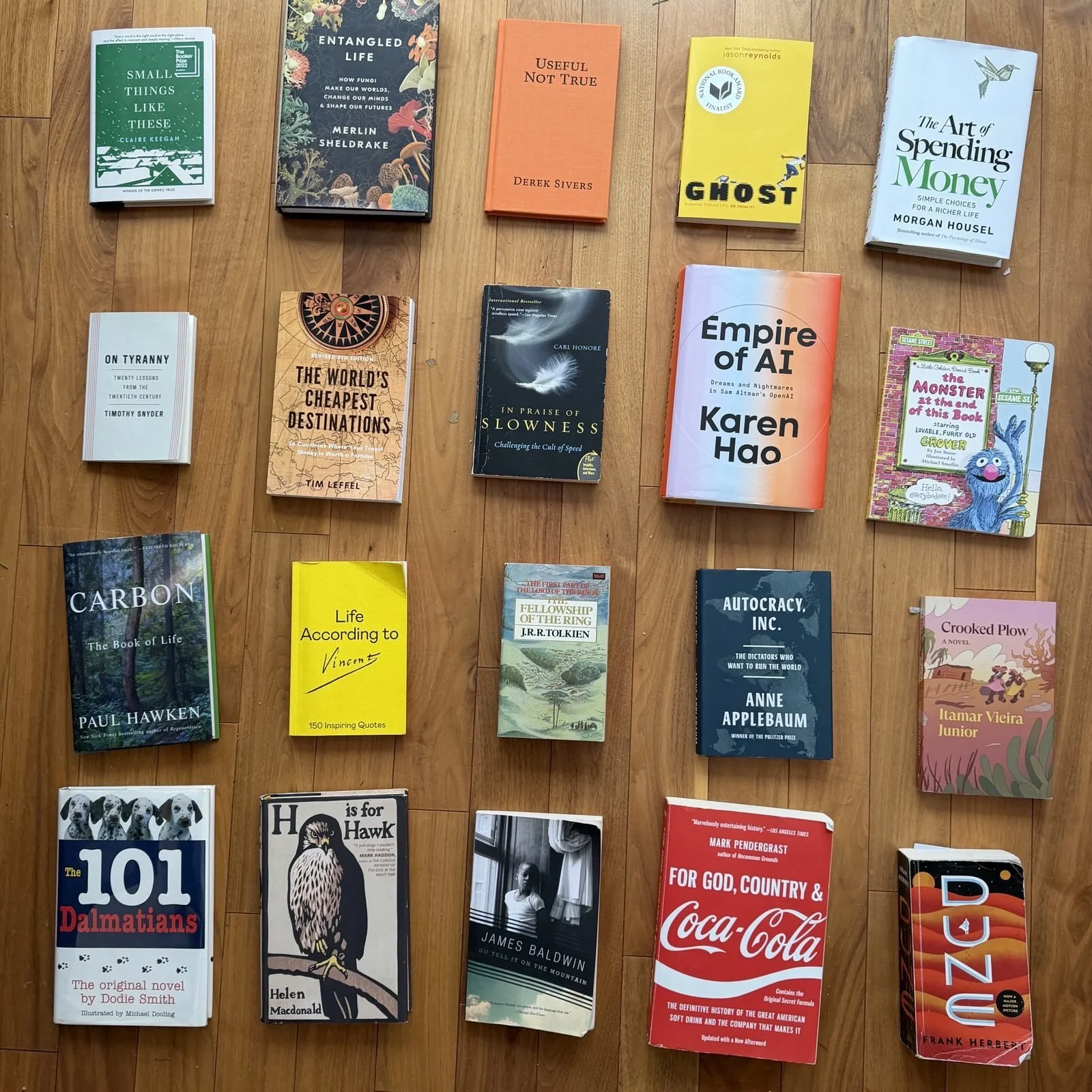
I don’t collect kickbacks on any links. Buy from your local indie (US/CAN/UK) or wherever you like!
Sending you energy, empathy, and some loving reading friendship in the run-up to the holidays...
Neil
20. Small Things Like These by Claire Keegan (b.1968). Crisp, poetic 119-page 2022 Booker shortlisted book following Keegan's 2010 stunner ‘Foster’ (BO2023) which takes a slow pan of a couple wintry months in New Ross, Ireland in 1985 through the eyes of local upstanding businessman, Bill Furlong, as he wrestles with what he discovers up on the hill.
First sentence: “In October there were yellow trees.”
Perfect for: book clubs who need a break from thick books, people looking for a gift for the English teacher, and historically oriented folks seeking to learn about the Magdalene laundries...
19.Entangled Life: How Fungi Make Our Worlds, Change Our Minds, & Shape Our Futuresby Merlin Sheldrake (b. 1987). Do you ... take statins? Drink alcohol? Eat truffles? Take antibiotics? Just a few of the hundreds of ways our lives revolve around fungi—and seemingly always have. This book shrinks our lives into the wider and vaster world. Big in scope, endlessly stimulating, and arranged in an organic, haphazard, expanding-underground-network type of way this is a weird, wonderful, impossible-to-forget look at the much bigger things outside ourselves.
First sentence: "Fungi are everywhere but they are easy to miss."
Perfect for: science nerds, people curious about psilocybin/magic mushrooms, fans of the podcast Ologies by Alie Ward...
18. Useful Not True by Derek Sivers (b.1969). Slim self-published 88-page hardcover which says: We make stuff up! That’s how we live. We adopt beliefs, tell ourselves stories, create realities that aren’t true—but ... they help us navigate. So in conclusion we may as well make up things that help us.
First sentence: “This book is about reframing—changing how you think about something—and choosing a perspective that's useful to you right now, whether or not it's universally true."
Perfect for: people who feel stuck chasing a dream, fans of Paul Graham's essays, entrepreneur-minded types…
17. Ghost by Jason Reynolds (b.1983). A 180-page, 14-point-font book you will feel, love, learn from, and fly through. Confusing title! Ghost? That's the self-anointed nom-de-plume of Castle Cranshaw, a poor seventh grade kid who accidentally joins a local track team, then finds himself addressing his own trauma and anger on a new emotional plane. Jason Reynolds is a magician. Perfect storytelling, memorable characters—it'll have you feeling like you can run the 100 meters in under 10 seconds by the end.
First sentence: "Check this out."
Perfect for: anyone needing a Young Adult (YA) speed booster, people looking to read a book out loud with their 10-year-old, or fans of running or track and field…
16. The Art of Spending Money: Simple Choices for a Richer Life by Morgan Housel (b.1988). The majority of lessons here aren't income-specific. And Morgan reminds us in general that if you’re reading a book about money there’s a chance you have the bug. So this is for people who have the bug—or at least some of it. But this isn't clean advice, clear to-dos, or a bulleted list of 7 habits. It's a powerful Wisdom book—slipping into that non-existent bookstore category somewhere between Self-Help and Business. Wonderful collection of stories and insights to provoke, shift, and expand your thinking about how to maximize the quality of your life through the quality of your financial decisions. A truly incredible book.
First sentence: "Dr. Dan Goodman once performed LASIK eye surgery on a woman looking to ditch her glasses."
Perfect for: anyone who wants to get more intentional about their spending, people who like business storytelling, and fans of Warren Buffet's shareholders letters...
15. On Tyranny: Twenty Lessons from the Twentieth Century by Timothy Snyder (b. 1969). A thin 126-page manifesto-as-listicle from professor Timothy Snyder (formerly of Yale and now at The University of Toronto) which distills twentieth-century history into simple lessons to help navigate today’s era. In #2 “Defend Institutions” he writes, “The mistake is to assume that rules who came to power through institutions cannot change or destroy those very institutions—even when that is exactly what they have announced that they will do.” In #7 “Be reflective if you must be armed” he writes, “If you carry a weapon in public service, may God bless you and keep you. But know that evils of the past involved policemen and soldiers finding themselves, one day, doing irregular things. Be ready to say no.” From #12 “Make eye contact and small talk” to #14 “Establish a private life” to #15 “Contribute to good causes” to #20 “Be as courageous as you can” he shines light through a dark vision of today’s world.
First sentence: "History does not repeat, but it does instruct."
Perfect for: fans of ‘1984’ by George Orwell, those looking to lead peaceful lives amidst great churn, community leaders, local builders, and politicians...
14. The World’s Cheapest Destination: 26 Countries Where Your Travel Money Is Worth A Fortuneby Tim Leffel (b. 1964). Tim writes the 22-year-running (!) ‘Cheapest Destinations’ blog and in this book we have his well-written travel guides to 26 countries you maybe haven’t thought about visiting. Kyrgyzstan, Albania, Laos, oh my! He shows how to avoid the cultural homogenization amidst Starbucks-overrun hotspots and how to do so safely and cheaply. Each 8-10 page country writeup has an overview that feels like you’re talking to a friend over a beer and then splits into sub-categories like “Transportation”, “Accommodation”, “Food&Drink”, and “What Else.” This book pays for itself again and again.
First sentence: "It's not how you go, but where!"
Perfect for: people who feel like traveling is expensive, people who want to get out of dodge without breaking the bank, anybody needing support before going to places they have heard are "dangerous"...
13. In Praise of Slowness: Challenging the Cult of Speed by Carl Honoré (b. 1976). Endless scrolling was invented twenty years ago, TikTok ten years ago, and AI images of anything you can think of ... now. We are experiencing a grand quickening. The danger is that Milan Kundera’s prophecy may come true: “When things happen too fast, nobody can be certain about anything, about anything at all, not even about himself.” Step one in steadying yourself in the tidal wave? This wonderful 20-year-old book by sagacious soul Carl Honoré. Benefits of meditation, resurgence of tantra sex, how garden views reduce pain—this and dozens of other paths are explored in this masterful tour de force.
First sentence: "What is the very first thing you do when you wake up in the morning?"
Perfect for: anyone curious about our relationship with time, people who liked ‘Quiet’ by Susan Cain or ‘Solitude’ by Michael Harris, people who agree with David Foster Wallace in this viral clip, and anyone who wants to find their own pace in the machine or just shift gears back down to “human"...
12. Empire of AI: Dreams and Nightmares in Sam Altman’s OpenAIby Karen Hao. Engrossing, propulsive, illuminating portrait tracing the many tentacles of this emerging giant squid. AI is a new "empire" says Hao who rejects "the dangerous notion that broad benefit from AI can only be derived from—indeed, will ever emerge from—a vision for the technology that requires the complete capitulation of our privacy, our agency, and our worth, including the value of our labor and art, toward and ultimately imperial centralization project.” What won't change about AI? The origin story. This book goes from Elon's 2013 Napa birthday party where Larry Page called him a “speciesist” to a 2015 dinner party at Sam Altman’s house where he and Elon hatch OpenAI, to “The Divorce” where a number of OpenAI employees revolted after OpenAI started taking private money. Proclamations! Ramifications! A vast, sweeping how-of-history book to help us understand and step back as the full largesse of AI begins to emerge, hulking, dripping.
First sentence: "On Friday, November 17, 2023, around noon Pacific Time, Sam Altman, CEO of OpenAI, Silicon Valley's golden boy, avatar of the generative AI revolution, logged on to a Google Meet to see four of his five board members staring at him."
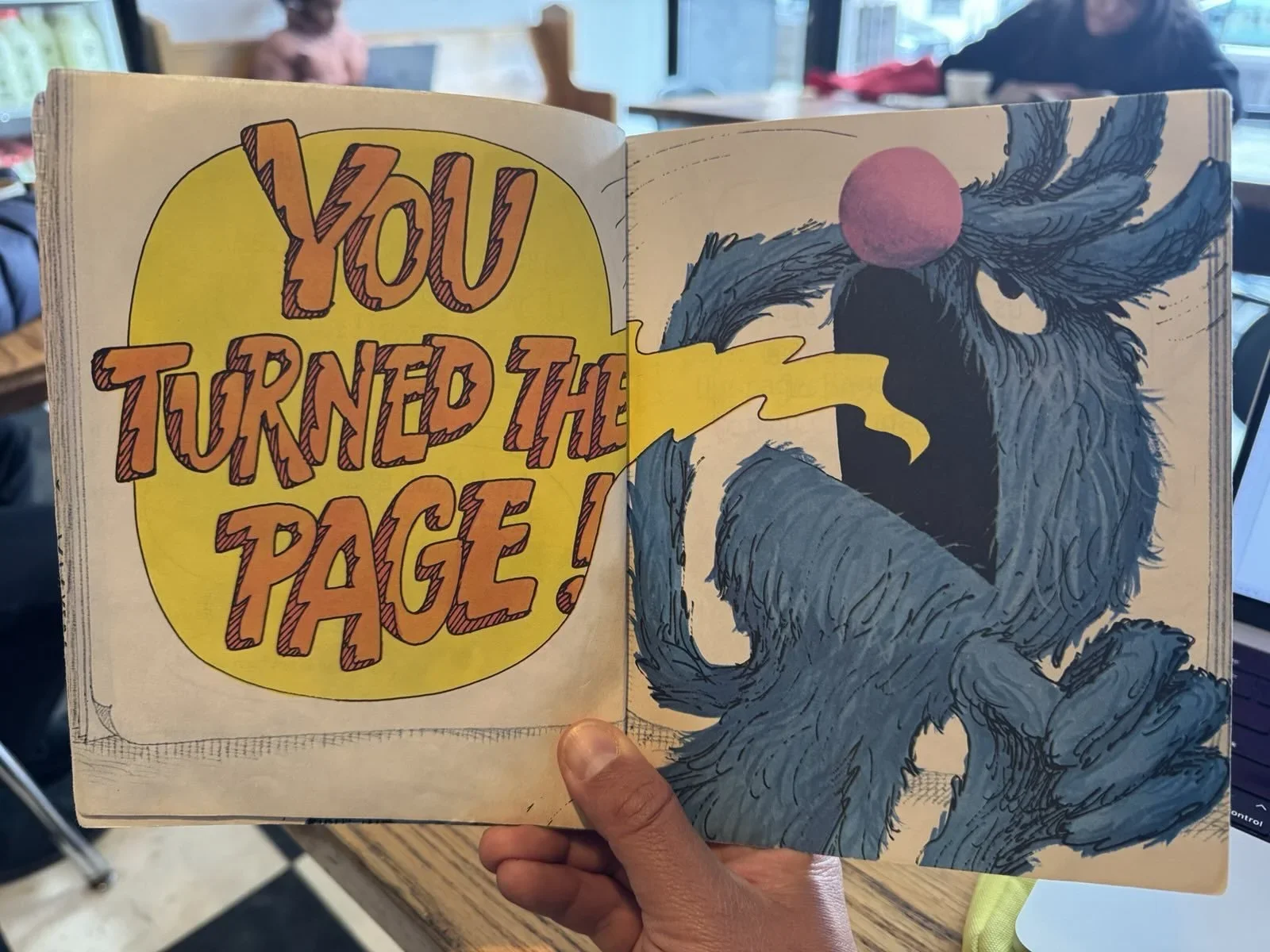
11. The Monster At The End Of This Bookwritten by Jon Stone (1931-1997), illustrated by Mike Smollin (1925-2010). I have loved this book longer than any book I have ever loved. Published in 1971 to me this is the OG interactive picture book with Grover breaking the fourth wall as he constantly begs you not to flip the page for fear of the monster who awaits at the end.
The monster is, of course, him, and the cymbal-crashing emotional cliff drop is exquisite. Delightfully popping images, escalating tension, and the violent smashing of brick walls just never gets old…
First sentence: "WHAT DID THAT SAY?"
Perfect for: 5-year-olds who watch Paw Patrol, animated adult storytellers who read to kids, and grandparents…
10. Carbon: The Book of Life by Paul Hawken (b.1946). First up, ignore the title. I think the book could easily have been called “One Of The Wisest Elders On Planet Earth Tells Us Everything He Knows About This Place And Our Relationship With It.” This is an “enormously hopeful book”, according to Elizabeth Kolbert (‘The Sixth Extinction’). And, I guess yeahhhhh, if you can see it that way—which is really, really hard—then I guess you could say it's hopeful? But that’s a tough place to land when every single living system on earth is declining. Birds? Declining! Clean water? Declining! Clean air? Healthy soil? You know the answers. We all do. That’s why it’s hard. But I believe a big part of things is understanding. We don’t know what’s going on so we don’t know how to talk about it so we don’t know what to do. Enter P-Hawk, master illuminator, epic distiller. This book just rolls around my head like a marble. The wisdom of our species speaks to us through this book—translated to us from a sage of sages.
First sentence: "Carbon moves ceaselessly through the four realms—the biosphere, oceans, land, and atmosphere."
Perfect for: Erudite environmentalists, big picture thinkers, people who like electric and motivational writing in the vein of a Tim Ferriss or Mel Robbins…
9.Life According to Vincent: 150 Inspiring Quotes by Vincent Van Gogh (1853—1890). I was thrilled to discover in Amsterdam last month at the Van Gogh Museum this shorter collection of literary gems culled thoughtfully from his (much, much longer) Penguin Classics book of letters. Van Gogh (or "Vun KHOKH" in Dutch) had skill with words equal to skill with brush. He knew it was just as tough! From Page 32: “There are so many people […] who imagine that words are nothing. On the contrary, don’t you think, it’s as interesting and as difficult to say a thing well as to paint a thing. There’s the art of lines and colours, but there’s the art of words that will last just the same.” From Page 56: “How much good it does a person if one is in a gloomy mood to walk on the empty beach and look into the grey-green sea with the long white lines of the waves.” You feel his genius through a different valance, one with equal depth, nuance, and complexity, rendered down to simple and striking lines.
First sentence: "Ideas for work are coming to me in abundance, and that means that even though isolated I don't have time to think or to feel. I'm going like a painting-locomotive."
Perfect for: anyone looking for illumination into the art of Van Gogh, those looking for suggestions on living an intentional life full of artistic temerity and strength, and people who "heart" quotes on Instagram...
8. The Lord of the Rings: The Fellowship Of The Ring by J.R.R. Tolkien (1892–1973). I watched Peter Jackson’s movies in my 20s but only read my first one this year. The black riders grew from terrifying to … mythological, ethereal, ominous. The mines of Moria expanded from thrilling to … dark, dismal, distressing. And the songs! So many songs. So loud, so clear. (Is it unsurprising Tolkien once worked on the letter “W” for the Oxford English Dictionary—apparently near waggle-warlock?) Sure, there are too many characters, lots of endlessly rolling scenes, but … it’s a vibe. A place to live that feels unlike any other place. I got a used copy at Balfour Books in Toronto but there is also a fancy new linen version I have my eye on next.
First sentence: "When Mr. Bilbo Baggins of Bag End announced that he would shortly be celebrating his eleventy-first birthday with a party of special magnificence, there was much talk and excitement in Hobbiton."
Perfect for: people who loved the movies but haven’t read the books, anyone who wants to disappear completely, self-identifying nerds who somehow do not seem whole…
7. Autocracy, Inc.: The Dictators Who Want To Run The Worldby Anne Applebaum (b. 1964). The zone is officially flooded and the overwhelming quantity of cheap misinformation along with a proliferation of bots, trolls, and AI-backed spammers manipulating algorithms threaten to destabilize reality and obscure what’s really happening. This tiny, powerful book by Pulitzer Prize-winning journalist Anne Applebaum zooms up and above the daily “whats” to offer the more illuminating and horrifying “whys” and “hows.” From Page 27: “Everyone assumed that in a more open, interconnected world, democracy and liberal ideas would spread to the autocratic states. Nobody imagined that autocracy and illiberalism would spread to the democratic world instead.”
First sentence: "In the summer of 1967, Austrian and West German capitalists from the gas and steel industries met a group of Soviet communists in the quiet confines of an old Habsburg hunting lodge near Vienna."
Perfect for: activists, politicians, and people hoping to get up and above the news to see the larger shifting plates…
6.Crooked Plow: A Novel by Itamar Vieira Junior (b. 1979). The Atlantic slave trade lasted nearly 400 years from the early 1500s to the late 1800s with over 12 million Africans shipped to toil in plantations across the Americas. Brazil is where the first slave ships went, most slaves went, and last slave ships went—with slavery abolished in 1888. But what is abolished? This is a transporting 276-page novel taking place almost entirely on a plantation in Northeastern Brazil from early to late twentieth century, told in three sweeping chunks by three different narrators. It famously won all three of Brazil’s top literary prizes.
First sentence: "When I opened the suitcase and took out the knife, wrapped in a grimy old rag tied with a knot and covered in dark stains, I was just over seven years old."
Perfect for: magic realism fans, people looking to read more South American fiction, fans of ‘Their Eyes Were Watching God’ by Zora Neale Hurston (BO2018)…
5.The 101 Dalmatians by Dodie Smith (1896-1990). This book is a gem! Everybody knows ‘101 Dalmatians’ was a Disney movie but not many know it was originally serialized in Woman’s Day magazine in the mid-1950s as ‘The Great Dog Robbery’ from English playwright Dodie Smith. I didn't! The story is fun, fast-paced, literary, and sure, the ending goes on a bit long—got to satisfy that Women's Day contract!—but, doesn't matter. Absolutely wonderful and somewhat lost 70-year-old treasure to read to your kids or enjoy yourself.
First sentence: "Not long ago, there lived in London a young married couple of Dalmatian dogs named Pongo and Missis Pongo."
Perfect for: people who feel stressed and want a quick mental palette cleanser, people who loved the movie, and, of course, dog people...
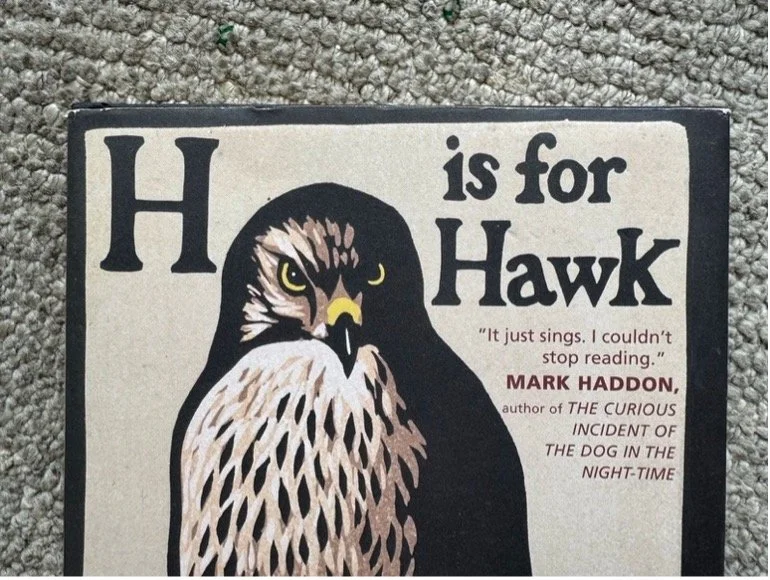
4.H is for Hawk by Helen Macdonald (b.1970). This book has been spying me from bookshelves since it came out in 2015.
I had seen that cover endlessly but hadn’t talon-snared it till this year. I completely fell into Macdonald’s first-person memoir of mastering the 4000-year-old art of raising, taming, and training, not just a hawk, but a Eurasian Goshawk— “bulkier, bloodier, deadlier, scarier.” Ominous, even spooky, but always somehow light enough to be death-examining without being a downer.
First sentence: "Forty-five minutes north-east of Cambridge is a landscape I've come to love very much indeed."
Perfect for: outsiders, people who enjoy hanging out in forests, those willing to examine or metabolize bits of grief or doubt or sadness they have stuck deep inside…
3.Go Tell It On The Mountain by James Baldwin (1927-1987). This book will crawl and sniff out the pains in your heart, the ones you forgot were there, and shake them and soften them, so you may briefly see yourself in others—in their tortures, in their truths—and then forgive yourself, and forgive them, and be grateful for where you are and what you have. This is James Baldwin's first novel, published in 1952, and it's a trauma-filled family soap opera stretching across generations from the South up to Harlem “…where the houses did not rise, piercing, as it seemed, the unchanging clouds, but huddled, flat, ignoble, close to the filthy ground, where the streets and the hallways and the rooms were dark, and where the unconquerable odor was of dust, and sweat, and urine, and homemade gin.” (Page 28). Bit of a tricky plot (read the Wiki plot summary first!) and then, once you see the layers, it's gorgeous prose, popping characters, and a serving of that uniquely brutal heart-scalding beauty we might only get from great novels.
First sentence: "Everyone had always said that John would be a preacher when he grew up, like his father."
Perfect for: anybody who hasn’t read a James Baldwin book and wants a good place to start, fans of family dramas, and people who love poetic and even abstract literature...
2.For God, Country & Coca-Cola: The Definitive History of the Great American Soft Drink and the Company That Makes It by Mark Pendergrast (b. 1948). Coca-Cola is the world’s most widely distributed product and “coke” is the second “most universally recognized word on earth” (#1 is “ok”). Coca-Cola's history is this unexpected reflection of American history and capitalism’s history with the drink helping to “alter not only consumption patterns but attitudes toward leisure, work, advertising, sex, family, life, and patriotism.” It’s important. And big! There is no “older-bigger” food or drink company … ever. Exquisitely researched, endlessly engaging case study on one of the most astounding organizations of all time. Opens with the compelling 'New Coke' story, and just never stops.
First sentence: "The boss was a very old man, near death."
Perfect for: Coca-Cola aficionados, biography readers since it’s basically a biography of a company, and corporate leaders looking to learn from the lessons of business history…
1.Duneby Frank Herbert (1920—1986). Monstrous, mind-expanding, faraway fantasy novel from 1965 told in a series of tight sequences that are simultaneously fast and slow, sharp and soft, detailed and abstract. This book has everything: cutting dialogue, twisting turns, visceral characters, bloody action, seismic myth. An endless conversation starter and when you're lugging it around it acts like a kind of nerd magnet. A simple action story but really a window into duality, ecology, philosophy, morality, and so much more. Unless you include YA (i.e., ‘The Hunger Games’), ‘Dune’ is the single best selling science fiction book of all-time with over 20 million copies sold. There’s a reason! A timeless epic serving as a mirror to reflect in and upon our big, small, complex, simple, chaotic, predictable world.
First sentence: "In the week before their departure to Arrakis, when all the final scurrying about had reached a nearly unbearable frenzy, an old crone came to visit the mother of the boy, Paul."
Perfect for: people who loved the 'Dune' movies, fans of 'Star Trek' and 'Star Wars', and people who would enjoy relaxing at the thought that everything happening now has happened again and again...
You made it to the bottom! My monthly book club is my oldest and most popular newsletter. Back issues here!
First time here? Join over 33,333 leaders and readers who get my handwritten, ad-free, algorithm-free book recommendations each month here.