I think happiness is a skill. I think there really are simple things we can do to help cultivate more positivity in our brains. Here are five of my favorite practices!
Neil
We can choose our own happiness by engaging with habits proven to promote greater feelings of well-being and positivity.
Studies show these "happiness habits" do slowly shift our brain to being more positive. Over the years I’ve collected these habits and today I want to share five with you that each take only 2 minutes or less to do!
1.Two-Minute Mornings
Let's start right when we open our eyes.
What's the first thing you do? Grab your phone? Check the time?
My argument is that you need to move the phone out of the bedroom and nurture this sacred liminal state between your subconscious and conscious by doing the simple "two-minute morning" practice of writing out your answer to three science-backed prompts:
1. I will let go of…
2. I am grateful for…
3. I will focus on…
I wrote a paper for Harvard Business Review about the story and research behind the practice and even put out a Two-Minute Mornings journal around the method that's become a big bestseller. These simple 3 prompts provide a two minute push to help you win the morning ... and get rolling for the day.
2. Commit An Act Of Kindness
Carrying out a conscious act of kindness dramatically improves happiness.
Sure, it might not be natural to hold a door open as a meeting exits, buy a coffee for a stranger, or shovel your neighbor's sidewalk—but it's powerful.
Professor Sonja Lyubomirsky, author of 'The How of Happiness' and (her new book!) 'How To Feel Loved', did a study asking Stanford students to perform five acts of kindness over a week. Not surprisingly, they reported much higher happiness levels than the test group. Why? They felt good about themselves! People appreciated them.
In his book 'Flourish', Professor Martin Seligman, co-founder of positive psychology, says “we scientists have found that doing a kindness produces the single most reliable momentary increase in well-being of any exercise we have tested.”
When a generous impulse strikes—act!
Send homemade chili to your friend with a kid in the hospital, a romantic thank you text to your spouse, or a little 3-line email expressing gratitude to your kid's teacher. You'll make their day ... and yours!
3. Two Pages Of Fiction
Next up!
Reading 2 pages of fiction.
There’s a George R.R. Martin quote I love that says:
“The man who reads lives a thousand lives before he dies … the man who never reads lives only one.”
We need to read books—real books on real paper—more than ever. We spend over five hours a day on our phone right now. In a world of endless dings and pings we need to get back to single-tasking and give our eyes a break from screens.
A 2011 study published in the Annual Review of Psychology showed that reading triggers our mirror neurons and opens up the parts of our brain responsible for developing empathy, compassion and understanding.
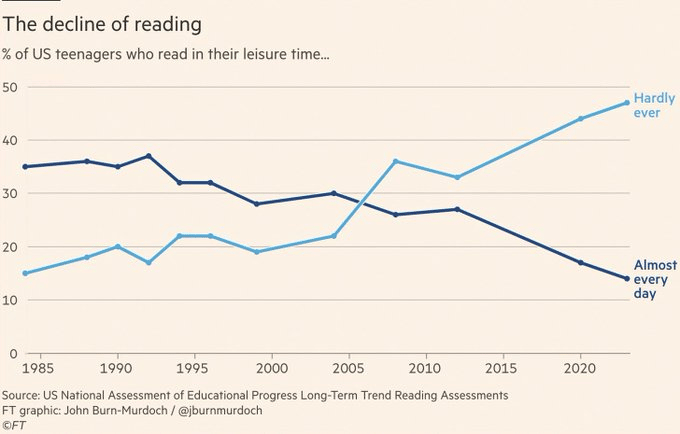
Recently, investor Paul Graham shared the image below with the tweet: "This bodes ill. Readers used to outnumber non-readers 2 to 1. Now non-readers outnumber readers 3 to 1. It's hard to imagine a change of that magnitude not having significant effects."
"... it’s not career achievement, money, exercise, or a healthy diet. The most consistent finding we’ve learned through 85 years of study is: Positive relationships keep us happier, healthier, and help us live longer. Period."
Professor Sonja Lyubomirsky, who I already quoted above, says: "Perhaps most critical to improving and maintaining happiness is the ability to connect with other people and to create meaningful connecting moments and even chemistry..."
Professor Daniel Gilbert, author of 'Stumbling on Happiness,' says: "We are happy when we have family, we are happy when we have friends and almost all the other things we think make us happy are actually just ways of getting more family and friends."
But we have less of it in our lives than we used to.
Why?
Online too much? Not connecting IRL? Upwardly mobile and geographically separating?
Could be all of those things.
What’s one solution?
Phone a friend!
Take 2 minutes in the middle of your day to send a quick voice note to a friend, cousin, or old roommate … doing 3 simple things:
State: State the value of the relationship. "I was thinking about your mentorship at our last job and how much it meant to me", "I was remembering our road trip after graduating", "I'm reaching out to all my dear cousins", etc.
Share: Share something going on with you. Something you're thinking about, wrestling with, struggling with. A relationship that's taken a turn, a tough situation at work, or a challenge you're having with a child. We all have lots and vulnerability breeds connection.
Seek: Seek something. Ask a question! Basically, give them something to respond to—so they have a reason to reply with a 2-minute voice note of their own.
Okay, that's four.
And now finally:
5. Play Rose, Rose, Thorn, Bud
A perfect game for the dinner table or before you turn out the lights.
Because one truth from our brains is that: If you can be happy with simple things it will be simpler to be happy.
Researchers Emmons and McCullough asked groups of students to write down five gratitudes, five hassles or five events that happened over the past week for 10 straight weeks. What happened? The students who wrote five gratitudes were happier and physically healthier than the other two test groups.
I’ve given keynote speeches sharing this research for years but was always left with a nagging question: What if you just don’t have the willpower to write down five gratitudes? I mean, when was honestly the last time you did that?
Well, today I want to share a game my wife Leslie and I play most nights that completely solves this problem.
A Rose: A highlight, a gratitude, something that went well.
A Second Rose: Another highlight, little win, or small pleasure from the day.
A Thorn: Something that didn’t go well. A chance to vent, process, and be heard.
A Bud: Something you’re looking forward to—small or big, soon or in a long time.
What does Rose, Rose, Thorn, Bud do in practice?
Well, as long as the Thorn doesn’t become a 45-minute argument about who didn’t do the dishes (LOL) it’s a perfect 2-minute exercise to swap four gratitudes right before bed. I wrote a blog post and Toronto Star article about the concept and also put it into a little journal, too.
As Charles Dickens said: “Reflect upon your present blessings, of which every man has many, not your past misfortunes, of which all men have some.”
So we did it!
Those are The Big 5.
Five of the most powerful studies distilled into 2-minute habits you can do any time you need a positive nudge.
Now the goal with all of these practices is not to be perfect.